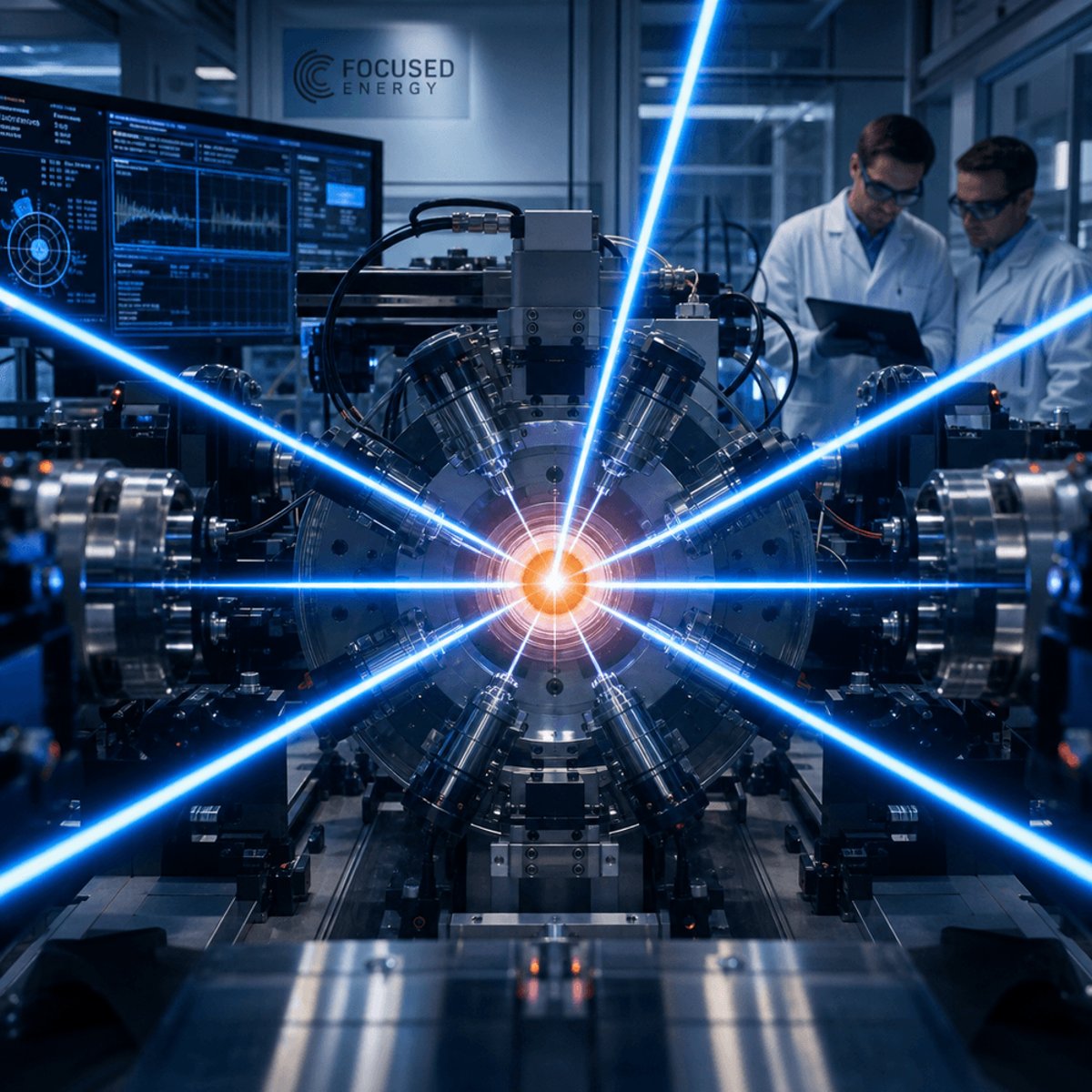
Fusion energy just pulled in another massive funding haul. Focused Energy, a startup developing laser-powered nuclear fusion technology, has closed a whopping $240 million Series A round, marking one of the largest early-stage investments in the fusion sector. The round, led by Prime Movers Lab, signals that deep-pocketed investors remain bullish on fusion despite the technology's notorious capital intensity and decades-long development timelines.
Focused Energy is betting that lasers hold the key to commercially viable fusion power, and investors are putting serious money behind that vision. The company's $240 million Series A, announced today, comes as the fusion sector continues to attract unprecedented capital despite the technology remaining years away from grid-scale deployment.
The round was led by Prime Movers Lab, a venture firm specializing in breakthrough scientific companies tackling civilization-scale problems. While the full investor lineup wasn't immediately disclosed, the deal size puts it in rarefied air for a Series A - especially in the notoriously capital-hungry fusion space where companies typically burn through hundreds of millions before reaching meaningful technical milestones.
Focused Energy is pursuing inertial confinement fusion, the same basic approach that enabled scientists at the National Ignition Facility to achieve fusion ignition in late 2022. The method uses powerful lasers to compress and heat fuel pellets to extreme conditions, triggering fusion reactions that release more energy than the lasers consume. It's technically distinct from the magnetic confinement approach used by competitors like Commonwealth Fusion Systems, which raised $1.8 billion in 2021, and Helion Energy, which secured a $500 million commitment from OpenAI CEO Sam Altman.
The fusion sector has become a magnet for venture capital and strategic investors who see it as essential to meeting global decarbonization goals. According to the Fusion Industry Association, private fusion companies have raised more than $6 billion cumulatively, with funding accelerating after the NIF breakthrough demonstrated that laser fusion ignition was physically achievable. But the path from laboratory proof-of-concept to commercial power plant remains long and expensive.
That's where Focused Energy's war chest comes in. The $240 million will fund continued development of the company's laser systems and target fabrication capabilities - two of the most technically challenging and expensive components of inertial fusion. Unlike the massive, building-sized laser arrays at NIF, commercial fusion will require compact, efficient, and repetitively firing laser systems that can zap fuel pellets multiple times per second.
The company is also working on advanced target designs and fuel delivery systems. Getting tiny fusion fuel capsules positioned perfectly in the laser firing chamber, thousands of times per day, with nanometer precision, represents an engineering challenge nearly as daunting as the fusion physics itself.
Focused Energy faces competition not just from other fusion startups but from the broader clean energy sector, where technologies like advanced batteries, next-generation solar, and small modular fission reactors are already much closer to commercial deployment. Critics argue that fusion's 'always 20 years away' reputation persists for good reason, and that the billions flowing into the sector might deliver faster climate impact if directed toward more mature technologies.
But fusion advocates counter that the prize - abundant, carbon-free baseload power with minimal land use and no long-lived radioactive waste - justifies the investment and patience. If Focused Energy and its competitors succeed, fusion could provide the always-on clean electricity needed to power AI data centers, industrial facilities, and electric grids that can't rely solely on intermittent renewables.
The timing is notable. While venture capital has pulled back from many climate tech sectors amid rising interest rates and economic uncertainty, fusion continues to attract mega-rounds. That suggests investors view fusion as a long-term strategic bet rather than a near-term revenue play - a moonshot worth taking precisely because the potential payoff is so transformative.
For Focused Energy, the immediate priority is demonstrating that laser fusion can be engineered into a practical power system, not just a scientific achievement. That means hitting technical milestones around laser efficiency, target production costs, and system reliability - the unglamorous but essential work of turning physics into a product.
Focused Energy's massive Series A is the latest evidence that fusion has graduated from fringe science project to serious investment category. Whether laser-driven fusion can deliver on its promise of clean, abundant energy remains to be seen, but the company now has the capital to find out. For investors, it's a generational bet - one that could either power the future or serve as an expensive lesson in the limits of breakthrough technology. The next few years will reveal which outcome we're heading toward.