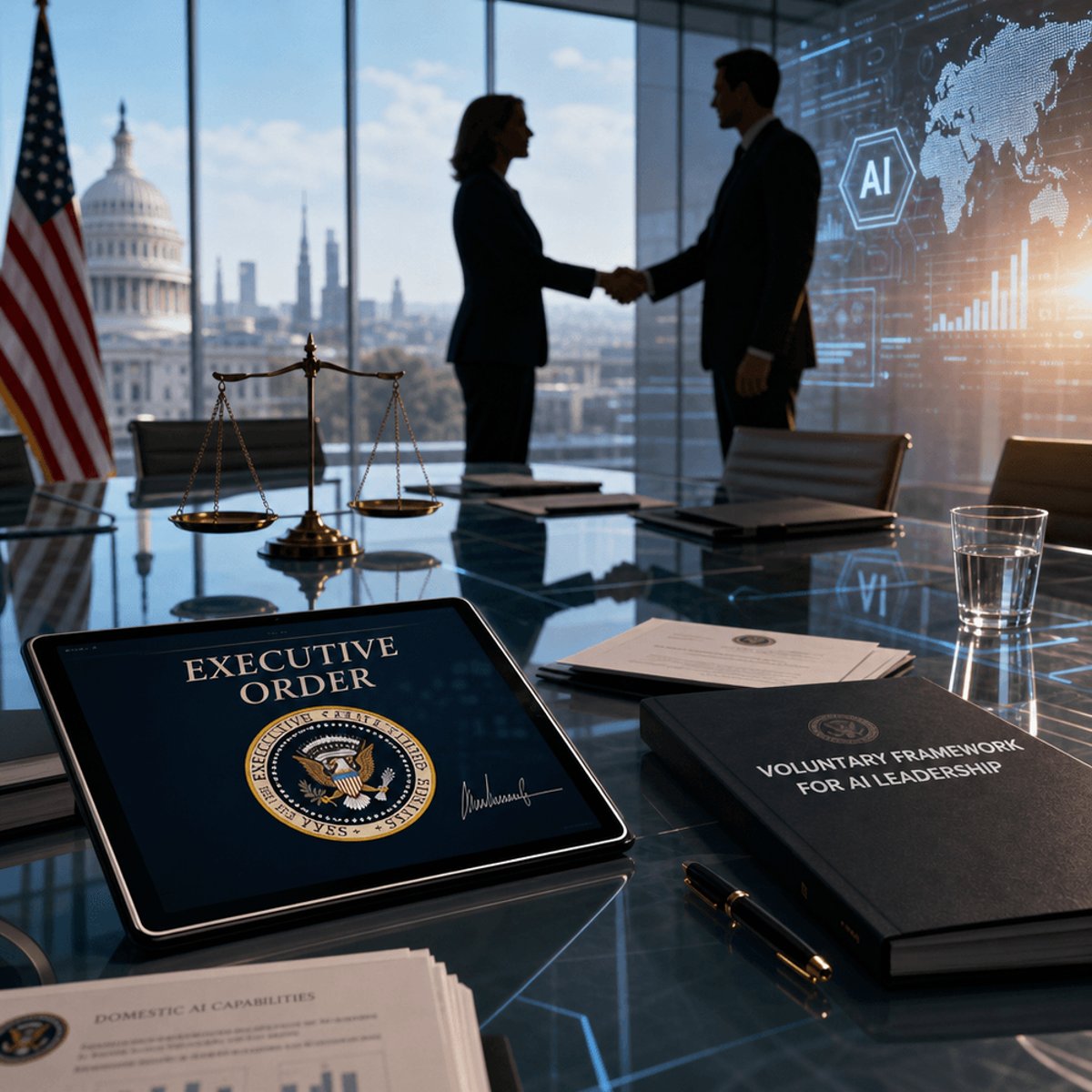
The White House just made its first major move to shape America's AI future under Trump's second term. President Trump signed an executive order today requesting AI companies voluntarily provide government agencies with early access to their most advanced frontier models - a significant pivot from the regulatory vacuum left after he scrapped Biden's AI framework earlier this year. The voluntary approach signals a softer touch than expected, but it puts OpenAI, Google, Microsoft, and other AI giants in a tricky position.
Trump's new AI executive order lands at a crucial moment for the industry. Since taking office and immediately dismantling Biden's sweeping AI safety framework, the administration has faced mounting pressure to articulate its own vision for governing artificial intelligence. Today's order provides that answer - and it's lighter on regulation than many feared.
The directive asks AI developers to collaborate with federal agencies on a voluntary basis, providing early access to frontier models before they hit the market. Unlike Biden's approach, which leaned heavily on mandatory safety testing and reporting requirements for the most powerful systems, Trump's framework treats industry cooperation as optional. But voluntary doesn't mean inconsequential.
For companies like OpenAI, Google, Microsoft, and Anthropic, the political calculus just got complicated. Declining to participate could paint them as uncooperative on national security - especially as concerns about AI's dual-use capabilities intensify. But sharing pre-release models with government agencies raises thorny questions about intellectual property protection, competitive advantage, and the potential for mission creep.
The timing reveals the administration's balancing act. After months of criticism from both sides - tech leaders warning about innovation-stifling regulation and safety advocates demanding guardrails - Trump's team appears to be splitting the difference. The voluntary approach gives the White House political cover to claim it's not heavy-handed while still inserting government oversight into the AI development pipeline.
What constitutes a "frontier model" will be critical. Industry insiders expect the definition to focus on systems with capabilities that could pose national security risks - likely models with advanced reasoning, code generation, or biological research capabilities. That would capture the next generation of systems from OpenAI's GPT family, Google's Gemini lineage, and Anthropic's Claude series.
The order doesn't specify which agencies will receive access or what they'll do with it. Defense Department involvement seems certain given Pentagon interest in AI applications. Intelligence agencies will likely want visibility into models that could be weaponized by adversaries. But questions remain about whether Commerce, Energy, or other departments will join the review process.
Early access arrangements already exist in limited form. OpenAI has briefed government officials on GPT capabilities, and Anthropic has engaged with policymakers about Constitutional AI. But formalizing these channels through executive action changes the dynamic - transforming ad hoc briefings into an expected practice.
The AI industry's response will be telling. Major players have mostly supported voluntary frameworks over hard regulation, but they've also fought to keep their most sensitive research proprietary. Silicon Valley's relationship with Washington has been strained lately, with battles over content moderation, antitrust enforcement, and now AI governance creating friction.
International implications loom large too. China and the EU are racing ahead with their own AI governance frameworks - China with strict controls, Europe with comprehensive regulation. America's voluntary approach could position the US as the innovation-friendly alternative, potentially attracting AI talent and investment. Or it could leave American companies navigating multiple conflicting regimes as they operate globally.
The executive order fills the policy void Trump created by canceling Biden's framework, but it raises as many questions as it answers. Without mandatory compliance, enforcement mechanisms, or clear definitions, the order functions more as a request for cooperation than a governing structure. How companies respond in the coming weeks will determine whether this becomes a meaningful oversight channel or political theater.
Trump's AI executive order marks a decisive shift toward light-touch governance after months of regulatory uncertainty. By making cooperation voluntary, the administration avoids the heavy regulatory hand industry feared while still claiming oversight credentials. But the real test comes next - whether AI leaders view early model sharing as genuine collaboration or political pressure they can't afford to resist. The answer will shape not just how America governs AI, but whether other countries follow the voluntary model or double down on mandatory controls. For now, the ball's in Silicon Valley's court.