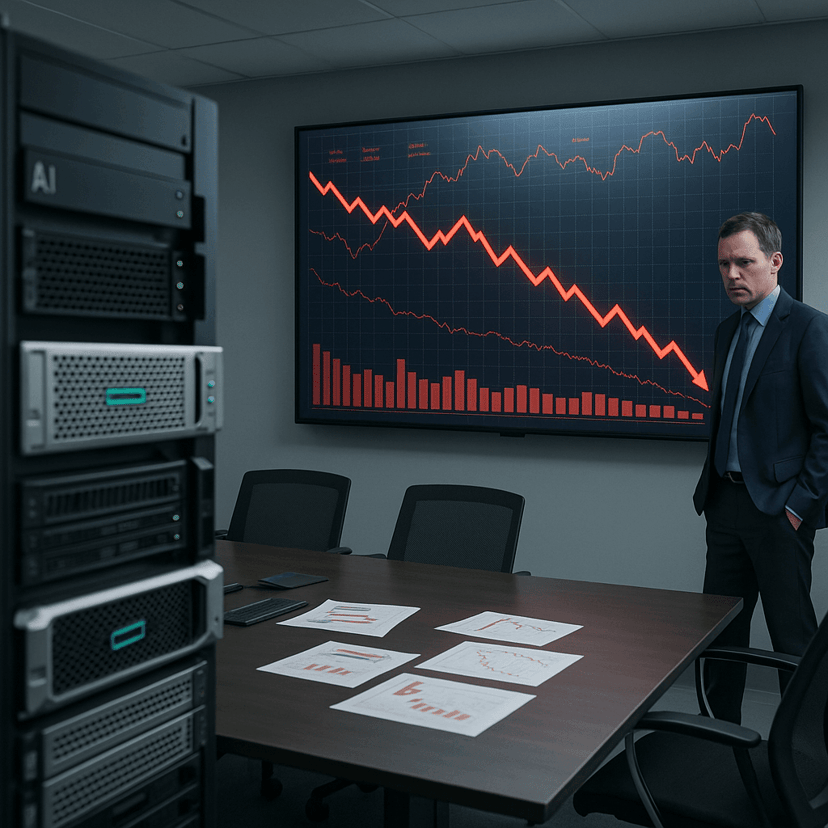
Super Micro Computer's stock dropped 6% Thursday after the AI server giant slashed its first-quarter revenue forecast to $5 billion, a stunning miss from its original $6-7 billion guidance. The shortfall stems from what CEO Charles Liang calls "design win upgrades" that pushed expected deliveries into the second quarter, highlighting ongoing execution challenges in the red-hot AI infrastructure market.
Super Micro Computer just delivered a reality check to the AI infrastructure party. The server maker's preliminary first-quarter results sent shares tumbling 6% Thursday, as the company revealed it would miss its revenue guidance by as much as $2 billion - a massive shortfall that has investors questioning whether the AI boom's brightest stars can actually deliver on their promises.
The numbers tell a sobering story. Super Micro now expects $5 billion in Q1 revenue, down sharply from the $6-7 billion range it had confidently projected just months ago. For a company that's become synonymous with AI infrastructure growth, this represents more than just a quarterly hiccup - it's a signal that even the most well-positioned players are struggling to execute at the breakneck pace the market demands.
"Design win upgrades" - industry speak for customer requests to modify server configurations - pushed expected revenue into the second quarter, according to Super Micro's business update. While CEO Charles Liang tried to spin the delay as a positive sign of customer engagement, telling investors "we see customer demand accelerating, and we are gaining AI share," the market wasn't buying the optimistic framing.
The timing couldn't be worse for Super Micro, which has positioned itself as the go-to infrastructure partner for companies racing to deploy AI capabilities. The company's servers power everything from OpenAI's ChatGPT to countless enterprise AI deployments, making it a critical bellwether for the broader artificial intelligence buildout. When Super Micro stumbles, it raises questions about whether the entire AI infrastructure supply chain can keep pace with demand.
What makes this miss particularly concerning is the nature of the delay. "Design win upgrades" suggest that customers are making last-minute changes to their server specifications - a sign that the AI market is still evolving rapidly and enterprises aren't sure exactly what they need. This uncertainty creates execution challenges for hardware manufacturers like Super Micro, which must balance customization requests with manufacturing efficiency.
The company did offer some reassurance, claiming it has secured "recent design wins" worth more than $12 billion, with delivery requested during the fiscal second quarter. This backlog suggests demand remains robust, but the revenue timing shift highlights the operational complexity of serving rapidly evolving AI customers who are still figuring out their infrastructure needs.
Super Micro's struggle reflects broader challenges facing AI infrastructure companies. Unlike traditional enterprise hardware purchases that follow predictable cycles, AI deployments are happening at unprecedented speed with constantly changing requirements. Companies like Nvidia have thrived by controlling the GPU bottleneck, but server manufacturers like Super Micro must navigate more complex customer relationships and customization requests.
The stock's 6% decline also reflects investor frustration with guidance volatility in the AI sector. Super Micro had already faced scrutiny over its accounting practices earlier this year, and this preliminary results miss adds to concerns about the company's ability to provide reliable forecasts in a fast-moving market.
Despite the Q1 shortfall, Liang maintained the company's full-year revenue outlook of "at least $33 billion for FY 2026 with the expectation of delivering more." This suggests management believes the revenue delay is temporary, but investors will be watching closely when the company reports official first-quarter results on November 4 to see if the optimism is justified.
For the broader AI infrastructure ecosystem, Super Micro's stumble serves as a reminder that explosive demand doesn't automatically translate to smooth execution. As enterprises continue their AI buildouts, hardware partners must balance rapid growth with operational discipline - a challenge that's proving harder than many anticipated.
Super Micro's revenue miss exposes the execution challenges lurking beneath the AI infrastructure boom. While the company maintains its bullish full-year outlook and points to strong customer demand, the $2 billion guidance shortfall highlights how quickly things can shift in this fast-evolving market. Investors will be watching November 4's earnings call closely to see if management can restore confidence in its ability to navigate the complex demands of AI customers while delivering predictable growth.