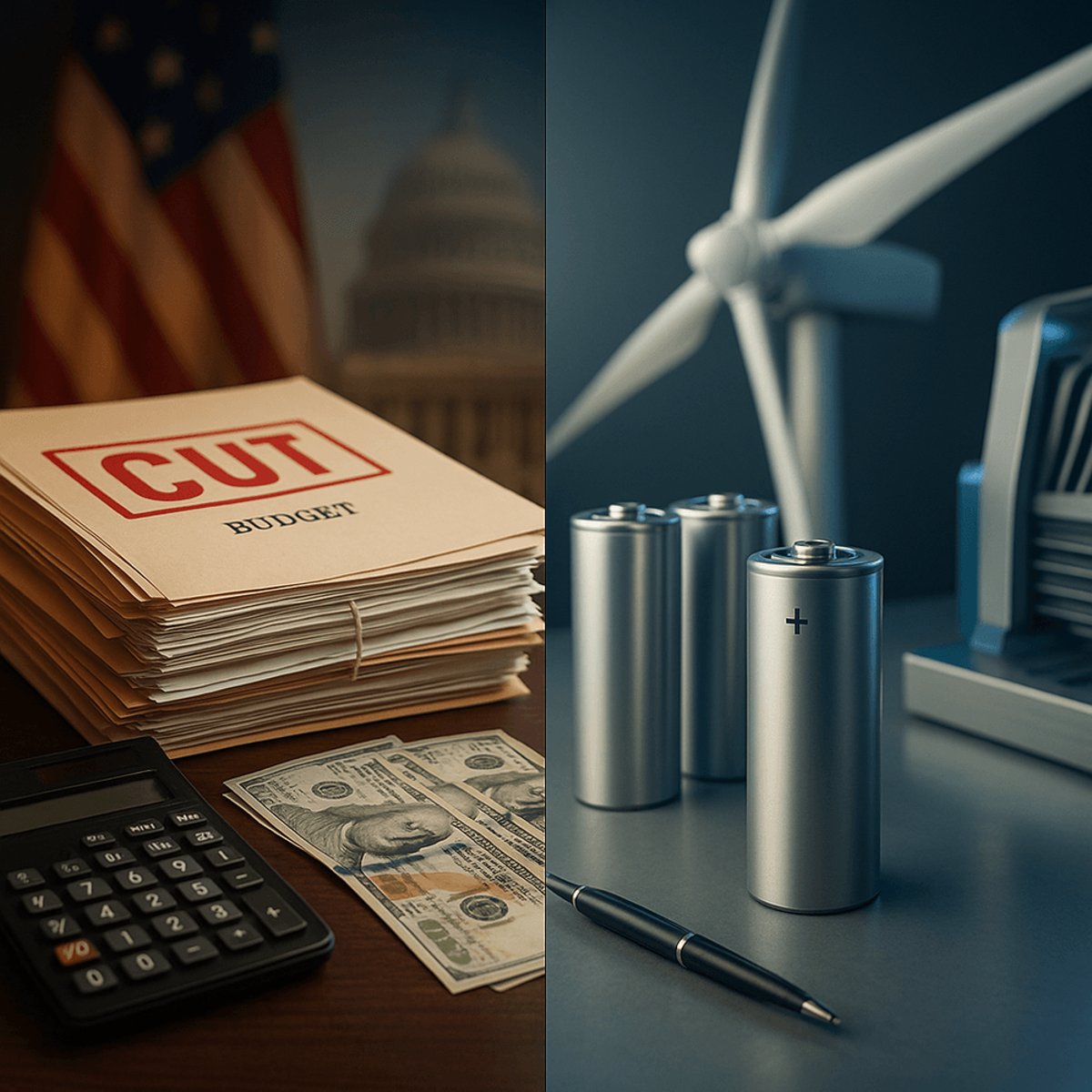
The Trump administration is moving to cancel over $500 million in federal grants to climate and battery startups, while major automakers including General Motors face massive funding cuts. According to an internal Department of Energy document obtained exclusively by TechCrunch, more than a dozen startups could lose critical funding awarded under Biden's infrastructure law, threatening projects ranging from carbon-free cement to domestic battery materials.
The startup funding landscape just got a lot more treacherous. Trump's Department of Energy is targeting over $500 million in grants to climate and battery startups, plus billions more to major automakers, in what could be the most significant federal funding pullback since the administration took office. The cuts, revealed in an internal DOE document analyzed by TechCrunch, would effectively kill dozens of projects designed to compete with Chinese dominance in critical materials.
General Motors stands to lose the most - at least $500 million earmarked for retooling its Lansing Grand River Assembly Plant in Michigan to produce electrified vehicles. The automaker had announced plans in July 2024 to manufacture hybrids at the facility, but that timeline now hangs in the balance. Ford and Stellantis are also on the chopping block, alongside European automakers Daimler Trucks, Mercedes-Benz Vans, and Volvo Technology.
But it's the startup cuts that reveal the administration's broader strategy. Materials startup Brimstone faces losing $189 million intended to build a plant producing Portland cement and alumina with dramatically lower carbon emissions. Chicago-based Anovion could lose over $100 million for a synthetic graphite factory that would have challenged Chinese battery material suppliers who currently dominate the market.
The timing couldn't be worse for these companies. Battery materials startup Li Industries secured $55.2 million to recycle lithium iron phosphate batteries - a critical piece of domestic supply chain independence. But with venture funding still recovering from 2023's crash and Chinese competitors ramping production, losing federal support could be fatal.
Cement startups are particularly vulnerable. Massachusetts-based Sublime Systems risks losing $86.9 million for an ultra-low-carbon cement plant, while Mountain View's Furno could lose $20 million for its modular cement kiln demonstration in Chicago. These aren't just financial hits - they're strategic retreats from sectors where the US desperately needs alternatives to carbon-intensive Chinese production.
The building materials sector faces similar devastation. CleanFiber and Hempitecture, which make sustainable insulation, could lose $10 million and $8.4 million respectively. Skyven Technologies' industrial heat pumps program faces a $15 million cut, while Luxwall's super-insulated windows project could lose $31 million. Each represents years of development work and market validation that federal support was meant to accelerate.
What makes these cuts particularly puzzling is how some directly contradict the administration's stated priorities. TS Conductor, facing a $28.2 million cut, makes advanced transmission line conductors that can double or triple grid capacity on existing infrastructure. That technology directly supports AI data center expansion and grid reliability - both administration priorities. But the company's climate tech origins apparently outweigh its strategic value.
The cuts come on top of an already announced $7.5 billion in contract cancellations revealed last week, suggesting a systematic unwinding of Biden-era climate investments. All the targeted grants were awarded under the Bipartisan Infrastructure Law, which passed with significant Republican support but is now facing administrative dismantling.
For startup founders who've spent months or years building companies around these federal commitments, the uncertainty is crushing. Many have already begun hiring, signed equipment contracts, or committed to customer deliveries based on expected federal support. Sources tell TechCrunch that several companies are scrambling to secure private funding to replace federal commitments, but venture investors remain skittish about deep tech investments.
The document viewed by TechCrunch represents proposed cuts, not final decisions, but the inclusion of so many previously unreported cancellations suggests the administration is moving aggressively. Companies have been given little warning, with some learning about potential cuts through media reports rather than official channels.
These proposed cuts represent more than budget trimming - they're a fundamental shift away from federal support for climate technology development. For startups that bet their futures on government backing, the message is clear: private markets and international competition will determine winners, not federal industrial policy. The question now is whether these companies can pivot fast enough to survive, or if America's brief attempt at climate tech leadership will end before it truly began.