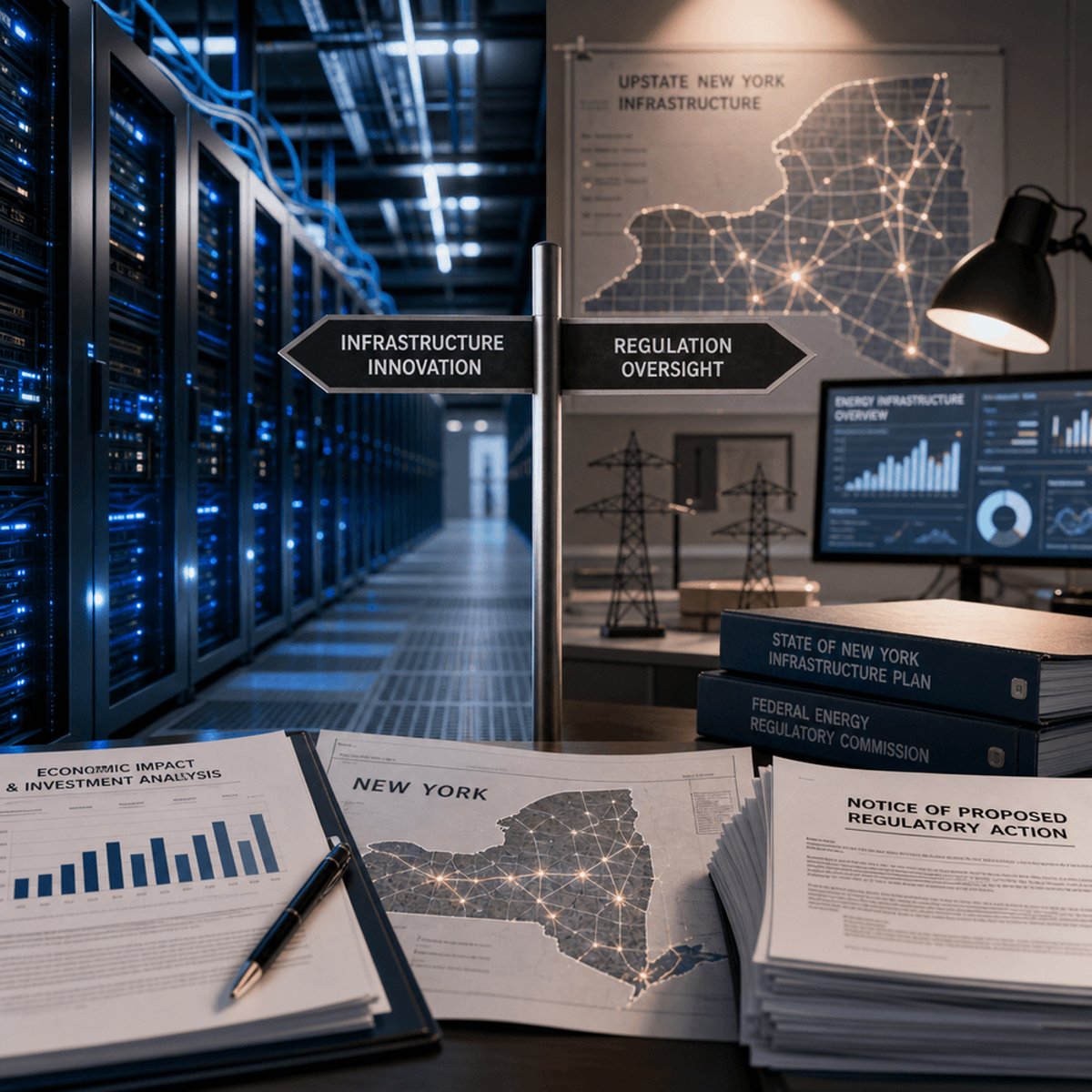
President Trump just launched a blistering attack on New York Governor Kathy Hochul's groundbreaking AI data center moratorium, demanding the state reverse course "immediately." The executive order, signed Tuesday, makes New York the first state in the nation to ban new AI infrastructure development - a move that's sending shockwaves through the cloud computing industry and setting up a major political showdown over America's AI future. With billions in data center investments hanging in the balance, the clash highlights the growing tension between state-level environmental concerns and federal AI ambitions.
The political collision over AI infrastructure just went nuclear. President Trump took to social media and press statements Wednesday evening to slam New York Governor Kathy Hochul's unprecedented AI data center moratorium, calling the Tuesday executive order a "disaster for American innovation" that the state must reverse immediately.
The move makes New York the first state in the nation to impose an outright ban on new AI data center construction - a decision that's caught the tech industry completely off guard. According to sources familiar with the matter, major cloud providers including Amazon Web Services, Microsoft Azure, and Google Cloud had been quietly planning multi-billion dollar data center expansions across upstate New York, betting on the state's hydroelectric power and fiber infrastructure.
Those plans are now frozen. The executive order, which Hochul's office says addresses concerns about energy consumption and environmental impact, effectively halts all new AI-specific data center permits indefinitely. Industry insiders estimate the moratorium could affect upwards of $8 billion in planned investments across the state, with projects ranging from hyperscale training facilities to edge computing deployments.
Trump's response was swift and pointed. "New York is killing jobs and sending our AI leadership straight to China," the president said in a statement. "Governor Hochul needs to change this policy immediately, or she's going to watch every tech company pack up and leave for Texas, Virginia, or anywhere that actually wants to compete in the 21st century."
The political theater masks a deeper industry crisis. Data center operators have been scrambling since Tuesday to understand the order's full scope and legal standing. The moratorium specifically targets facilities designed for AI training and inference workloads - a distinction that's proving murky in practice since most modern cloud infrastructure can theoretically support AI applications.
"This creates massive uncertainty for enterprise AI planning," one cloud infrastructure executive told reporters on background. "If you're a Fortune 500 company building out your AI strategy, do you bet on New York locations or not? What happens to existing contracts? The lack of clarity is paralyzing decision-making."
The timing couldn't be worse for the AI industry. Companies have been racing to secure data center capacity amid exploding demand for large language model training and deployment. Nvidia's latest H200 GPUs remain backordered for months, and colocation space in major metro areas commands premium pricing. New York's moratorium effectively removes a key geographic market from the equation just as competition for AI infrastructure reaches fever pitch.
But Hochul's office is standing firm. Sources close to the governor say the executive order responds to legitimate concerns from environmental groups and utility providers about AI's energy demands. New York's aging power grid has struggled with summer peak loads in recent years, and state officials worry that massive AI data centers could destabilize the system or force expensive infrastructure upgrades that ratepayers would ultimately fund.
The policy divide reflects a broader national tension that's been building for months. While the Trump administration has made AI dominance a cornerstone of its economic agenda - pushing for accelerated permitting and federal subsidies for data center construction - progressive state governments have grown increasingly wary of the technology's resource footprint and societal implications.
Now other states are watching closely. Sources in California, Oregon, and Washington suggest that similar moratoriums are under quiet consideration, with legislators waiting to see how the New York situation plays out politically. If Hochul weathers the Trump backlash without major political damage, it could open the floodgates for state-level AI restrictions nationwide.
For cloud providers and enterprise AI customers, that's a nightmare scenario. The data center industry thrives on regulatory predictability and long-term infrastructure planning. A patchwork of state-by-state AI restrictions would fragment the market, drive up costs, and potentially push more computing capacity offshore to jurisdictions with friendlier policies.
The Business Council of New York State, representing major employers, issued a carefully worded statement Wednesday calling for "dialogue and clarity" around the moratorium's implementation. Behind closed doors, tech lobbyists are reportedly exploring legal challenges to the executive order, arguing it exceeds gubernatorial authority and potentially violates interstate commerce protections.
Meanwhile, the human impact is already emerging. Construction firms with data center contracts are putting projects on hold and furloughing workers. Real estate developers who'd acquired land for tech campuses are reassessing valuations. Local governments in upstate communities that had been counting on tax revenue from new facilities are suddenly facing budget shortfalls.
The clash also highlights the growing gap between AI policy rhetoric and practical governance. While Washington talks about maintaining American AI leadership and Beijing's competitive threat, state and local officials are grappling with immediate constituent concerns about power consumption, water usage, and whether AI actually delivers promised economic benefits to communities.
Trump's demand for an immediate reversal sets up a high-stakes political test for both leaders. Hochul faces pressure to stand firm and not be seen caving to federal bullying, especially with environmental groups praising her leadership. But the economic consequences of lost investment could prove difficult to defend if jobs and tax revenue flee to neighboring states.
What happens next will likely determine whether AI infrastructure becomes the next front in America's ongoing federalism debates - joining contentious issues like climate policy, immigration enforcement, and tech regulation as areas where state and federal governments operate on fundamentally different tracks. For an industry built on the premise of borderless cloud computing, that fragmentation represents an existential challenge to the business model.
New York's first-in-nation AI data center moratorium has ignited a political firestorm that goes way beyond state borders. Trump's demand for immediate reversal sets up a crucial test of whether states can independently regulate AI infrastructure or if federal economic imperatives will override local concerns. For the tech industry, the stakes are existential - a patchwork of state restrictions could fundamentally reshape where and how AI gets built in America. As other states watch this clash unfold, the outcome will likely determine whether AI infrastructure faces the same regulatory fragmentation that's already complicated everything from privacy law to content moderation. The next few weeks will reveal whether this is an isolated policy experiment or the opening salvo in a much larger battle over who actually controls America's AI future.