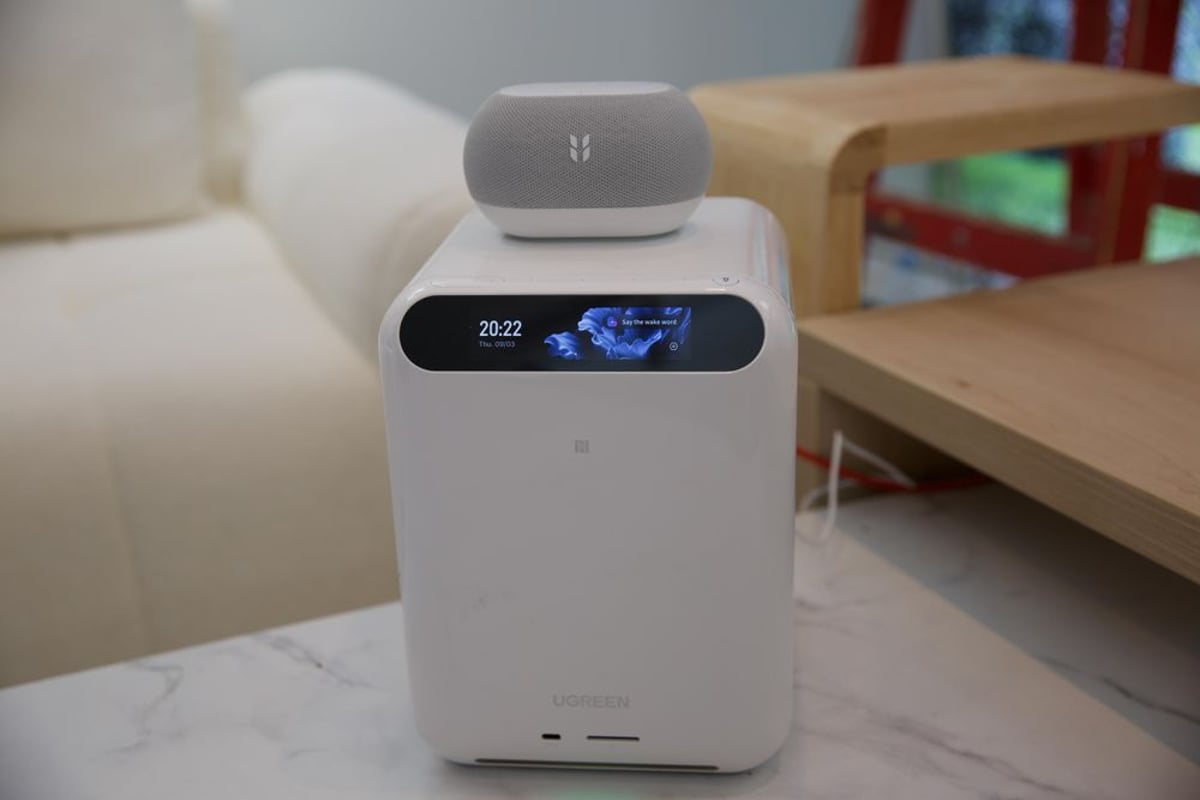
Ugreen, the company you probably know for power banks and network storage boxes, just made a serious play for your living room. At IFA this week, the Shenzhen-based hardware maker unveiled HomeAgent, a smart home platform built around a local hub, on-device AI, and a new voice assistant called Uliya, all pitched on a promise that's become rare in this industry: your data stays home.
Ugreen just did something nobody really expected from a company best known for stuffing your desk drawer with USB-C cables and portable SSDs. At IFA in Berlin this week, the storage and charging brand unveiled HomeAgent, a full smart home platform that fuses security camera storage, on-device AI, and voice control into a single local-first system, as first detailed by The Verge. The pitch is simple: your smart home shouldn't have to phone a server farm in another country just to turn off the lights.
At the center of it all sits a hub, essentially a network-attached storage box repurposed as the brain of your house. Ugreen is offering three hub configurations, topped by the H100 Pro, which handles camera footage storage and AI inference locally, with what the company describes as only occasional cloud dependency for specific features. That local-first framing is Ugreen leaning hard into its NAS heritage, the same instinct that's made brands like Synology and QNAP popular with privacy-conscious households who'd rather not hand their surveillance footage to a third party they've never met.
The headline feature, though, is Uliya, a voice assistant designed to interpret natural language commands and route them through the hub rather than a distant server. That's a notable departure from how most of the smart home industry has operated for the past decade. Amazon's Alexa and Google's Assistant, and more recently its generative successor Gemini for Home, have leaned almost entirely on cloud processing, a model that's delivered convenience but also years of headlines about data retention, third-party access, and outages that leave entire homes unresponsive when the internet blinks. Ugreen is betting there's a meaningful slice of consumers who'd trade a bit of that cloud-powered polish for a system that keeps working, and keeps quiet, even when the router hiccups.
It's a crowded field to walk into. Apple's HomeKit has long marketed itself on privacy, though it requires an Apple ecosystem buy-in that not everyone wants. Samsung's SmartThings spans a wider device catalog but still routes plenty of traffic through the cloud. Smaller players like Aqara and Home Assistant's open-source community have built loyal followings specifically around local control, proving there's real demand, just not yet at mass-market scale. Ugreen's advantage might be distribution. The company already has retail shelf space and an installed base of NAS customers who trust it with their files, and now it wants to trust it with their front door camera too.
The caveat, and there's always one with these local-AI pitches, is that HomeAgent isn't fully cloud-free. Ugreen has acknowledged some caveats around certain AI functions still requiring outside processing, a nuance that echoes the broader industry struggle to deliver snappy, conversational AI entirely on-device. Running large language model-style natural language processing locally is computationally expensive, and most companies, including far bigger ones, still lean on data centers for the heaviest lifting. How much of Uliya's smarts actually stay on the hub versus ping out to a server will matter a lot once reviewers get hands-on time with the hardware.
Still, the timing isn't accidental. Smart home fatigue has been building for a while, subscription costs stack up, privacy scandals pile on, and shoppers increasingly ask why their thermostat needs an internet connection to function at all. Ugreen showing up with a hub, a camera storage answer, and a voice assistant wrapped in a local-first promise taps directly into that mood. Whether HomeAgent can actually deliver on it, at scale, across three different hub tiers, with a brand-new voice assistant competing against a decade of Alexa muscle memory, is the question reviewers and early buyers will be answering in the coming months.
For now, Ugreen has planted its flag. The rest of the smart home industry, especially the players who've built empires on cloud subscriptions, will be watching closely to see if local-first finally has its moment.
Ugreen's move into smart home hubs is less about a single gadget and more about testing whether privacy and local control can actually win back consumers who've grown tired of subscription-laden, cloud-dependent ecosystems. If HomeAgent delivers on its local-first promise without sacrificing the convenience people expect from Alexa or Google Home, it could nudge the rest of the industry, including the giants, toward rethinking how much of your home really needs to live on someone else's server.