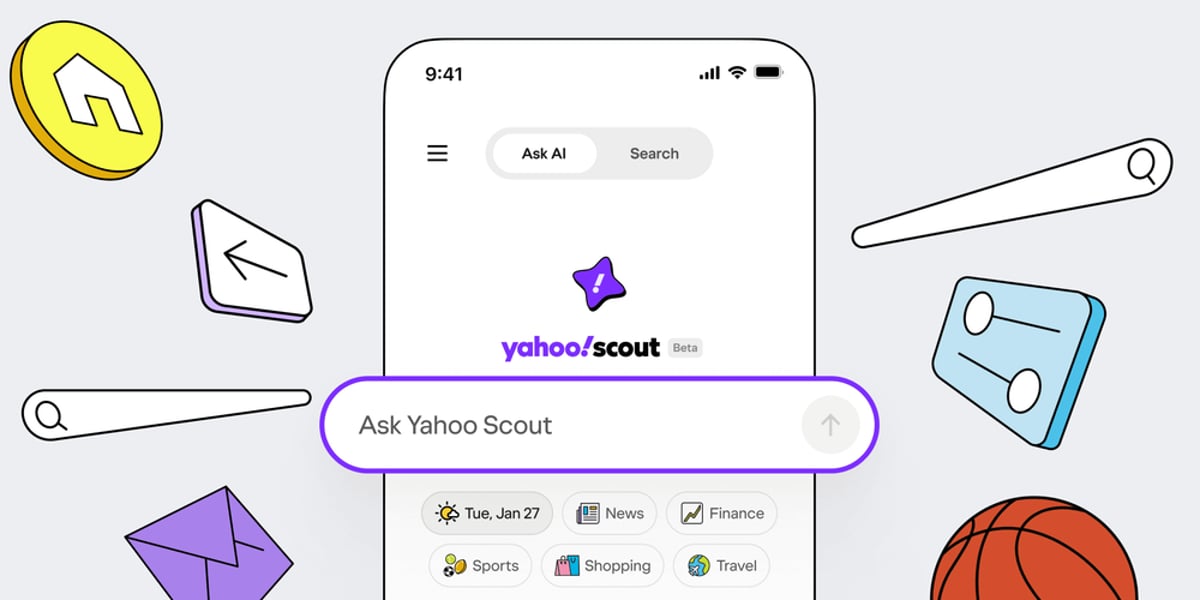
Yahoo just launched Scout, an AI-powered search portal that's taking the company back to its 1990s origins as "Jerry's guide to the world wide web." But this time, there's a twist - the legacy internet giant is using Anthropic's Claude model to power what it calls an "answer engine," and unlike competitors, Scout actually wants you to click through to websites. In early testing, Scout surfaces nine links per query compared to the buried citations favored by ChatGPT, Perplexity, and Google's AI Mode. For a company that's been overshadowed in search for two decades, it's a calculated bet that being web-friendly might be the differentiator that matters.
Yahoo is making its biggest AI play in years, and it looks nothing like what Google or OpenAI are building. The company just unveiled Scout, an AI-powered search portal that's essentially a return to Yahoo's 1990s identity as a curated web directory, now supercharged with large language models. According to The Verge's hands-on coverage, Scout is launching as a tab within Yahoo Search, a standalone web app at scout.yahoo.com, and a centerpiece feature in Yahoo's redesigned mobile search app.
What makes Scout different from the avalanche of AI search tools flooding the market? It actually wants you to leave. When testing a query about winter storm updates, Scout delivered a one-paragraph summary with three prominent blue hyperlinks embedded directly in the text, followed by detailed sections and a "Latest News" module packed with links to Yahoo stories, partner publications, and external sources. The page tallied nine total links, plus a unified sources view. That's a stark contrast to ChatGPT, Perplexity, and Google AI Mode, which tend to bury citations behind subtle icons or light-gray buttons.
"It's moved from 'how do I find things on the internet' to weeding through clickbait and now AI slop," Eric Feng, who leads Yahoo's research group and spearheaded the Scout project, told The Verge. Yahoo CEO Jim Lanzone frames Scout as an inevitable evolution, arguing that Yahoo's unique combination of proprietary content verticals (Sports, Finance, Weather, Mail, Shopping) and search infrastructure creates advantages that even Google can't easily replicate. "We're the only ones who can take our user data, our usage data, our content, our relationships and information, and combine that with everything we know about search into an AI answer engine," Lanzone said.
Yahoo isn't building its own foundation model, a decision Lanzone describes as both practical and strategic. Instead, Scout runs on Anthropic's Claude, layered with what Feng calls "Yahoo content, Yahoo data, Yahoo personality." The web-search index comes from Yahoo's long-standing partnership with Microsoft and Bing. By avoiding the massive capital expenditure of training proprietary models, Yahoo can move faster and focus on what it does own - decades of user behavior data, a newsroom cranking out original journalism, and partnerships with major publishers.
The business model is straightforward. Scout launches with affiliate links on shopping queries and ad units at the bottom of search results. Lanzone says the goal is to keep Scout free through advertising, though he didn't rule out a future premium tier. "Free search is extremely important," he noted. That's a different approach from Perplexity's subscription model or Google's ad-light AI Mode, which is still being cautiously integrated to avoid cannibalizing Google's $200 billion-plus search ads business.
And that's where Yahoo sees its opening. Google is famously constrained by its need to protect existing revenue streams, slow-walking AI Mode's rollout even as the company clearly views it as the future of search. Yahoo has no such baggage. Lanzone confirmed Scout won't replace Yahoo Search immediately, but made it clear that's the plan "before long." For a company whose search engine somehow still ranks third in the US (a stat Lanzone loves to mention), moving aggressively on AI could be the unlock it needs to regain relevance.
Yahoo's content machine gives it another structural edge. The company operates massive verticals like Yahoo Sports, Yahoo Finance, and Yahoo News, all staffed with journalists and editors producing fresh content daily. That's high-quality grounding data for an LLM - no scraping required. Plus, Yahoo has existing revenue-sharing deals with publishers, which could smooth over tensions about AI search products siphoning traffic. When Scout links to a Yahoo Finance article or a partner story, those clicks feed into existing business relationships.
In side-by-side testing, Scout's link-forward design stands out. ChatGPT did surface a carousel of news links at the top of winter storm results, but Perplexity and Google AI Mode both defaulted to summary-first presentations with citations tucked away. Scout's approach - blue hyperlinks woven into prose, followed by categorized link sections - feels more like enhanced search than a chatbot trying to replace the web. That's intentional. Yahoo's pitch is that Scout is a guide, not a gatekeeper.
The tone reinforces that positioning. Scout doesn't try to be conversational or companion-like. It's straightforward, factual, and utility-focused - more "here's what you asked for" than "let me help you with that." In one test, a query about the Winter Olympics start date delivered a clearer, faster answer than Google, ChatGPT, or Perplexity, according to The Verge's David Pierce. That's not enough to dethrone Google, but it suggests Yahoo has carved out a legitimate niche.
The question now is whether users care. Yahoo Search still has scale - that third-place ranking translates to hundreds of millions of monthly users - but it's been years since Yahoo was a destination people chose rather than defaulted to. Scout's success hinges on whether being the most web-friendly AI search engine is a meaningful differentiator, or just a footnote in a market dominated by Google and increasingly shaped by OpenAI's ChatGPT. Yahoo is betting publishers and users will reward a product that actually sends traffic instead of hoarding it. If that bet pays off, Scout could be the company's first major search innovation in over a decade.
Yahoo's Scout arrives at a pivotal moment for AI search, when publishers are increasingly wary of tools that summarize their content without sending traffic back. By building the most link-forward AI search product on the market and leveraging its existing content empire, Yahoo is positioning itself as the web-friendly alternative in a landscape dominated by summary-obsessed competitors. Whether that's enough to win back users who abandoned Yahoo Search years ago remains uncertain, but for a legacy internet company trying to stay relevant, Scout represents a coherent strategy built on actual competitive advantages rather than just chasing trends. The real test will be whether users reward Yahoo's approach or if they've already moved on for good.