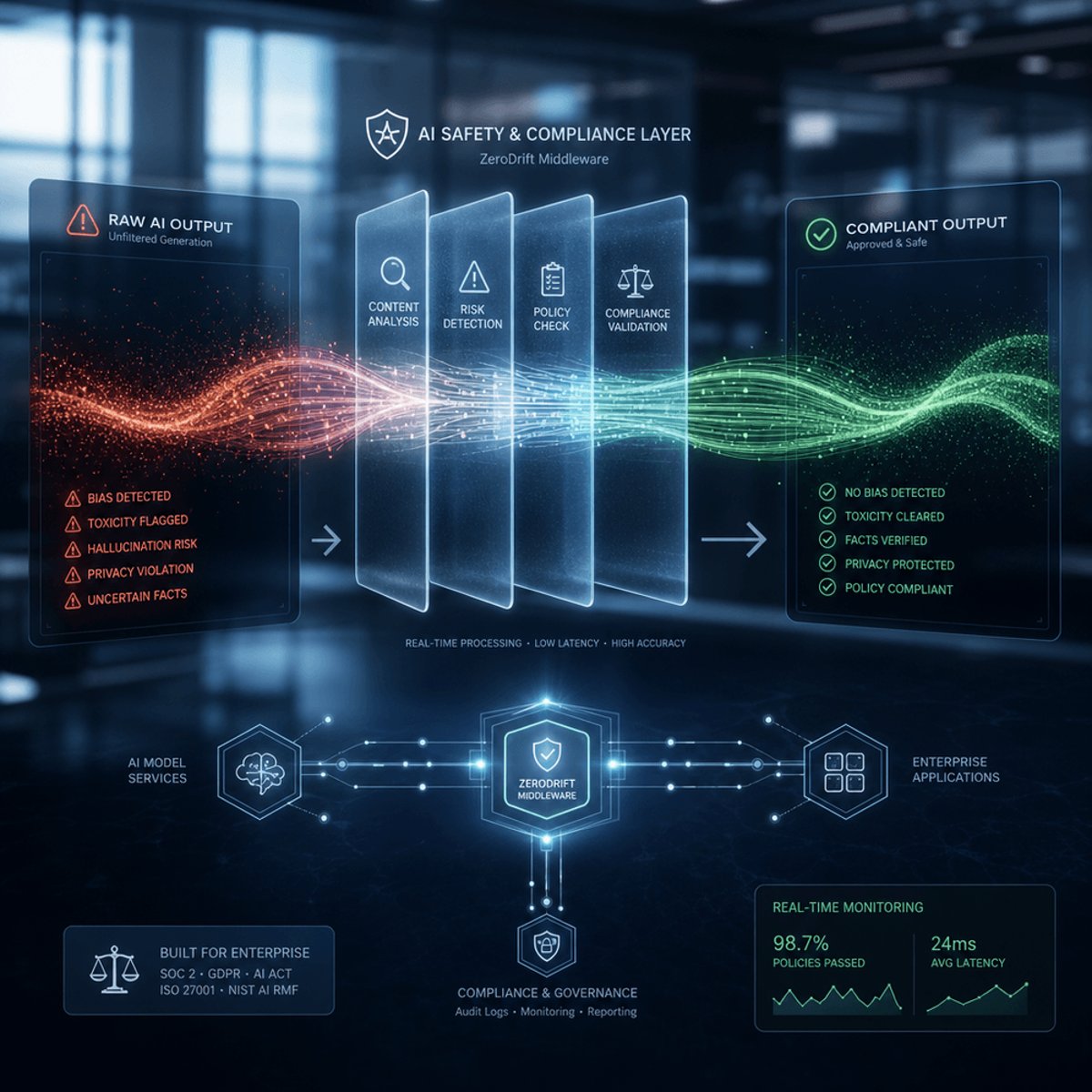
A new startup just raised $10 million to solve one of enterprise AI's messiest problems: what happens when your chatbot says something it shouldn't. ZeroDrift is building a compliance layer that sits between AI models and end users, intercepting and replacing any output that could trigger regulatory headaches. The timing couldn't be better - as companies rush to deploy AI assistants, they're discovering that even the best models occasionally hallucinate legal advice, leak sensitive data, or generate content that violates industry regulations.
ZeroDrift just closed a $10 million funding round to build what amounts to a safety net for corporate AI deployments. The startup's pitch is simple but addresses a real pain point: even state-of-the-art language models sometimes generate outputs that could land companies in regulatory hot water.
The service works as middleware, analyzing every message an AI model produces before it reaches the end user. When ZeroDrift's system detects potential compliance issues - whether that's hallucinated medical advice, inadvertent disclosure of proprietary information, or content that violates industry-specific regulations - it flags and replaces the problematic output in real-time.
It's a Band-Aid solution to a fundamental problem with large language models. Companies from Google to OpenAI have poured billions into making their models safer and more reliable, but the probabilistic nature of these systems means they'll never be 100% predictable. That unpredictability becomes a liability the moment you deploy them in regulated environments.
The market opportunity is massive. Financial services firms are experimenting with AI customer service tools but worry about models dispensing unauthorized financial advice. Healthcare providers want AI assistants that won't accidentally violate HIPAA. Legal departments are terrified of AI tools that might create attorney-client privilege issues. ZeroDrift is betting these fears are strong enough that companies will pay for an additional safety layer, even if it adds latency to their AI interactions.
The $10 million raise suggests investors agree. While the company hasn't disclosed which firms led the round, the funding reflects growing venture appetite for AI infrastructure plays - particularly those addressing governance and compliance. Last year saw similar momentum for AI observability platforms and prompt injection defense tools, but compliance middleware represents a newer category.
What makes ZeroDrift's approach interesting is the interception model. Rather than trying to make the underlying AI model itself more compliant - a technically challenging problem that Microsoft, Google, and OpenAI are already working on - the company treats compliance as a separate layer. It's analogous to how web application firewalls sit in front of websites, filtering malicious traffic without modifying the application code.
The technical challenge is speed. AI applications already face criticism for latency, and adding another analysis layer before each response could make the problem worse. ZeroDrift will need to prove its compliance checks happen fast enough that users don't notice the delay. The company likely uses its own fine-tuned models optimized for rapid classification of compliance risks rather than general-purpose reasoning.
There's also the question of accuracy. If ZeroDrift's system is too aggressive, it'll flag legitimate responses and create a frustrating user experience. Too lenient, and it fails to protect companies from the very risks it's supposed to prevent. Finding that balance - and customizing it for different industries and use cases - will determine whether the product actually works at scale.
The timing aligns with broader regulatory momentum around AI. The EU's AI Act is forcing companies to think harder about AI governance, while U.S. financial regulators are issuing guidance on AI risk management. Even without comprehensive federal AI legislation, sector-specific rules are creating compliance obligations that general-purpose AI models weren't designed to handle.
ZeroDrift joins a growing ecosystem of AI safety infrastructure companies. Firms like Lakera focus on prompt injection attacks, while others tackle AI observability and monitoring. But compliance filtering occupies its own niche - it's less about security vulnerabilities and more about ensuring AI behavior aligns with industry rules and corporate policies.
The $10 million will presumably fund product development and early customer acquisition. For a B2B SaaS play, the key metrics to watch are deployment speed (how quickly can enterprises integrate the middleware) and accuracy rates (what percentage of flagged outputs are actually problematic versus false positives). Customer concentration matters too - landing a few major banks or healthcare systems as reference customers could accelerate adoption.
Competition is inevitable. The major cloud providers - Amazon Web Services, Microsoft Azure, and Google Cloud - all offer AI services and could build compliance filtering into their platforms. OpenAI and Anthropic might add similar capabilities to their model APIs. ZeroDrift's window to establish itself may be narrower than typical enterprise software categories.
The broader question is whether compliance middleware is a temporary solution or permanent infrastructure. If AI models get dramatically better at following rules and avoiding problematic outputs, the need for an external safety layer diminishes. But if model unpredictability remains an inherent characteristic - and regulatory scrutiny continues intensifying - then compliance filtering could become as standard as firewalls and antivirus software.
ZeroDrift's $10 million bet is really a wager on two trends continuing: that AI deployment accelerates faster than model safety improves, and that regulatory pressure keeps mounting. If both prove true, compliance middleware becomes essential infrastructure for any enterprise AI deployment. If model makers solve the safety problem first, or if regulations stay vague enough that companies feel comfortable taking risks, the market shrinks considerably. For now, the funding suggests enough enterprises are worried about AI compliance that they're willing to pay for an extra layer of protection - even if it's treating the symptom rather than curing the disease.