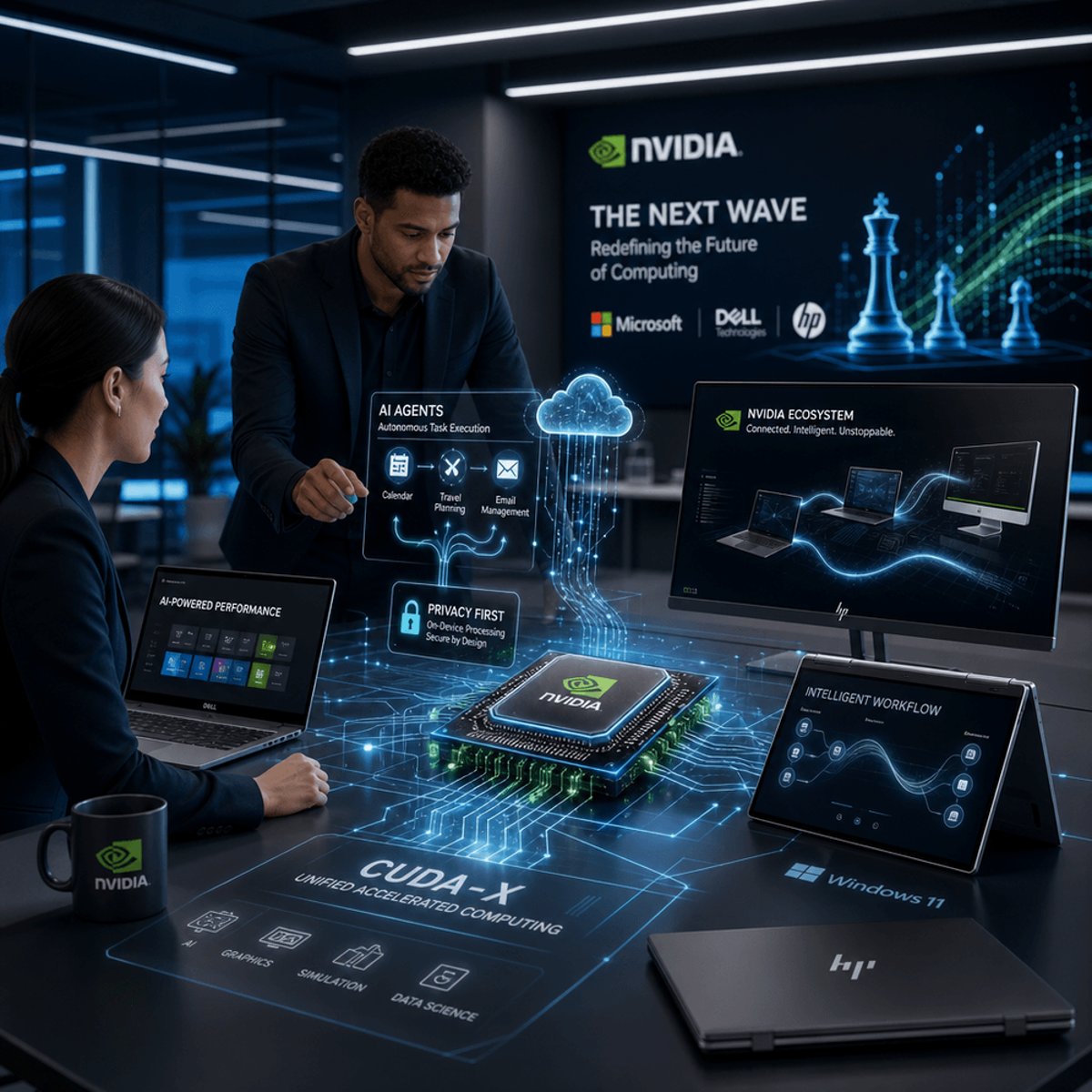
Nvidia just fired a shot across Intel and AMD's bow. The GPU giant is making its long-anticipated push into the $200 billion CPU market with a wave of AI agent-powered PCs built by Microsoft, Dell, and HP. If the company has actually cracked the code on making AI agents accessible, safe, and genuinely useful for everyday users, this could reshape the entire PC industry - and finally give consumers a reason to upgrade their aging laptops.
Nvidia isn't content dominating the AI datacenter anymore. The company's announcing a major offensive into personal computing with AI agent-capable PCs shipping from Microsoft, Dell, and HP - a direct challenge to Intel and AMD in the $200 billion CPU market they've controlled for decades.
The timing couldn't be more strategic. PC sales have been stagnant for years, with consumers seeing little reason to replace perfectly functional laptops. Nvidia's betting that AI agents - software that can actually complete tasks autonomously rather than just answer questions - will be the catalyst the industry desperately needs.
But here's the critical question: has Nvidia actually solved the AI agent problem? According to TechCrunch, if the company has cracked a way to bring AI agents "easily, safely and usefully to the masses, it could - and should - be big." That's a lot of ifs.
The AI agent space is littered with failed promises. Companies from Google to countless startups have struggled with the same fundamental challenges: getting AI to reliably complete multi-step tasks without hallucinating, maintaining user privacy when agents need access to personal data, and building interfaces that don't require a computer science degree to operate.
Nvidia's approach appears focused on on-device processing, leveraging the company's GPU expertise to run AI models locally rather than in the cloud. This addresses privacy concerns - your data stays on your machine - but raises the bar for hardware requirements. That's exactly where Nvidia wants the market to go.
The partnership lineup tells you everything about Nvidia's strategy. Microsoft brings the enterprise credibility and Windows integration. Dell and HP provide the manufacturing scale and corporate sales channels to reach both businesses and consumers. Together, they represent the established PC ecosystem betting on a radical shift in how people interact with computers.
For Intel, this has to sting. The chipmaker has been pushing its own AI PC vision for over a year, adding neural processing units to its latest processors and partnering with software developers to build AI-powered features. AMD has been playing similar cards with its Ryzen AI chips. Now Nvidia - primarily known for discrete GPUs - is positioning itself as the AI agent platform of choice.
The $200 billion market size matters. CPU sales dwarf GPU revenue in personal computing, representing a massive growth opportunity for Nvidia beyond its datacenter dominance. The company's stock has already soared on AI datacenter demand, but Wall Street is always hungry for new growth vectors.
What remains unclear is what these AI agents will actually do. Will they book your travel, manage your calendar, and draft emails with genuine competence? Or will they be glorified chatbots with better marketing? The difference between those two outcomes will determine whether this becomes a genuine platform shift or another overhyped AI feature that users ignore.
Enterprise adoption will be the real test. IT departments are notoriously cautious about AI tools that could expose sensitive data or make costly mistakes. Nvidia and its partners will need to prove that these agents can operate within corporate security policies and compliance frameworks. That's a much harder sell than consumer hype.
The competitive response should be fierce. Intel and AMD aren't going to cede the AI PC narrative without a fight. Expect aggressive counter-announcements, price cuts, and partnerships of their own. Apple, meanwhile, continues developing its own Apple Silicon roadmap with increasing AI capabilities - a closed ecosystem that Nvidia can't easily penetrate.
Nvidia's track record in new markets is mixed. The company dominated PC gaming GPUs and conquered AI training. But it's also stumbled in mobile chips and seen mixed results in automotive despite years of investment. CPUs for mainstream PCs represent a different challenge entirely, with razor-thin margins and brutal competition.
What's genuinely intriguing is the potential for AI agents to change how we think about computing power. If agents can truly automate complex workflows - researching topics, synthesizing information, coordinating across apps - then suddenly hardware capabilities matter again. That virtuous cycle of "better agents need better chips need better agents" is exactly what could reinvigorate the PC market.
The proof will come in the reviews and real-world usage over the coming months. Early adopters and enterprise pilots will reveal whether Nvidia's AI agents deliver genuine productivity gains or just battery drain and privacy headaches.
Nvidia's push into AI agent PCs with Microsoft, Dell, and HP represents either a brilliant flanking maneuver into the $200B CPU market or an expensive bet on technology that isn't quite ready for prime time. The partnerships give Nvidia instant credibility and distribution, but the hard part - proving that AI agents can be easy, safe, and actually useful - remains unproven. If these machines ship and the agents work as promised, Nvidia could crack open a massive new revenue stream while forcing Intel and AMD to play catch-up in AI capabilities. If the agents disappoint, this becomes another cautionary tale about AI hype outpacing AI reality. Either way, the PC industry just got a lot more interesting.