Newsletter
Beyond Tech: Your Weekend Upgrade

The Tech Buzz
August 08, 2026
Consumer Tech: DeepSeek cheap AI; folding iPhone; Googlebook; iPhone–Windows clipboard; MODRA delivery
Art/Culture: Spotify AI remixes; IMAX split; AI “Rubberz”; Hollywood AI pushback; Pippa royalties
Food/Drink: Taco Bell lettuce deaths; Amazon fish labels; Kellogg toys; whisky-fed omega-3; MGP whiskey slump
Sports: FIFA $20B U-turn; Khelo India $3.8B; bank jersey deals; WRC rally funding
Futurism: MIT molecule chips; DNA hack risk; EON space lasers; wall-seeing camera; China fusion magnet
Wellness: Public health outbreaks; AI anti-aging enzyme; DNA repair; bispecific drugs; $50 tick test; Parva AI

Cheapest Frontier Model — DeepSeek's V4-Flash claims to run over 100x cheaper than Anthropic's Claude Fable 5 on benchmarks, sharpening the AI price war.
Folding Finally — Apple will unveil its first folding iPhone at the September conference, base iPhone 18 slips to spring 2027. + Plans to add 1GB of memory to the iPhone 18e as an AI upgrade for handling on-device AI.
Post-Chromebook Gamble — A leaked Lenovo Googlebook 15 blends Android apps with ChromeOS, adding a Gemini key, premium hardware to take on Windows.
Windows Truce — Apple is building a copy-paste via Universal Clipboard between iPhone and Windows after EU pressure to open up compatibility.
Plumber Turns Retail — MODRA is an AI shopping marketplace doing same-day local delivery with an assistant that learns shopper preferences.

Hint, Martha Stewart's new free AI home app, sends proactive reminders for home upkeep most homeowners forget. Here’s a look at how it works.
A new app called Hint launched this week to catch those home tasks you didn’t even know you needed to know. It knows things like when to flush a water heater, when to check the salt on a home well, and when those fridge coils need a vacuum. Then it pushes a reminder to your phone so you don't have to keep any of it in your head.
An example, behind most refrigerators, down near the floor, sits a set of coils. Dust settles on them. Let them clog and the fridge works harder, runs hotter, and on some models turns into a fire risk. Most people have owned a fridge for years and never once looked back there.
Getting started on Hint is quick. You enter your home address, and Hint builds a profile of the place from public data: property records, weather, soil, and utility info. The soil part matters more than it sounds. It can hint at how your lawn drains or whether your foundation might shift over time. It also pulls air quality and drought data, which can feed into flood risk and even your insurance rates.
From there you upload your own paperwork. Inspection reports, home warranties, mortgage documents, insurance policies, old invoices. Snap photos of your big appliances and the app walks you through how-to questions for each one. It hands you a single home score, a quick number telling you how well you've been keeping up.
The built-in chatbot is where it gets useful for the boring stuff. Ask when you last had the AC serviced. Ask what you're paying per kilowatt hour. Ask whether a HELOC makes sense for tapping your equity, or whether your insurance deductible is set too high. For anyone who has ever stared at a home equity decision with no idea where to start, having your actual documents answer back is a real shift.
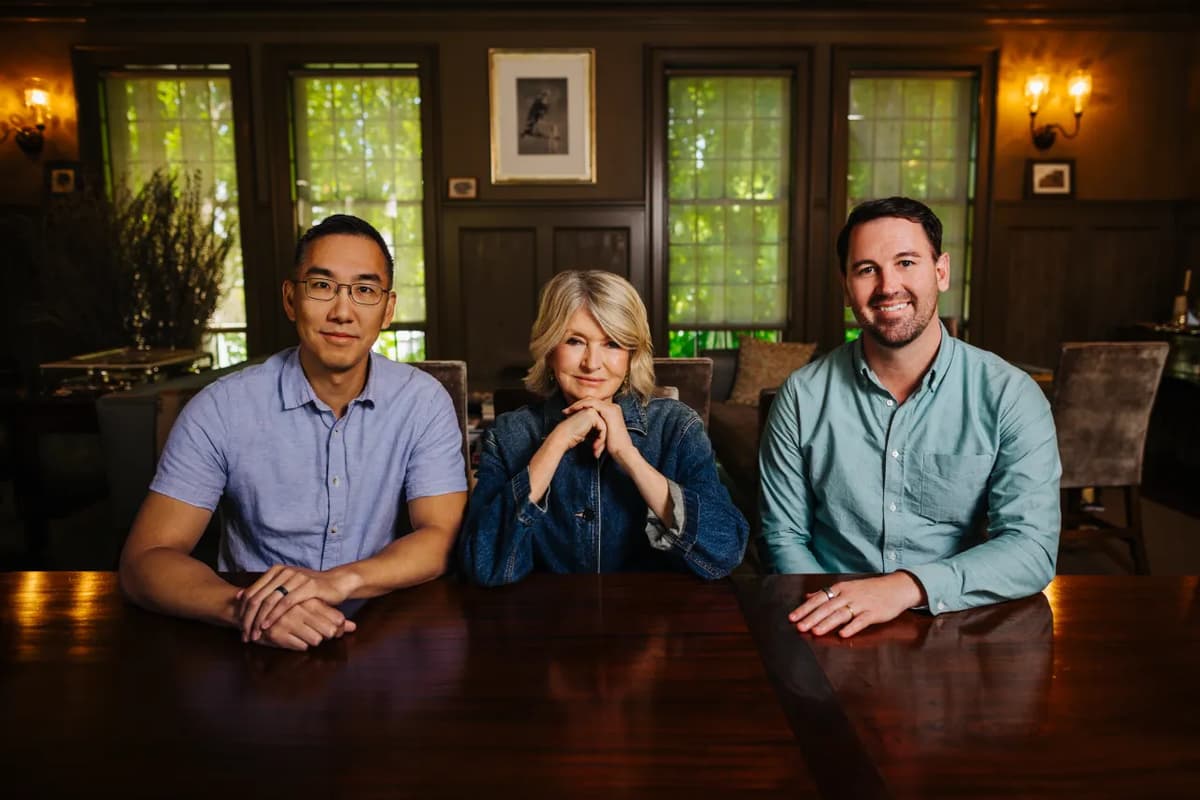
Here is the twist that got everyone's attention. TV home and lifestyle guru Martha Stewart is a cofounder. It seems, she is not a face on a poster, but a genuine cofounder with real equity who shows up for the work.
Her CTO, Kyle Rush, says he drives over about twice a week to sit with her and go through the app. When it gets something wrong about soil, she says so. When it misjudges something about a home, she flags it. She weighs in on the design, the branding, and the words the app uses. Decades of real wisdom gleaned from running actual households, poured into software. It's a strange and kind of perfect fit.
Hint costs nothing today. No ads, no subscription. The company raised $10M to make that possible, from backers including Slow Ventures, Tusk Venture Partners, and Brian Kelly of The Points Guy.
So how does a free app pay the bills? Affiliate revenue. Hint has a network of service providers, and it earns when you use them. Rush says that money is walled off from the AI, so the recommendations you get aren't tilted toward whoever pays. Down the road, expect a premium tier for power users, likely aimed at people juggling more than one property.
That free-with-a-footnote setup is worth sitting with. The advice feels neutral, and the company insists it is. Whether that firewall holds as the business grows is the thing worth watching.
The stuff Hint tracks is stuff almost nobody enjoys thinking about, which is exactly why it slips through the cracks and turns into a $2,000 repair. An app that quietly remembers the coils, the filters, and the water heater is solving a genuinely annoying problem.
The trade is your home's data. Address, documents, appliance photos, all in one place. For some people that's a fair swap for peace of mind. For others it's a lot to hand over to a two-year-old startup. Only you can make the call on that one.
The app is free on iOS right now. If you've been meaning to get a handle on your house and never quite have, it's possibly worth a look.
"We want it to be in the hands of every homeowner in the country."

30K Labels Onboard — Spotify struck a deal with Merlin giving its AI remix tool access to 30,000 independent labels and a far deeper catalog.
Sharing the Big Screen — IMAX will split screens between Spider-Man and The Odyssey after both posted record weekends and outstripped available capacity.
Song of the Summer — Fenix Flexin’s hit song “Rubberz” has hip-hop fans arguing over whether it was generated by AI. Some say they have proof it’s machine-made.
Hollywood's Reckoning — Industry leaders push back on generative AI scripts and digital actors, and Amazon MGM shelved an AI project after threats.
Paying the Artists — A new app, Pippa plans to pay royalties for training data, betting that cutting creators in can defuse the AI copyright fight.


Two Deaths in Michigan — First U.S. cyclospora fatalities trace to Mexican lettuce served at Taco Bell, with nearly 2,000 cases and dozens hospitalized.
Fishy Claims — Amazon faces a class action alleging its seafood sustainability labels misrepresent how the fish is actually sourced.
Toys Are Back — WK Kellogg revives cereal-box toys with Toy Story 5 spoons, chasing millennial and Gen X parents as cereal sales keep sliding.
Whisky to Omega-3 — Scottish startup MiAlgae turns distillery waste into omega-3 microalgae, scaling a fish oil substitute it hopes to sell at cost parity.
Whiskey Hangover — MGP Ingredients sales fell 19% with net income down 35% to $15.4M, as contract distilling collapsed 43%.

Infantino Backs Down — FIFA dropped its $20B equity sale after UEFA, AFC and CONCACAF threatened boycotts and staff resigned over the plan.
India's $3.8B Push — Khelo India will spend $3.82B over five years on school talent pathways and coaching, aiming to grow its athlete pool tenfold.
Banks on Jerseys — JPMorgan Chase paid $17M to sponsor Ohio State and SoFi $18-20M for Notre Dame, chasing young customers through college sport.
Patches and Payrolls — SoFi, JPMorgan and Busey Bank pair jersey-patch rights with athlete financial education in multi-year university deals.
Rally Cash Injection — FIA partnered with Cosmobilis and Park Square Capital on a WRC and ERC deal funding grassroots rally before 2027 rule changes.


Molecules on Chips — MIT found a way to place molecular materials onto chips undamaged, hitting 96% yield across 1,000 devices with DARPA backing.
Crime Lab Loophole — A flaw dating to 1995 leaves DNA data files at U.S. crime labs open to online tampering, and Thermo Fisher's patch may not cover wider risk.
Fiber to Lasers — EON raised $10.75M from General Catalyst and a16z to replace undersea cable with 2.4Tbps laser satellites, demo set for 2027.
Seeing Through Walls — WaveSight uses radio waves to map hidden structures in 3D, built by ex-Apple and Google engineers and raising obvious privacy questions.
582 Tonnes of Magnet — China's CRAFT fusion project passed full-load testing on a 582-tonne coil in Hefei that traps plasma at 100M°C, with 16 needed to close the ring.
No Chinese Parts — An Indian startup built a humanoid robot free of Chinese components, a self-reliance play shaped by India-China trade tensions and a US ban on foreign robots.


Public Health Bill Due — A a widening range of viruses, bacterium, and parasites is spreading across the US, which experts tie to earlier public health policy cuts and weakened infrastructure.
Skin of a 30-Year-Old — Scientists used AI to engineer CMLase, an enzyme that strips inflammatory AGEs from tissue and restored 70-year-old skin to youthful levels in testing.
100,000 Lesions a Day — Researchers studying centenarians and long-lived animals are hunting ways to boost DNA repair, the system that fixes most of the damage cells take daily.
Two Targets, One Shot — Bispecific antibodies that bind two targets at once are moving into clinics fast, with more elaborate multi-target versions already in development for tumours.
$50 Tick Test — LymeAlert launches in August, letting people test a removed tick for Borrelia burgdorferi in minutes to speed Lyme disease diagnosis.
Typing Tells — Mantis Biotech's Parva reads computer interactions for cognitive signals, raising $7.4M from Decibel and Y Combinator.
Instagram: https://www.instagram.com/thetechbuzz.ig/

Advertisement
Advertisement
| Get the daily newsletter that helps you understand the tech ecosystem sent to your inbox.