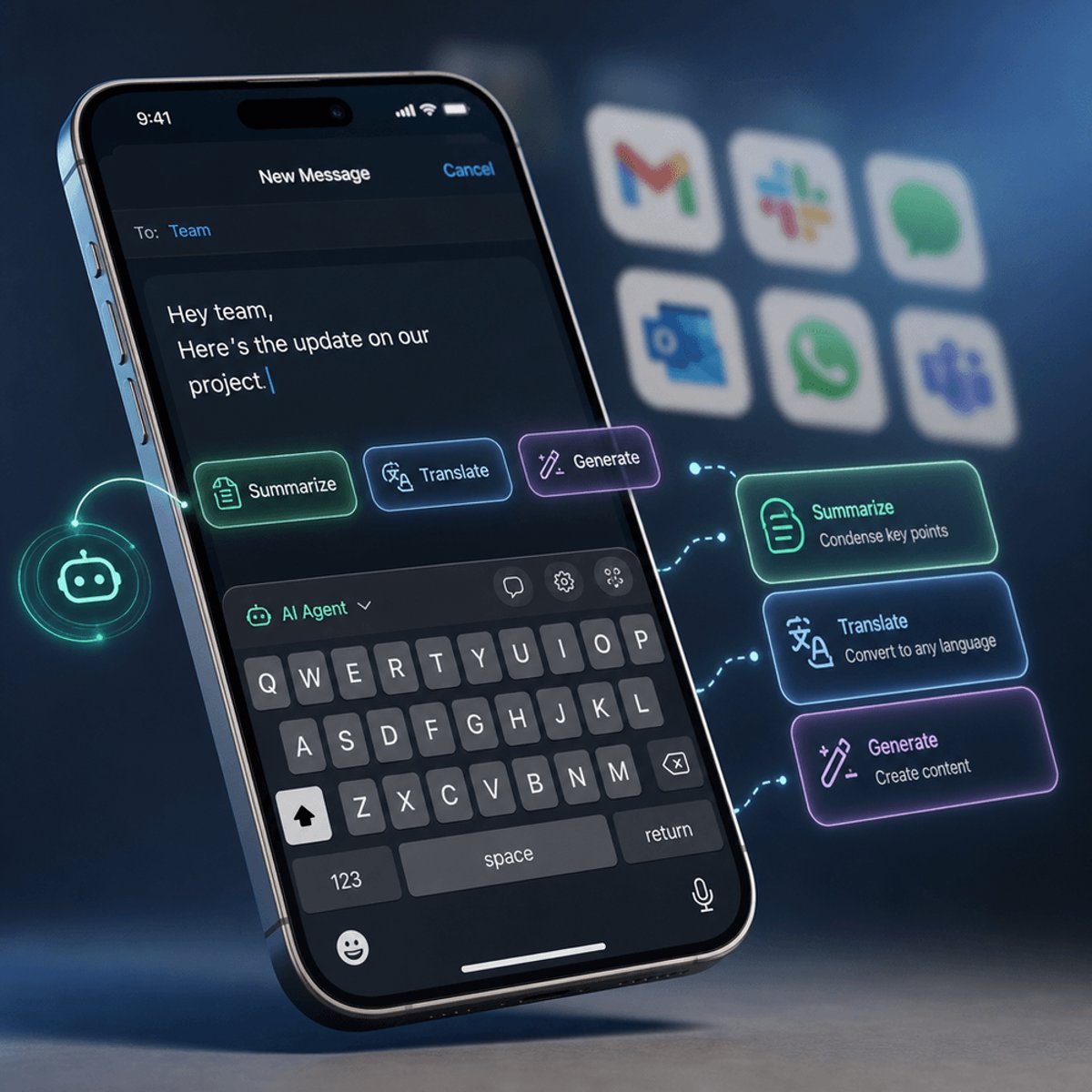
Your smartphone keyboard just got a lot smarter. Acti, a new startup, is launching an AI-powered keyboard that works across iOS and Android apps, letting users build custom AI shortcuts using plain English. Instead of switching between apps or opening ChatGPT separately, Acti embeds AI agents right where you're already typing - betting that the keyboard is the next natural home for AI assistants.
Acti is making a bold bet that your keyboard - the most-used interface on your phone - should be powered by AI agents. The startup just launched its keyboard app for both iOS and Android, bringing AI assistance directly into the typing experience rather than forcing users to jump between apps.
The concept is straightforward but potentially transformative. Instead of copying text, opening ChatGPT or another AI app, pasting it in, waiting for a response, then copying that back to wherever you were working, Acti lets you invoke AI agents right from your keyboard. According to TechCrunch, users can create custom shortcuts using natural language, essentially programming their own AI-powered workflows without writing code.
This approach addresses one of the biggest friction points in mobile AI adoption. While AI assistants have exploded in capability over the past few years, actually using them on a smartphone remains clunky. You're constantly context-switching, losing your flow, and dealing with the cognitive overhead of managing multiple apps. Acti removes that friction by meeting you where you already are - in your messaging app, email client, notes, or browser.
The keyboard works across apps, which is crucial for mainstream adoption. Whether you're drafting an email in Gmail, responding to a Slack message, or posting on social media, the AI agents are consistently available. This cross-app functionality puts Acti in direct competition with both traditional keyboard makers like Gboard and SwiftKey, and AI-first mobile apps trying to become your go-to assistant.
What makes Acti particularly interesting is its focus on customization through natural language. Rather than offering a fixed set of AI features, users can essentially teach the keyboard what they want it to do. Need to automatically translate messages into Spanish? Want to summarize long emails before responding? Looking to generate quick meeting notes from voice-to-text? You can create shortcuts for all of these using conversational commands, not technical workflows.
The timing couldn't be better. Mobile keyboards have remained relatively unchanged for years, while AI capabilities have skyrocketed. Apple introduced AI features in iOS, Google has been integrating Gemini across Android, and Microsoft is pushing Copilot everywhere. But most of these implementations still feel bolted on rather than native to how people actually use their phones.
Acti is effectively arguing that the keyboard is the killer interface for mobile AI - more natural than widgets, more accessible than dedicated apps, and more contextual than system-level assistants. It's where your thoughts become text, making it the perfect interception point for AI enhancement.
The startup faces significant challenges, though. Convincing users to switch keyboards is notoriously difficult. People develop muscle memory, and privacy concerns around keyboard apps remain high since they technically have access to everything you type. Acti will need to be crystal clear about its data policies and security measures.
There's also the question of monetization. Will this be a freemium model with premium AI features? A subscription? Ad-supported? The economics of keyboard apps have always been tricky, and adding AI compute costs into the mix makes it even more complex.
But if Acti can nail the execution - fast, reliable, private, and genuinely useful - it could redefine how we interact with AI on mobile. The keyboard is used dozens or hundreds of times daily by billions of people. If AI agents can live there seamlessly, that's a significantly bigger opportunity than yet another standalone AI chat app.
The launch comes as the AI agent space heats up dramatically. OpenAI has been pushing agents hard, Google is building them into Gemini, and countless startups are trying to crack the agent interface problem. Acti's answer is elegantly simple - put them where people are already working, not where you wish they would go.
For now, the app is available on both major mobile platforms, which is smart. Going cross-platform from day one maximizes potential user base and avoids the chicken-and-egg problem of building for just one ecosystem. Whether users will actually embrace AI-powered keyboards remains the billion-dollar question.
Acti is betting big that the keyboard - not a dedicated app or system-level assistant - is where AI agents belong on mobile. By embedding AI directly into the typing interface and letting users create custom shortcuts with natural language, the startup is tackling one of mobile AI's biggest problems: friction. If people actually adopt it, Acti could shift how billions of smartphone users interact with AI daily. But it'll need to overcome steep challenges around user adoption, privacy concerns, and monetization. The concept is compelling - whether the execution delivers is what we'll be watching.