TL;DR:
• Acura unveils RSX Prototype featuring Honda's first in-house AI operating system
• Asimo OS will power Honda Zero series and enable over-the-air updates
• Production starts second half 2026 at Honda's Ohio EV Hub facility
• Vehicle offers bidirectional charging to power homes, putting Honda ahead of EV energy trends
Acura just pulled the covers off the RSX Prototype at Monterey Car Week, marking a seismic shift in how the premium brand approaches electric vehicles. This isn't just another EV—it's the first vehicle to debut Honda's proprietary Asimo operating system, the AI-powered brain that will control the company's entire next-generation fleet starting in 2026.
Acura's RSX Prototype just made its global debut at Pebble Beach, and the automotive world is taking notice. The resurrected nameplate signals Honda's most ambitious bet yet on software-defined vehicles, powered by the company's breakthrough Asimo operating system that was first teased at CES earlier this year.
The timing couldn't be more strategic. While Tesla continues to dominate EV software integration and GM struggles with its Ultium platform reliability, Honda is making its play for the premium EV market with an entirely in-house approach. The RSX will roll off the same Ohio production line as the Integra starting in the second half of 2026, according to Acura's announcement at The Quail Motorsports Gathering.
What sets this apart from Honda's current EV lineup is the platform independence. Unlike the ZDX and Prologue, which rely on GM's Ultium architecture, the RSX represents Honda's first completely proprietary electric vehicle engineered on its new global EV Platform. This is the same foundation that will underpin the Honda Zero series, starting with the Honda 0 SUV next year.
Asimo's integration goes far beyond typical infotainment systems. The AI-powered OS will control core vehicle functions and evolve through over-the-air updates, positioning Honda to compete directly with Tesla's software-first approach. Industry analysts see this as Honda's recognition that future automotive profits will increasingly come from software services rather than traditional hardware sales.
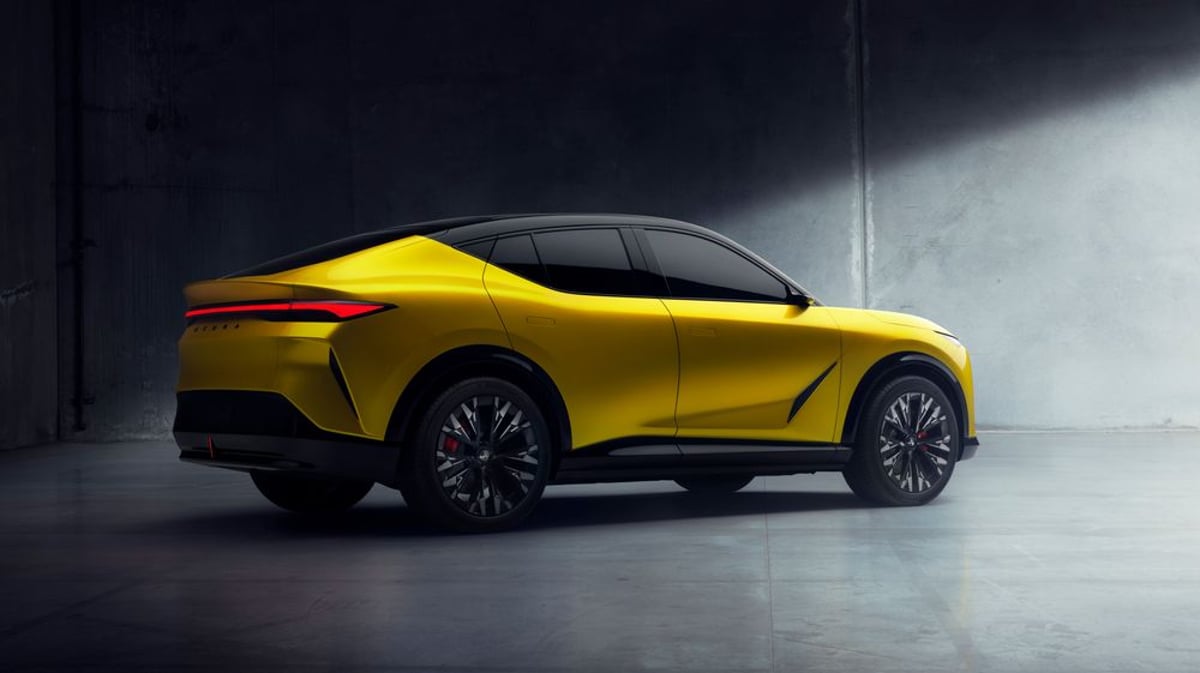
The prototype's design language draws heavily from last year's Performance EV concept, but with production-ready refinements. The sharp angles and boat-like silhouette remain, anchored by aggressive slit-style LED running lights that frame the Acura logo. The rear design pays homage to the second-generation NSX with full-width taillights and bold "ACURA" lettering across the tailgate.
While Acura hasn't released performance specifications, the visual cues suggest serious capability. Multi-spoke 21-inch wheels reveal bright red Brembo brake calipers, while the fastback roofline and coupe-like proportions hint at the performance DNA that made the original RSX a tuner favorite in the early 2000s.
The energy story extends beyond driving range. The RSX Prototype introduces bidirectional charging capability, allowing it to serve as a mobile power station for appliances or even whole-house backup power. This vehicle-to-grid technology puts Honda ahead of most competitors in addressing the growing demand for energy independence, a feature that could prove crucial as extreme weather events stress traditional power grids.
Honda's broader EV strategy reveals the stakes involved. The company has committed to electrifying its entire North American lineup by 2040, with software-defined vehicles as the cornerstone. The RSX and upcoming Zero series represent a fundamental shift from Honda's traditionally hardware-focused engineering culture toward a Tesla-style software-first approach.
Market positioning will be critical. The RSX enters a crowded premium EV crossover segment dominated by Tesla's Model Y, with strong challenges from Genesis GV60, BMW iX, and Mercedes EQS SUV. Honda's bet is that Asimo's AI capabilities and bidirectional charging will differentiate the RSX in ways that traditional performance metrics cannot.
The announcement also hints at Honda's sports car future. Company executives confirmed an "NSX-type" electric sports car is in development for 2027-2028, suggesting the Asimo platform will eventually support high-performance applications beyond crossovers and sedans.
The RSX Prototype represents more than just Acura's return to a beloved nameplate—it's Honda's declaration that it's ready to compete on software as much as hardware. With Asimo OS at its core and bidirectional charging as a key differentiator, the RSX could reshape expectations for what premium EVs should deliver beyond just driving range. As production begins in late 2026, the automotive industry will be watching to see if Honda's software-defined vehicle strategy can challenge Tesla's dominance and establish a new paradigm for AI-powered mobility.