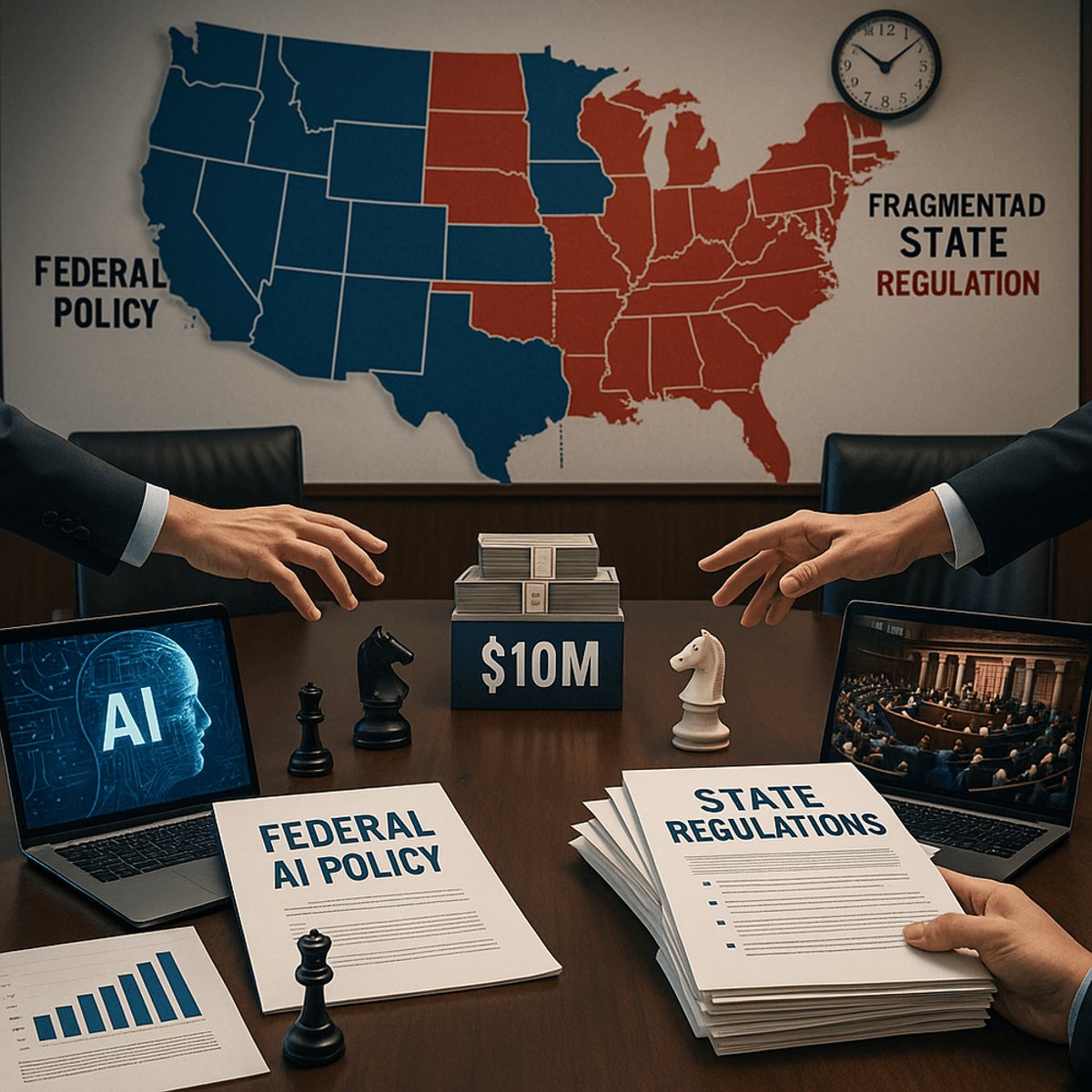
The AI industry just fired the opening shot in what's shaping up to be the biggest regulatory battle in tech's history. A super PAC called Leading the Future launched a $10 million campaign today to push Congress toward a uniform national AI policy that would override state-by-state regulations, timing their offensive perfectly with the Trump administration's own war on state AI laws.
The timing couldn't be more calculated. Just as Leading the Future announced its $10 million blitz today, sources familiar with White House discussions told CNBC that congressional Republicans are actively working to slip preemption language into upcoming spending bills. The message is crystal clear: states need to back off, and fast.
The PAC isn't playing around with this campaign either. We're talking TV, digital, and social media ads plus an orchestrated assault of 10,000 calls to lawmakers' offices this week alone, according to internal memos. "There is broad public demand for congressional action and a uniform national approach to AI," Nathan Leamer, executive director of the PAC's advocacy arm Build American AI, told CNBC. But the real muscle behind this push comes from venture capital giant Andreessen Horowitz, Palantir co-founder Joe Lonsdale, AI search company Perplexity, and SV Angel founder Ron Conway.
Trump's already singing from their hymn book. Last Tuesday, he posted on Truth Social that the U.S. "MUST have one Federal Standard instead of a patchwork of 50 State Regulatory Regimes." The same day, Leamer posted a White House photo, casually mentioning he was there discussing "the need for a national AI framework." Coincidence? Not likely.
The industry's urgency becomes clearer when you look at what's already happening at the state level. New York's RAISE Act, which codifies safety protocols for the largest AI companies, has passed the legislature and sits on Governor Kathy Hochul's desk. California's been drafting its own comprehensive AI regulations. These aren't symbolic gestures - they're real rules with real teeth that could fundamentally change how AI companies operate.
But the Trump administration isn't waiting for congressional action. A draft executive order that surfaced last week proposes creating an "AI Litigation Task Force" and threatens to withhold federal funding from states that don't fall in line. Trump's expected to sign an AI-related executive order today at 4 p.m. ET, though it's unclear if it's the same draft or something new entirely.
The PAC's already drawn its first blood for 2026. They've targeted New York Assemblymember Alex Bores, who's running for Jerry Nadler's Manhattan congressional seat and co-sponsored the RAISE Act. "We should eventually have a federal AI standard. I strongly agree with that," Bores said on CNBC's Squawk Box this morning. "But what is being debated right now is, should we stop the states from making any progress before the feds have solved the problem?"
That's exactly the question that'll define the next two years of AI policy. The industry clearly believes it can shape federal legislation more easily than fighting 50 separate state battles. With over $100 million in initial funding and backing from AI's biggest players, Leading the Future has the resources to make this a defining issue in 2026 midterms.
The stakes couldn't be higher. We're watching the birth of an entirely new regulatory framework for the technology that's reshaping everything from healthcare to national defense. The industry wants one set of rules they can work with. States want the flexibility to protect their residents as they see fit. And Trump's administration appears ready to use federal power to settle the debate once and for all.
This isn't just another lobbying campaign - it's the opening salvo in a regulatory war that'll determine whether AI development happens under a single federal framework or gets fragmented across dozens of state jurisdictions. With the industry's deepest pockets backing a coordinated offensive and Trump's administration wielding federal preemption powers, state lawmakers face their biggest challenge yet in protecting local interests. The 2026 midterms just became a referendum on who gets to write the rules for artificial intelligence in America.