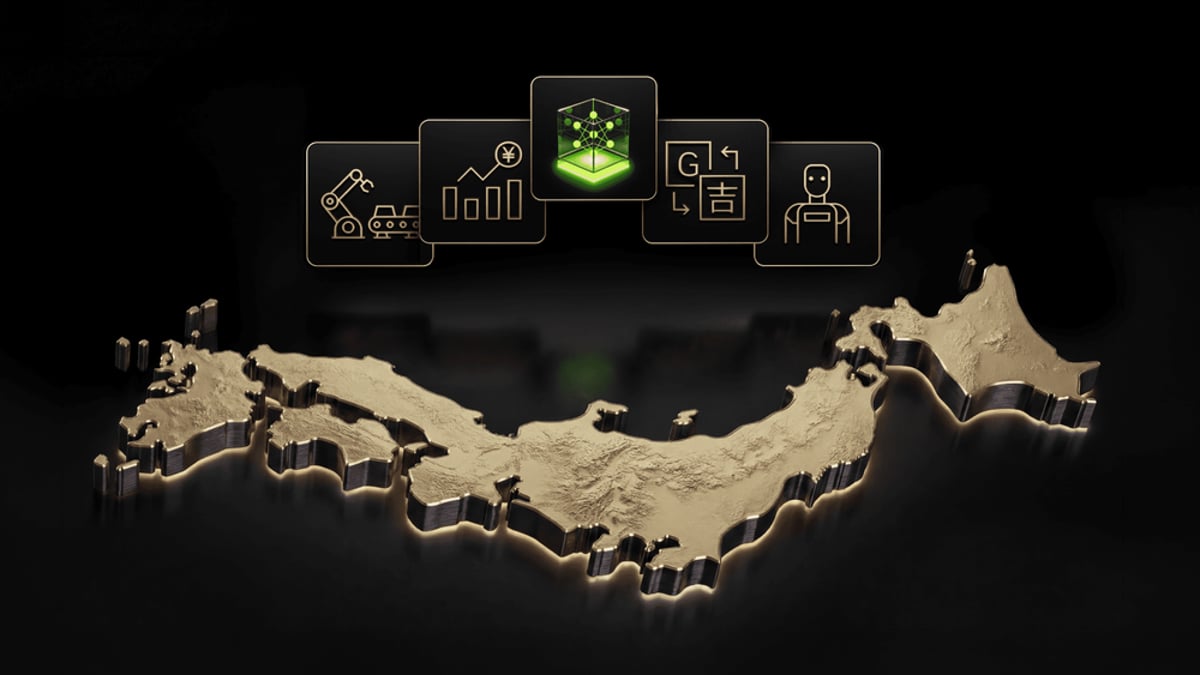
NVIDIA just handed Japanese enterprises the keys to custom AI development. The chipmaker announced that leading companies, startups, and research institutions across Japan are building industry-specific AI models using NVIDIA Nemotron open models, data libraries, and toolkits - a strategic push to localize AI for Japan's unique language requirements and industrial needs. This marks a significant shift in how enterprises approach AI customization, moving away from one-size-fits-all solutions to highly tailored models built on open infrastructure.
NVIDIA is making a calculated bet on Japan's AI future, and the country's enterprises are responding. The company's announcement reveals a growing ecosystem of Japanese organizations building custom AI models with NVIDIA Nemotron, the chipmaker's open-source AI platform that includes pre-trained models, datasets, and development libraries.
The timing couldn't be more strategic. While much of the AI world has focused on English-language models, Japan represents a critical test case for AI localization. Japanese language processing presents unique challenges - multiple writing systems, contextual nuances, and industry-specific terminology that generic models often fumble. By providing open models that companies can fine-tune, NVIDIA is positioning itself as the infrastructure provider for a wave of Japanese AI applications.
What makes this development particularly significant is the breadth of adoption. We're not talking about a handful of tech startups experimenting with new tools. Leading enterprises across multiple sectors - from manufacturing to finance to healthcare - are reportedly building production AI systems on Nemotron's foundation. Research institutions are joining the effort, suggesting this isn't just commercial adoption but a broader movement toward indigenous AI development.
The open model approach represents a sharp departure from the closed, API-driven strategy championed by companies like OpenAI. Instead of accessing AI through controlled interfaces, Japanese developers can inspect, modify, and optimize models for their specific needs. For enterprises handling sensitive data or requiring precise control over AI behavior, this matters enormously.
NVIDIA's strategy here extends beyond just selling chips. By providing the full stack - models, data, libraries, and presumably the GPUs to run them - the company is creating ecosystem lock-in at a foundational level. Japanese companies building on Nemotron will need NVIDIA hardware to train and deploy these models at scale. It's infrastructure play disguised as open-source altruism.
The Japanese market offers NVIDIA several advantages. The country has strong AI research traditions, significant capital for technology investment, and industries desperately seeking automation solutions as the workforce ages. Japan's government has also made AI sovereignty a priority, preferring domestic or customizable solutions over dependence on foreign cloud APIs.
For startups in the mix, Nemotron provides a shortcut past the most capital-intensive part of AI development. Instead of training foundation models from scratch - a process requiring millions of dollars and months of compute time - they can start with NVIDIA's base models and specialize them for vertical markets. A legal tech startup can fine-tune for Japanese contract analysis. A medical AI company can adapt models for clinical documentation in Japanese hospitals.
The competitive implications ripple outward. Google has its own Japanese AI initiatives. Microsoft is pushing Azure AI services in the region. Amazon offers Japanese-language capabilities through AWS AI tools. But none have committed to open models with the same depth as NVIDIA's Nemotron platform. That openness might prove decisive for enterprises wary of cloud vendor lock-in.
What we're witnessing is the fragmentation of the AI landscape along regional and linguistic lines. The dream of universal AI models is giving way to the reality that effective AI requires cultural and contextual customization. NVIDIA is capitalizing on this trend by providing the tools for localized AI development rather than trying to build those localized models itself.
The real test comes next: can these Japanese enterprises actually ship production AI applications that outperform generic models? Early results will determine whether other regions follow Japan's lead in demanding open, customizable AI infrastructure. If Japanese companies demonstrate measurable advantages from custom models, expect similar initiatives across Asia, Europe, and Latin America.
NVIDIA's Nemotron deployment across Japan signals a fundamental shift in enterprise AI strategy - away from one-size-fits-all cloud APIs and toward customizable, open infrastructure. For Japanese companies, it offers a path to AI systems that actually understand their language and industries. For NVIDIA, it creates a new revenue stream and ecosystem lock-in that extends well beyond chip sales. The question now is whether this model of regional AI customization spreads globally, potentially reshaping how enterprises worldwide approach AI implementation. If Japan's experiment succeeds, we may be looking at the blueprint for the next phase of enterprise AI adoption.