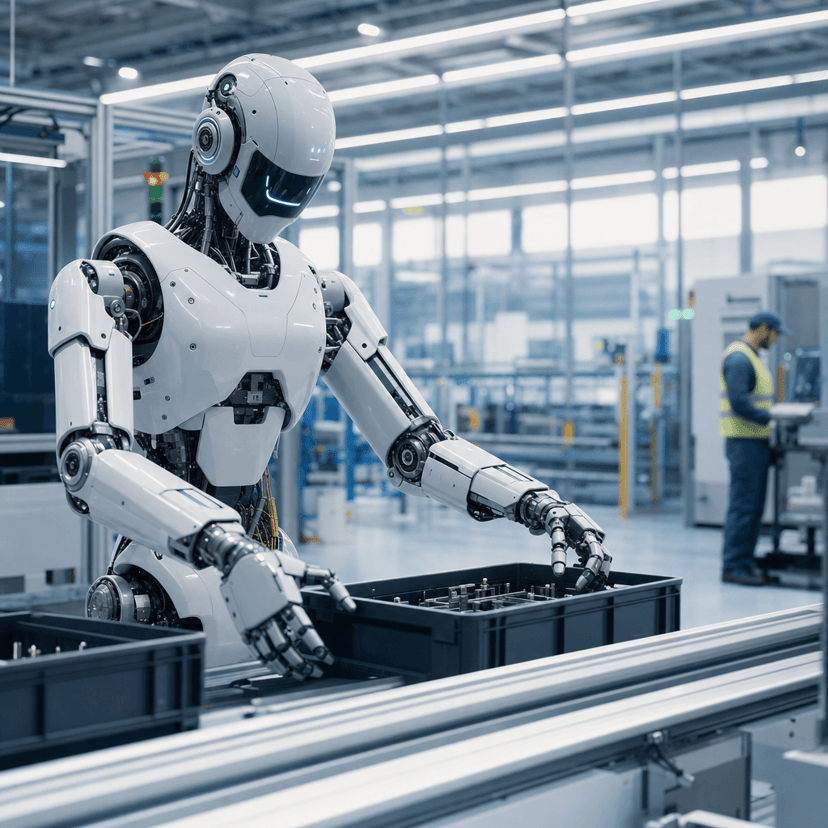
Amazon just made its boldest bet yet on humanoid robotics, acquiring Fauna Robotics in a deal that signals the retail giant's push beyond warehouse automation into consumer-facing robots. Fauna's flagship product, Sprout, is a 3.5-foot bipedal robot priced at $50,000 and explicitly designed to be "approachable and human-friendly" - a stark departure from the industrial bots that currently patrol Amazon's fulfillment centers. The move puts Amazon in direct competition with Tesla, which has been developing its Optimus humanoid, and marks a strategic shift toward robots that can work alongside humans rather than replace them.
Amazon is bringing humanoid robotics in-house. The company confirmed it's acquiring Fauna Robotics, a startup that's been developing Sprout, a bipedal robot that looks more like a friendly companion than an industrial workhorse. At $50,000 per unit and standing just 3.5 feet tall, Sprout represents a fundamentally different approach to robotics than the massive, industrial machines Amazon already deploys across its logistics network.
The acquisition comes as the humanoid robotics market enters a critical phase. While Amazon has pioneered warehouse automation with systems like its Proteus robots and Sparrow robotic arms, those machines were built for efficiency, not interaction. Sprout's explicit design goal of being "approachable and human-friendly" suggests Amazon sees a future where robots don't just move boxes but work directly with customers and employees.
Fauna Robotics had been operating relatively under the radar before this deal, but its core technology addresses one of the biggest challenges in humanoid robotics - making machines that humans actually want to be around. The $50,000 price point positions Sprout somewhere between industrial equipment and consumer products, potentially opening up applications in retail stores, hotels, healthcare facilities, and even home assistance.
The timing is notable. Tesla has been aggressively promoting its Optimus humanoid robot, with CEO Elon Musk claiming it could eventually be produced for around $20,000. Other players like Boston Dynamics, Figure AI, and Agility Robotics are all racing to commercialize humanoid platforms. Amazon's acquisition of Fauna suggests the company believes it's better to buy proven technology and talent than develop everything from scratch.
For Amazon, the strategic calculus is clear. The company already operates one of the world's largest robotics fleets, with over 750,000 robots working in its warehouses globally. But those machines are confined to controlled environments with minimal human interaction. Humanoid robots that can navigate unpredictable spaces and interact naturally with people open up entirely new business opportunities.
Think Amazon Go stores staffed by helpful robots, or Whole Foods with robotic assistants that can guide customers and restock shelves simultaneously. The same technology could power robots in Amazon's physical retail locations, its cloud computing data centers, or even be sold as a service to enterprise customers through AWS.
The deal also reflects broader industry momentum. Investment in humanoid robotics has surged over the past 18 months, with companies raising hundreds of millions to develop machines that can perform tasks in environments designed for humans. The technology is finally catching up to the ambition, thanks to advances in AI, computer vision, and battery efficiency.
But challenges remain. Bipedal robots are mechanically complex, expensive to manufacture, and notoriously difficult to make reliable. They need sophisticated AI to navigate real-world environments, understand human commands, and respond appropriately to unexpected situations. Fauna's emphasis on approachability suggests the company has made progress on the human-robot interaction front, which could be just as valuable to Amazon as the hardware itself.
Financial terms of the acquisition weren't disclosed, and Amazon declined to comment beyond confirming the deal. It's unclear whether Fauna will continue to operate independently or be absorbed into Amazon's existing robotics division. What is clear is that Amazon sees humanoid robots as more than a novelty - they're a strategic priority.
The acquisition positions Amazon to compete not just in logistics automation but in the emerging market for general-purpose humanoid robots. As these machines become more capable and affordable, they could transform industries from hospitality to healthcare. Amazon wants to make sure it's not just a customer for that technology but a leader in developing it.
Amazon's acquisition of Fauna Robotics marks a strategic evolution from pure warehouse automation to human-centric robotics. While competitors like Tesla chase the headlines with ambitious humanoid robot promises, Amazon is quietly assembling the pieces to deploy robots that can actually interact with customers and employees in real-world settings. The $50,000 Sprout may be just the beginning - if Amazon can scale the technology and drive costs down, humanoid robots could become as common in its retail operations as Alexa devices are in homes. The race to commercialize humanoid robotics just got a major new entrant with the resources and distribution to make it happen at scale.