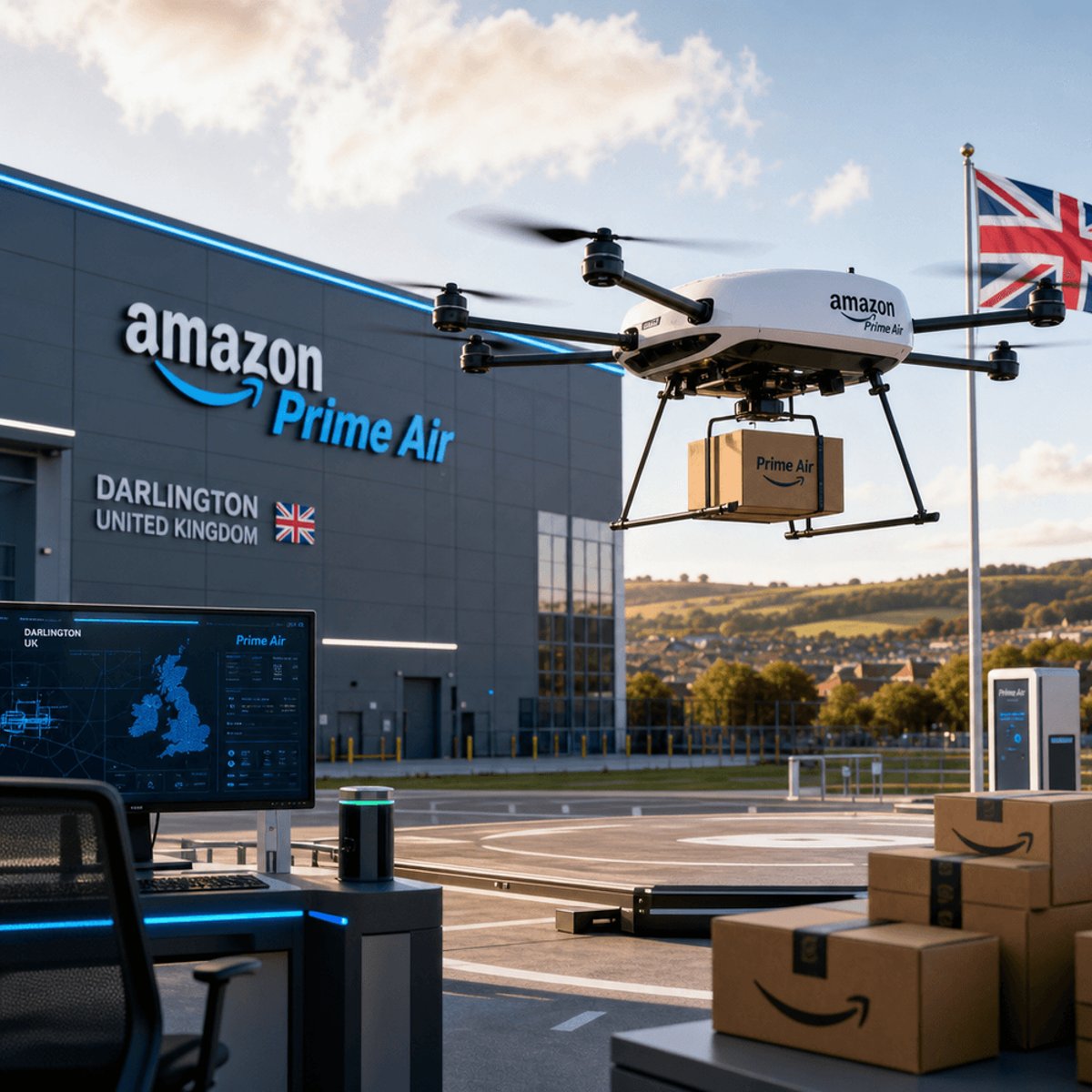
Amazon just took its drone delivery ambitions international. The e-commerce giant opened its first Prime Air facility outside the United States in Darlington, England, signaling a major expansion of its autonomous delivery network. The move comes as Amazon races to make aerial deliveries a mainstream reality while competitors like Alphabet's Wing and Walmart partner with drone startups to stake their claims in last-mile logistics.
Amazon just crossed the Atlantic with its drone delivery program, and the UK logistics landscape may never be the same. The company's new Prime Air facility in Darlington, England represents more than just geographic expansion - it's a test of whether autonomous aerial delivery can scale beyond American suburbs into Europe's denser, more regulated airspace.
The Darlington site is Amazon's first drone delivery operation outside the United States, where the program has been quietly refining its technology in College Station, Texas and Lockeford, California since 2022. But while those US sites served as proving grounds, the UK launch signals Amazon's confidence that the technology is ready for international markets with stricter aviation rules and different urban layouts.
The facility will initially serve select neighborhoods within Darlington, delivering packages weighing up to 5 pounds in under 60 minutes. That weight limit covers roughly 85% of items Amazon ships, according to logistics analysts - everything from phone chargers to paperback books can theoretically arrive by air. The drones operate autonomously using computer vision and machine learning to navigate around obstacles, drop packages in backyards, and return to base without human pilots.
But Amazon isn't flying solo in this space. Alphabet's Wing has been delivering via drone in parts of Australia and Finland for years, while Walmart partnered with DroneUp and Zipline to test deliveries across multiple US states. The difference is scale and integration - Amazon controls the entire stack from warehouse to doorstep, while competitors rely on third-party partnerships that can slow deployment.
The UK's Civil Aviation Authority granted Amazon approval after months of safety testing and community consultation. British airspace regulations are notoriously strict, making this approval a significant regulatory win that could open doors across Europe. If Amazon can operate safely in England's congested skies, the argument goes, it can operate anywhere.
Darlington wasn't chosen randomly. The northeastern England town offers a mix of suburban density and open spaces - perfect for testing how drones handle varied terrain while serving a meaningful customer base. Local officials embraced the program, seeing it as a tech investment that puts their region on the innovation map. Amazon promised the facility would create dozens of jobs for drone technicians, logistics coordinators, and support staff.
The timing is strategic too. E-commerce growth has plateaued in mature markets, pushing Amazon to compete on delivery speed rather than selection. Drone delivery slashes last-mile costs - the most expensive part of shipping - while offering a customer experience competitors can't match. Getting a package in 30 minutes without paying extra delivery fees could reset consumer expectations for what "fast shipping" means.
Critics point out that weather remains a major constraint. Drones can't fly safely in heavy rain, strong winds, or low visibility - conditions England experiences regularly. Amazon's drones are rated for light precipitation, but a typical British winter could ground the fleet for days at a time. The company hasn't disclosed how it will handle seasonal variations or what happens when drone delivery simply isn't possible.
There are privacy concerns as well. Hovering drones equipped with cameras raise questions about surveillance, even though Amazon insists the imaging systems only identify landing zones and obstacles. Local privacy advocates have called for clear guidelines about flight paths and data retention, issues that will likely surface in every new market Amazon enters.
Still, the infrastructure investment is real. Amazon built a dedicated drone hub with charging stations, maintenance bays, and a control center staffed around the clock. The facility can launch multiple drones simultaneously, routing them through algorithmically optimized flight paths that avoid each other and manned aircraft. It's logistics choreography at a scale no one has attempted before.
The UK launch also positions Amazon ahead of regulatory curves elsewhere in Europe. As the European Union develops continent-wide drone delivery frameworks, Amazon can point to operational data from Darlington to shape those rules in its favor. First-mover advantage in aviation regulation is worth millions in avoided compliance costs down the line.
For Darlington residents who opt in, the experience is surprisingly simple. They order as usual through the Amazon app, and eligible items show up with a drone delivery option. If they select it, they get a notification when the drone is approaching and another when it's landed in their yard. The package drops from about 12 feet via a small winch system, then the drone ascends and flies back to base. Total delivery time from order to doorstep averages 45 minutes.
Whether this becomes the future of delivery or remains a niche offering depends largely on economics Amazon hasn't fully disclosed. Drones require significant upfront infrastructure investment, and it's unclear at what delivery volume the unit economics make sense compared to traditional vans. But Amazon has patience and capital to burn while it figures that out - luxuries most competitors lack.
Amazon's Darlington drone hub is more than a logistics experiment - it's a statement about where retail delivery is headed. By planting its flag in the UK before competitors, Amazon gains operational data, regulatory credibility, and customer insights that will shape autonomous delivery globally. The real question isn't whether drone delivery works technically - Amazon has proven that in Texas and California. It's whether consumers will embrace it at scale, and whether the economics justify the infrastructure investment. Darlington gives Amazon a year or two head start on answering those questions in international markets, and in the race to redefine last-mile delivery, that lead could prove decisive.