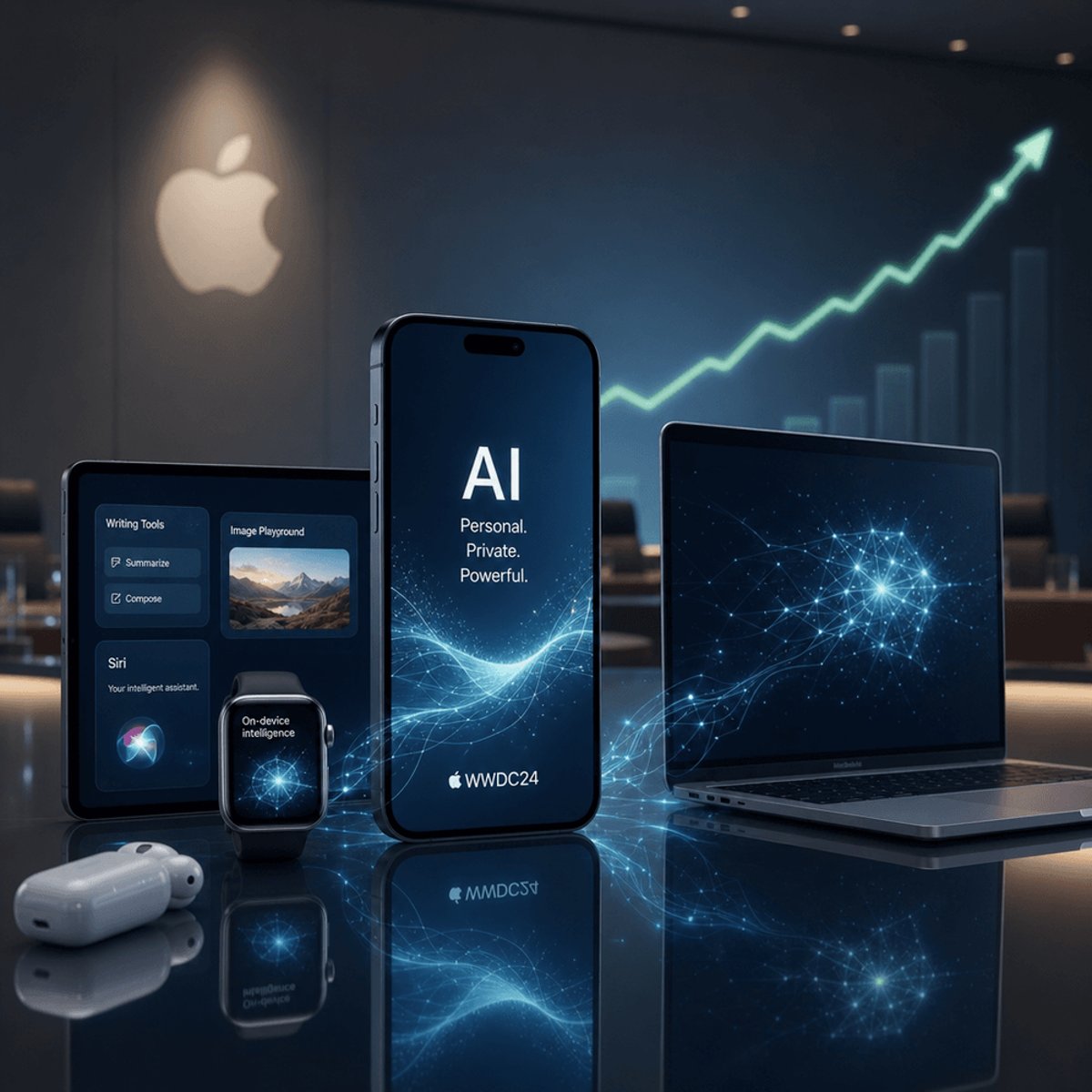
Apple stock is riding a wave of momentum heading into next week's Worldwide Developers Conference, with investors laser-focused on one thing: Apple Intelligence. The rally comes as Wall Street bets the company will finally detail its AI strategy in a way that justifies recent gains and proves it can compete with Microsoft, Google, and other tech giants that have already gone all-in on artificial intelligence. What Apple announces at WWDC could either validate the current stock price or leave investors questioning whether the hype was premature.
Apple finds itself in an unusual position heading into WWDC 2026 - riding high on investor optimism while still needing to prove it belongs in the AI conversation. The stock has climbed steadily in recent weeks as anticipation builds around what the company will reveal about Apple Intelligence, its long-awaited answer to the generative AI boom that's reshaped the tech landscape.
For investors buying at these levels, it's all about the AI bet. Microsoft and Google have already demonstrated revenue growth from their AI integrations, while OpenAI continues to dominate mindshare with ChatGPT. Apple, meanwhile, has been conspicuously quiet - a strategy that's both frustrated analysts and created pent-up expectations for a major reveal.
The stakes at this year's WWDC are higher than usual. Developers and investors alike want to see not just flashy demos but concrete products that leverage Apple's unique strengths: its massive installed base, tight hardware-software integration, and privacy-first approach. According to market observers cited by CNBC, the company needs to demonstrate that Apple Intelligence isn't just a rebranding exercise but a genuine platform that will drive the next upgrade cycle.
The timing is critical. Apple's iPhone sales have shown signs of stagnation in key markets, and the company needs a compelling reason for users to upgrade beyond incremental camera improvements. AI features that work seamlessly across iPhone, iPad, and Mac - and that respect user privacy in ways competitors can't match - could be that catalyst. But the features need to be ready now, not promised for some distant future release.
Investors are particularly focused on how Apple will differentiate its AI approach. While Google leverages cloud-based models and Microsoft has tied its future to OpenAI, Apple has hinted at on-device processing that keeps user data private. If the company can deliver AI experiences that feel magical while maintaining its privacy credentials, it could justify the premium valuation that's already baked into the stock price.
The developer community will also be watching closely. Apple needs third-party apps to embrace Apple Intelligence APIs to make the platform feel comprehensive rather than limited to first-party apps. That means the tools and frameworks announced at WWDC need to be powerful, easy to implement, and available immediately - not in beta for months.
Wall Street's expectations have created a high bar. Analysts want to see AI features that will ship with iOS 20 this fall, not vague roadmaps. They want demonstrations of real-world use cases that will make consumers open their wallets. And they want evidence that Apple's chip designs give it an advantage in running sophisticated models on-device without destroying battery life.
The stock's recent run-up suggests investors believe Apple will deliver. But that also means there's limited room for disappointment. A lackluster WWDC presentation, features that won't ship until 2027, or AI capabilities that feel derivative rather than revolutionary could trigger a sharp selloff as reality fails to meet inflated expectations.
Apple has historically excelled at being a fast follower rather than a first mover - letting others pioneer categories before perfecting the execution. That playbook worked for smartphones, tablets, and smartwatches. The question now is whether it can work for AI, where network effects and data advantages compound quickly for early leaders.
The company's vast resources and talent pool give it fighting chances. Its control over hardware, operating systems, and services creates integration opportunities that pure software players can't match. And its brand loyalty means users might choose Apple's AI features even if they're not technically superior, as long as they're good enough and more trustworthy.
But good enough won't satisfy investors who've bid up the stock in anticipation of something special. Next week's WWDC needs to show that Apple Intelligence is more than a marketing term - it needs to be a platform that redefines what's possible with AI on personal devices while staying true to Apple's values. Anything less could leave the stock searching for support.
Apple stands at a pivotal moment as WWDC approaches. The stock's recent strength reflects genuine optimism that the company will finally show its AI hand in a compelling way, but it also creates pressure to deliver something extraordinary. Investors betting on Apple at these levels are essentially wagering that the company's deliberate approach will pay off with AI features that feel distinctly Apple - private, integrated, and essential. If next week's announcements live up to that promise, the stock rally could extend further. But if Apple Intelligence feels half-baked or derivative, those same investors will quickly reassess whether the AI premium was justified. The developer conference isn't just about software updates anymore - it's about validating whether Apple deserves a seat at the AI table alongside Microsoft, Google, and OpenAI.