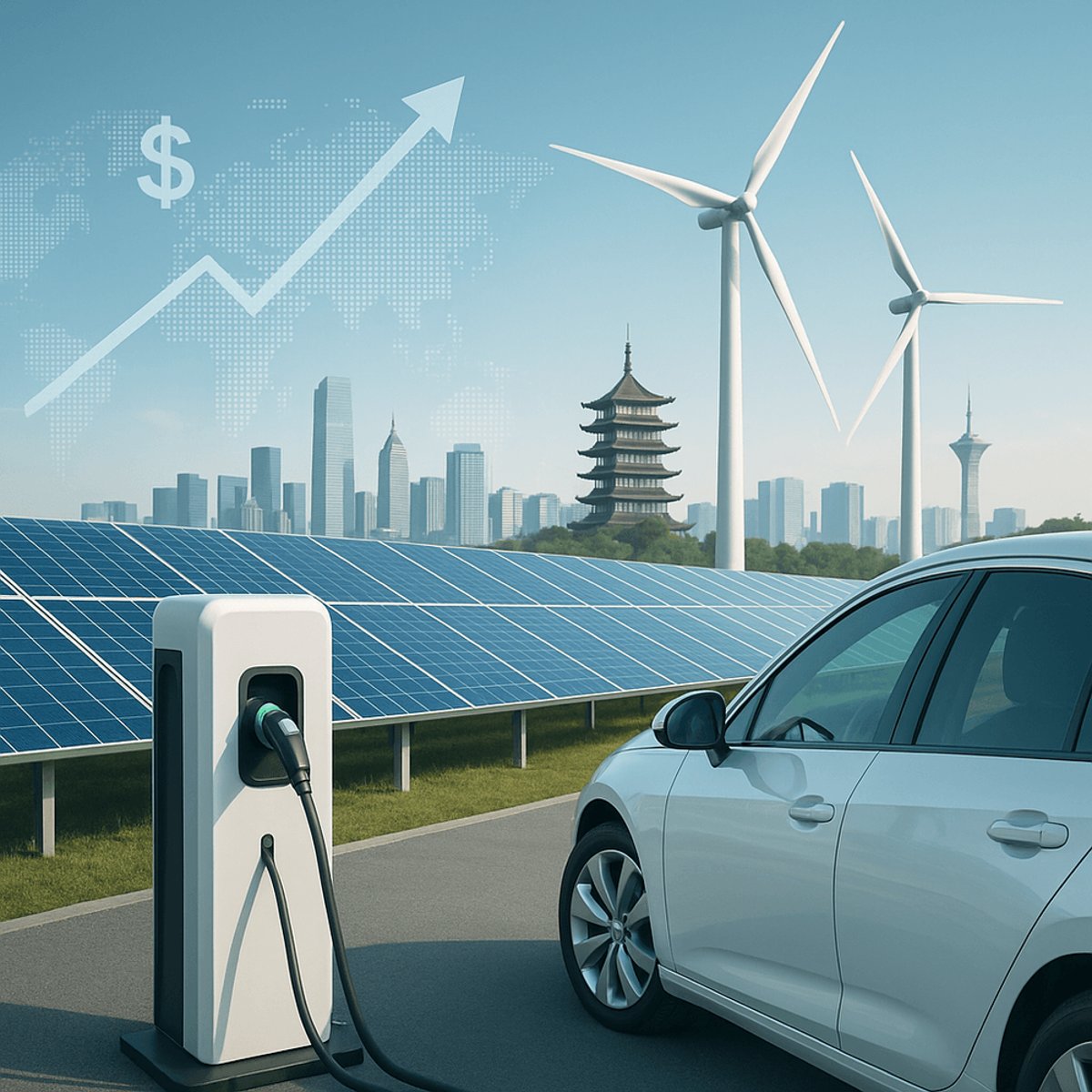
China just threw down a $625 billion gauntlet in the clean energy race. While the US retreats from climate commitments, Beijing announced its first-ever pledge to actually cut emissions - not just slow their growth - targeting a 7-10% reduction by 2035. The move comes as China already dominates global renewable energy investment, spending nearly a third of the world's total last year alone.
China just made the biggest clean energy bet in history while America heads in the opposite direction. At last week's UN Climate Summit in New York, President Xi Jinping laid out a $625 billion strategy that's already reshaping global energy markets - and leaving other world powers scrambling to keep up.
The timing couldn't be more stark. While Tesla and other American companies navigate Trump's renewed Paris Agreement withdrawal, China committed to its first absolute emissions reduction target: cutting greenhouse gases 7-10% by 2035. It's a fundamental shift from Beijing's previous approach of merely slowing emissions growth tied to economic expansion.
"Despite some countries going against the trend, the international community should stay on the right track," Xi said in what observers saw as a clear jab at Trump's climate reversals. The Chinese president didn't need to name names - the contrast speaks for itself.
The numbers back up China's climate leadership claims. According to Chatham House senior advisor Bernice Lee, China's $625 billion clean energy investment last year represents nearly a third of global spending. That massive domestic market has become "a formidable driver" in bringing down renewable technology costs worldwide, she notes.
But Xi's UN speech revealed just how ambitious Beijing's plans really are. The country aims to reach 3,600 gigawatts of installed wind and solar capacity by 2035 - six times its 2020 figures. To put that in perspective, that's more renewable capacity than the entire US currently has across all energy sources combined.
"The rise of Chinese renewables is reshaping the global economy and replacing coal in the domestic market," Lee told Wired. The ripple effects extend far beyond China's borders as massive production scales drive down prices globally.
The electric vehicle sector showcases this dynamic perfectly. China hosts automotive giants like BYD and battery supplier Catl, which powers roughly 50 global brands including Tesla and Volkswagen. Xi announced plans to make EVs "mainstream" in Chinese sales, leveraging the country's control over rare earth minerals essential for battery production.
Not everyone's impressed with the pace, though. William Lamb from the Potsdam Institute for Climate Impact Research points out that China's promised 1% annual emissions decline lags behind industrialized nations. Italy has cut emissions 3.2% yearly since 2006, the UK by 2.8% since 2004, and France by 2.3%.
But Andreas Sieber from climate nonprofit 350.org sees potential upside. "China has often promised little and achieved much," he notes, suggesting Beijing might overdeliver. The country's centralized system also means policies won't face election-cycle reversals like in democratic nations.
The geopolitical implications run deep. While the EU offered only "drab declarations" at the UN Summit and India remains largely inactive on climate, China finds itself in the unusual position of climate leadership by default. It's not necessarily a title Beijing sought, but one that fell to them as other powers retreated.
Xi's broader commitments include expanding carbon trading markets to more emission-intensive sectors and increasing forest coverage to 34 billion cubic meters. The renewable energy mix target of 30% by 2035, while modest, represents steady progress from a country that burned more coal than the rest of the world combined just a decade ago.
The real test isn't China's commitments but whether other nations follow Beijing's example rather than America's retreat. With Chinese universities churning out climate tech research and attracting international scientists, the technological momentum appears solidly behind the clean energy transition.
Market forces are already responding. The dramatic drop in renewable technology prices, driven largely by Chinese manufacturing scale, makes clean energy increasingly competitive with fossil fuels globally. Even skeptical governments find it hard to argue against cheaper electricity.
What makes this moment particularly significant is the vacuum China's filling. The world looked very different during 2021's COP26 conference, when climate action seemed like a global priority. Russia's Ukraine invasion, subsequent energy crises, and political shifts have pushed climate down many agendas - except in Beijing.
China's $625 billion clean energy bet isn't just reshaping global markets - it's redefining climate leadership itself. While other major economies retreat or stagnate on environmental commitments, Beijing's massive investments and technological scale are driving down renewable costs worldwide. The question isn't whether China can hit its emissions targets, but whether its example will inspire other nations to accelerate their own transitions or leave them further behind in the clean energy race. With Chinese renewable tech already powering global supply chains and the country's domestic market becoming a proving ground for next-generation technologies, the momentum seems firmly on Beijing's side.