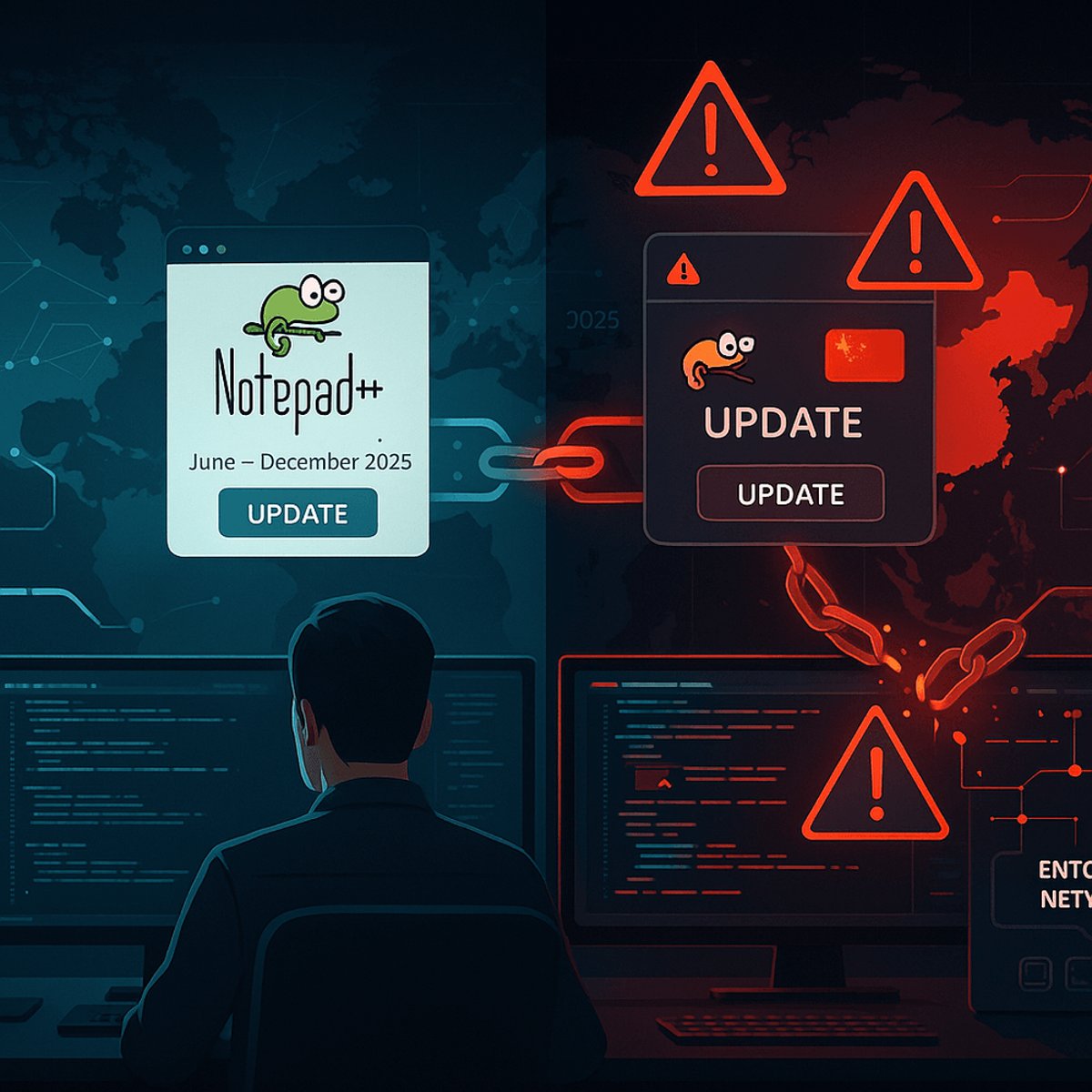
Chinese government-linked hackers hijacked the update mechanism of Notepad++, one of the world's most popular open-source text editors, delivering malicious software to targeted users for six months. The supply chain attack, which ran from June through December 2025, represents a significant escalation in nation-state cyber operations targeting developer tools. With tens of millions of downloads globally, the breach raises urgent questions about open-source security and the vulnerability of critical development infrastructure.
A sophisticated supply chain attack has shaken the open-source community. Notepad++, the beloved text editor used by millions of developers worldwide, just confirmed that Chinese government hackers infiltrated its update mechanism and delivered tainted software to carefully selected targets for half a year.
Developer Don Ho broke the news Monday in a security advisory that detailed how attackers weaponized his two-decade-old project between June and December 2025. The admission comes after security researcher Kevin Beaumont first spotted the intrusion in December, observing suspicious activity affecting organizations with East Asian interests.
"The cyberattack was likely carried out by hackers associated with the Chinese government," Ho wrote, citing analysis from security experts. "This would explain the highly selective targeting" that characterized the campaign. The precision of the attack stands out - rather than carpet-bombing all users, the hackers carefully chose their victims, suggesting intelligence gathering rather than ransomware or crypto-mining motivations.
The technical execution reveals sophisticated tradecraft. Attackers didn't compromise Notepad++'s source code directly. Instead, they exploited a vulnerability in the shared hosting server where the project's website lived. By targeting Notepad++'s web domain specifically, they could redirect certain users requesting software updates to attacker-controlled servers. Those unlucky enough to hit the malicious endpoint received compromised versions of the software that gave hackers "hands-on" access to their machines.
Beaumont's initial investigation found the breach affected "a small number of organizations" - though neither he nor Ho disclosed exact figures. The developer didn't respond to questions about the scope by publication time, leaving critical details about victim count and data exposure unanswered. What's clear is that the attackers maintained persistence for months, quietly collecting intelligence from compromised systems.
The attack vector got shut down in stages. Notepad++ version 8.8.9, released in November, patched the underlying bug the hackers were exploiting. By early December, the attackers' access was fully terminated. Ho noted that logs show the threat actors attempted to re-exploit the fixed vulnerabilities afterward, but the patches held.
"We do have logs indicating that the bad actor tried to re-exploit one of the fixed vulnerabilities; however, the attempt did not succeed after the fix was implemented," Ho wrote in his disclosure. The developer apologized for the incident and urged all users to download the latest version 8.9.1, which contains comprehensive security fixes.
The Notepad++ compromise draws immediate comparisons to the SolarWinds breach that rocked the cybersecurity world in 2020. Russian intelligence operatives infiltrated that company's build system and planted backdoors in software updates pushed to Fortune 500 customers and government agencies. The attack compromised the Departments of Homeland Security, Commerce, Energy, Justice, and State, exposing the catastrophic risks of supply chain attacks.
But there are key differences. SolarWinds was a commercial vendor with enterprise customers and security obligations. Notepad++ is an open-source passion project maintained largely by one developer. The resource disparity highlights a growing security crisis - critical developer tools that millions depend on often lack the security infrastructure of commercial software.
The "exact technical mechanism" of how hackers initially breached the servers remains under investigation, Ho acknowledged. That uncertainty will likely fuel ongoing forensic work and raise questions about what other access the attackers may have gained. The targeting of East Asian interests suggests this was an espionage operation, potentially aimed at stealing intellectual property or monitoring geopolitical developments.
For the open-source ecosystem, the breach serves as a wake-up call. Notepad++ has been downloaded tens of millions of times and is a staple tool for developers, sysadmins, and technical professionals globally. Its ubiquity made it an attractive target - compromise one widely-used tool and gain access to countless high-value networks. The attack demonstrates that nation-state actors are increasingly targeting the software supply chain at its most vulnerable points.
Security teams at organizations using Notepad++ now face urgent incident response work. They need to identify which employees downloaded updates during the June-December window, determine if those versions were compromised, and hunt for indicators of attacker activity on affected systems. The selective nature of the targeting means most users are likely unaffected, but those in sensitive industries or with East Asian exposure should treat this as a potential breach.
The Notepad++ breach exposes the fragile security foundations underneath much of the software industry. As nation-state actors increasingly target the supply chain, the line between trusted development tools and attack vectors continues to blur. For organizations, the immediate action is clear - update to version 8.9.1 or later and conduct forensic reviews of systems that may have received compromised updates. But the larger question looms: how do we secure the open-source infrastructure that powers modern technology when maintainers often work alone, without enterprise security resources? The answer will shape not just Notepad++'s future, but the security posture of the entire developer ecosystem.