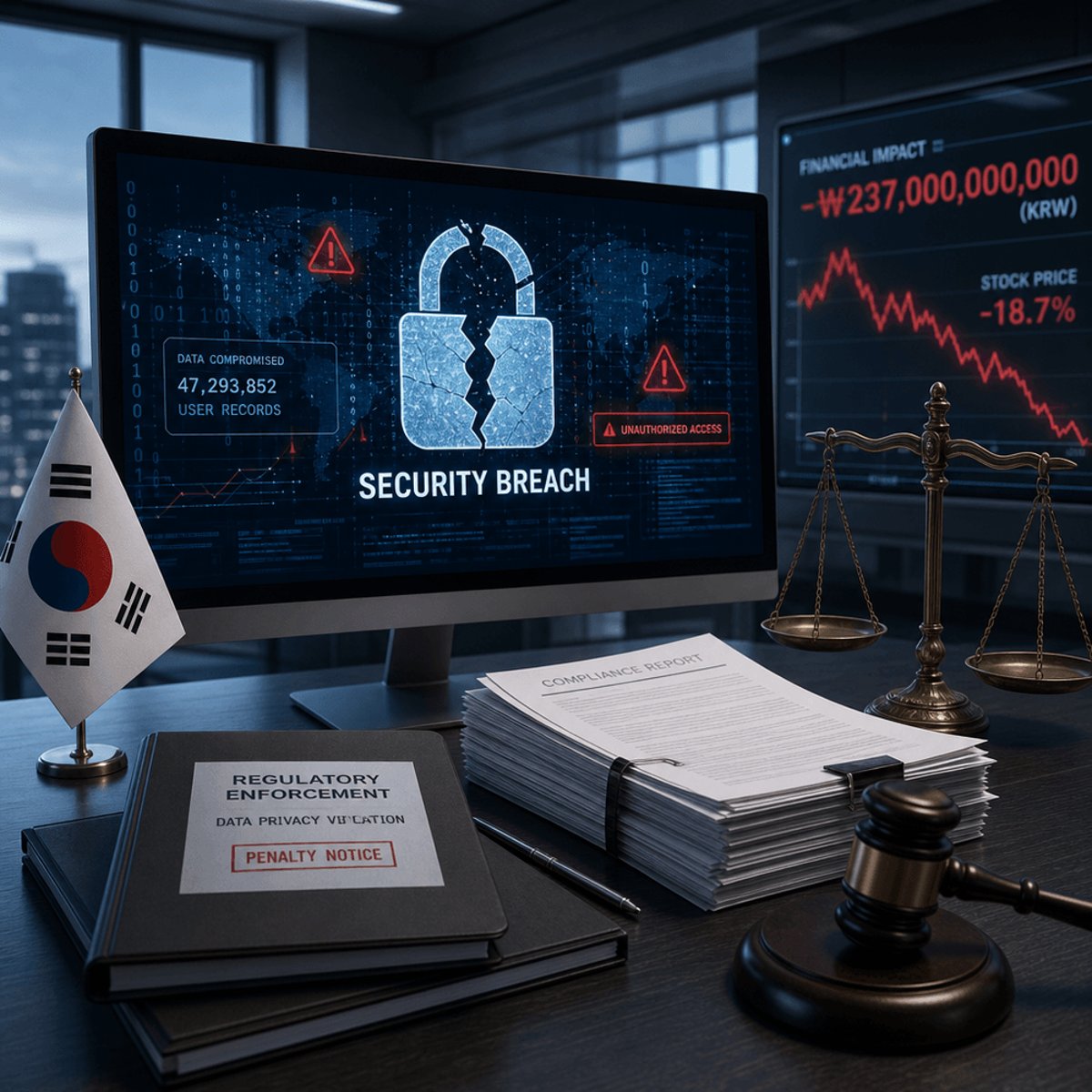
South Korea just dropped the hammer on Coupang with a record-breaking $400 million fine following a data breach that exposed personal information of over 30 million customers. The penalty marks the largest enforcement action in South Korean history for data protection violations and signals a dramatic escalation in how regulators are holding tech companies accountable for security failures. For an e-commerce platform that's been dubbed the 'Amazon of South Korea,' the fine represents a watershed moment in Asia-Pacific data privacy enforcement.
Coupang, South Korea's dominant e-commerce platform, is reeling from a record-breaking $400 million fine issued by South Korean authorities after a massive data breach compromised the personal information of more than 30 million customers. The penalty, announced Thursday, represents the most severe data protection enforcement action in the country's history and sends shockwaves through the tech industry about the real cost of security failures.
The breach affected roughly 30 million users - nearly 60% of South Korea's total population - making it one of the most significant data exposures in the Asia-Pacific region. According to reports from TechCrunch, South Korean regulators determined that Coupang failed to implement adequate security measures to protect customer data, a violation that left millions vulnerable to identity theft and fraud.
The scale of the penalty reflects how seriously regulators are taking data protection in an era where breaches have become almost routine. South Korea's Personal Information Protection Commission doesn't mess around - they've been steadily ramping up enforcement, but this fine dwarfs previous actions. For context, most previous penalties in the region barely scratched eight figures. The $400 million hit to Coupang demonstrates that regulators are done treating data breaches as mere compliance hiccups.
Coupang's breach joins a growing list of massive security failures that have exposed the fragility of enterprise data protection systems. The company, which has positioned itself as South Korea's answer to Amazon with rapid delivery services and an expanding ecosystem of offerings, now faces not just the immediate financial penalty but potential long-term damage to customer trust. In a market where convenience and reliability drive customer loyalty, a breach of this magnitude could prove more costly than the fine itself.
The timing couldn't be worse for Coupang. The company has been aggressively expanding its services beyond basic e-commerce, pushing into streaming content, food delivery, and financial services. Each of these verticals requires collecting and storing even more sensitive customer data. The breach raises uncomfortable questions about whether the company's security infrastructure kept pace with its rapid growth, or if it prioritized expansion over the unsexy work of hardening its systems.
What's particularly striking about this enforcement action is how it reflects a broader shift in regulatory attitudes across Asia-Pacific markets. While Europe's GDPR has grabbed headlines with massive fines against tech giants, Asian regulators have historically been more cautious. This $400 million penalty suggests that era is ending. South Korea is sending a clear message that data protection isn't optional, and companies that fail to invest in proper security will pay dearly.
The breach also highlights a critical vulnerability in how e-commerce platforms handle customer data at scale. Coupang processes millions of transactions daily, each generating data points about purchasing habits, payment information, delivery addresses, and personal preferences. When security fails at this scale, the exposure isn't just about email addresses and passwords - it's about detailed profiles that can enable sophisticated fraud and social engineering attacks.
For enterprise security teams watching this unfold, the message is unmistakable: regulators are done accepting breach notification letters and promises to do better. The $400 million fine works out to roughly $13 per affected customer - a per-record cost that should make every CISO recalculate their security budgets. It's no longer enough to meet minimum compliance standards; companies need to demonstrate proactive security measures that can withstand determined attacks.
The penalty also arrives as South Korea positions itself as a tech powerhouse in artificial intelligence, semiconductors, and advanced manufacturing. The country can't afford to be seen as weak on data protection if it wants to attract global tech investment and partnerships. By making an example of one of its most prominent tech companies, South Korean regulators are establishing credibility that could prove crucial as they negotiate data sharing agreements and cross-border tech partnerships.
What happens next will be closely watched across the industry. Coupang will likely appeal the fine, and the final amount could be negotiated down. But the precedent is set. Other e-commerce platforms, fintech companies, and digital service providers operating in South Korea - or anywhere in Asia - now know that massive penalties are on the table if they cut corners on security.
The record $400 million fine against Coupang marks a turning point in how Asian regulators enforce data protection standards. This isn't just about one company's security failure - it's a clear signal that the era of relatively modest penalties for massive breaches is over. For tech companies operating across Asia-Pacific markets, the calculus has changed. Investing in robust security infrastructure is no longer a cost center to minimize but a fundamental business imperative. As regulators gain confidence and coordination, expect more enforcement actions at this scale. The question for every platform handling customer data is simple: can your security measures withstand both determined attackers and increasingly aggressive regulators? For Coupang, the $400 million answer is a resounding no.