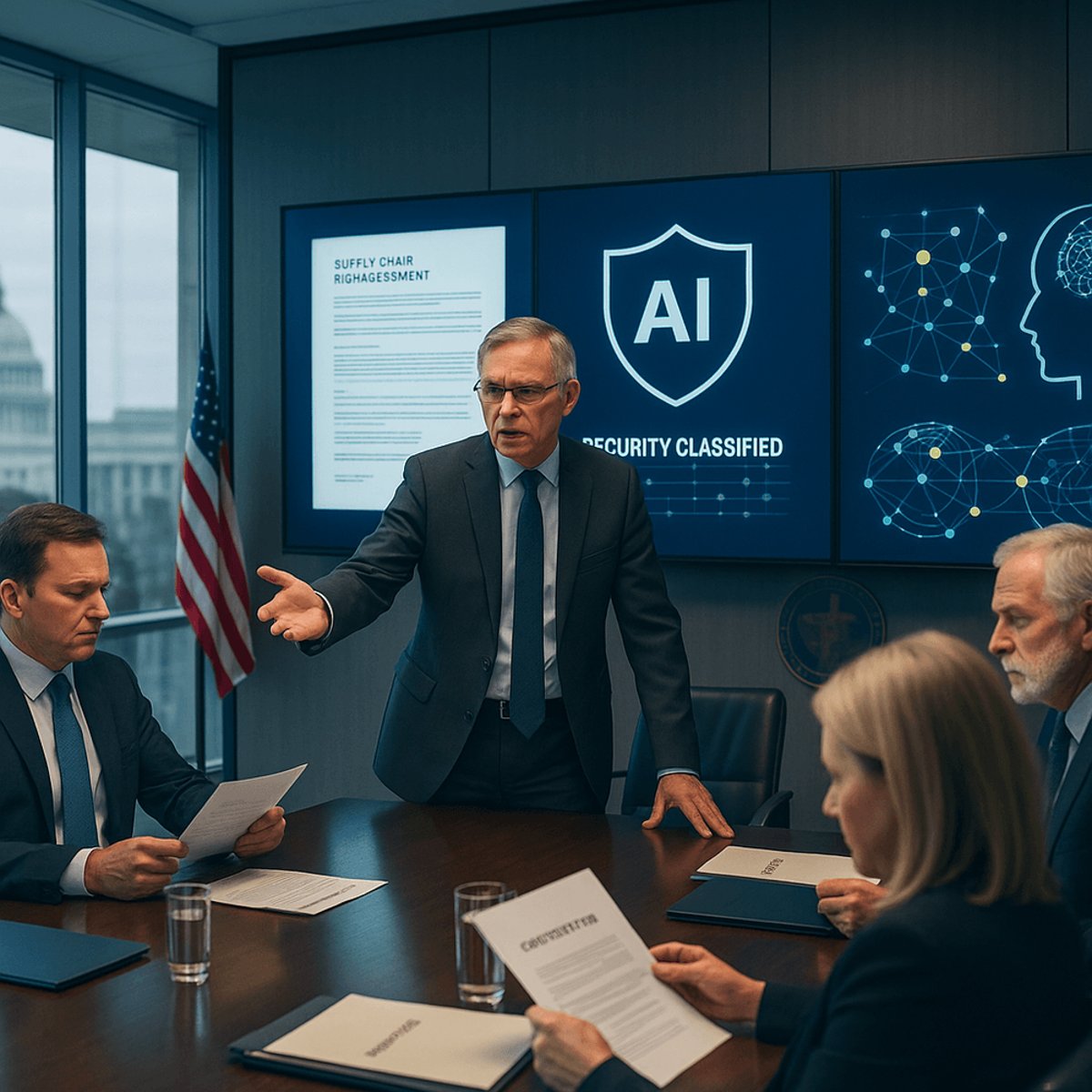
A group of former defense and intelligence officials is calling on Congress to investigate the Pentagon's controversial decision to label Anthropic as a supply chain risk, marking an unprecedented pushback against the Department of Defense's recent move that has already forced government contractors to drop the AI company's Claude chatbot. The letter, sent to key Congressional committees, warns the designation sets a dangerous precedent that could undermine America's AI competitiveness at a critical moment in the global tech race.
The Pentagon's quiet addition of Anthropic to its supply chain risk list just triggered a political firestorm. Former defense and intelligence officials are now publicly challenging the Department of Defense, urging Congress to investigate what they're calling an unprecedented and potentially damaging move against one of America's leading AI companies.
The letter, sent to Congressional oversight committees this week, represents a rare public split between former national security insiders and current Pentagon leadership. According to sources familiar with the matter, the signatories include veterans of multiple administrations who worry the DoD's decision could backfire spectacularly, pushing cutting-edge AI capabilities away from government use just as China accelerates its own military AI programs.
The controversy erupted after the Pentagon quietly added Anthropic to its supply chain risk designation list, effectively banning government contractors from using the company's Claude AI assistant. The move sent shockwaves through the defense tech ecosystem, with contractors scrambling to rip out Claude integrations and switch to alternatives. Some companies told CNBC they received less than 72 hours notice to comply or risk losing federal contracts worth millions.
What makes this case unusual is Anthropic's profile. Unlike Chinese-owned companies that have faced similar restrictions, Anthropic is a San Francisco-based company backed by Google, Amazon, and prominent Silicon Valley investors. The company has positioned itself as a leader in AI safety, often citing its constitutional AI approach designed to make models more controllable and aligned with human values.
The former officials' letter argues the Pentagon failed to provide adequate justification for the designation. They point out that Anthropic has no apparent ties to adversarial nations, maintains rigorous security practices, and has actively sought government partnerships. One signatory told reporters the decision appears to stem from bureaucratic confusion rather than legitimate security concerns, potentially reflecting deeper dysfunction in how the DoD evaluates commercial AI providers.
The timing couldn't be worse for US-China AI competition. While the Pentagon restricts access to American AI companies, Beijing is pouring billions into military AI applications with few bureaucratic hurdles. Former intelligence officials warn that overly restrictive policies could hand China a strategic advantage, particularly as the PLA rapidly integrates AI into weapons systems, logistics, and intelligence analysis.
The commercial fallout has been swift and severe. Defense contractors who had invested heavily in Claude-powered systems for everything from document analysis to code generation are now facing costly migrations to alternative platforms. Some are switching to OpenAI's GPT models, while others are exploring Microsoft's Azure AI services. But the sudden disruption has left projects delayed and budgets strained.
Industry observers see broader implications for AI-defense partnerships. If the Pentagon can blacklist a respected American AI company with minimal transparency, what message does that send to other tech firms considering government work? Some venture capitalists are already advising portfolio companies to think twice before pursuing defense contracts, worried that bureaucratic whims could destroy business models overnight.
Congressional staffers confirm that multiple committees are now reviewing the matter. The House Armed Services Committee and Senate Intelligence Committee have both requested briefings from Pentagon officials to explain the rationale behind Anthropic's designation. One senior staffer described the situation as a potential watershed moment for how Congress oversees military AI procurement and vetting processes.
The letter's signatories are pushing for formal oversight hearings and demanding the Pentagon release its assessment criteria for supply chain risk designations. They argue current processes lack transparency and accountability, creating an environment where political considerations or interagency rivalries could influence decisions that should be purely security-based. The stakes extend beyond Anthropic to the entire relationship between Silicon Valley and Washington.
What happens next could reshape the defense tech landscape for years. If Congress sides with the former officials and pressures the Pentagon to reverse course, it would signal that commercial AI companies have political cover to challenge questionable security designations. But if the DoD's decision stands, expect a chilling effect across the industry as companies weigh the reputational and financial risks of deep government engagement against the uncertainty of arbitrary blacklisting.
The defense establishment's rare public challenge to Pentagon leadership over Anthropic signals deeper tensions about how America manages AI innovation in an era of strategic competition. Whether Congress investigates or the DoD doubles down, this confrontation will define the rules of engagement between commercial AI developers and national security agencies for the next decade. For Anthropic, the company's reputation as a safety-focused AI leader now collides with the harsh reality of Washington bureaucracy, where perception and process can matter more than technical merit. The resolution will either validate concerns about government overreach in tech regulation or confirm that even prominent American AI companies aren't immune from security scrutiny.