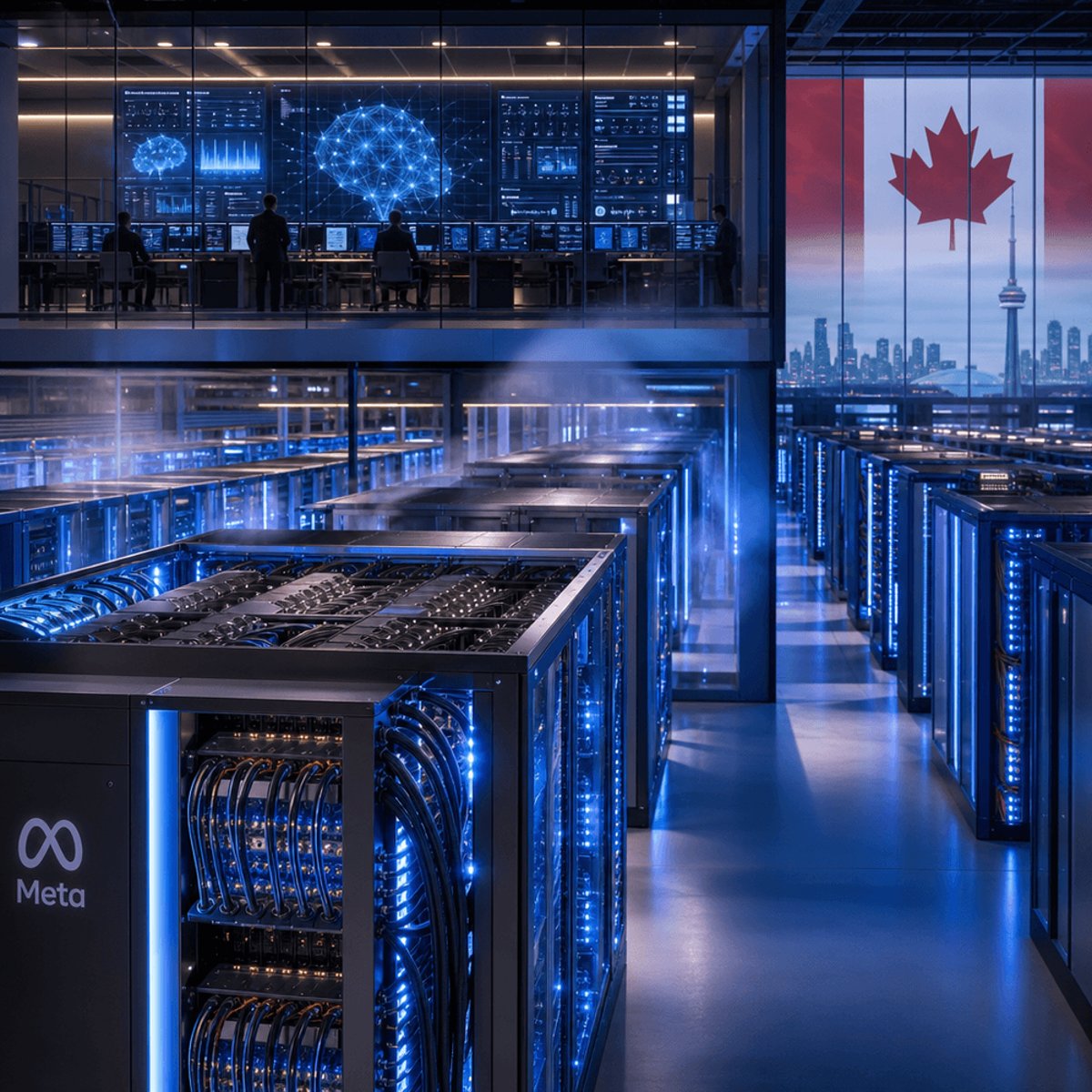
Meta is building its first major data center in Canada, marking a significant expansion of the company's AI infrastructure beyond U.S. borders. The move signals Meta's aggressive push to scale its artificial intelligence capabilities while diversifying its global computing footprint. As demand for AI processing power intensifies across the tech industry, the Canadian facility will join Meta's growing network of hyperscale data centers that power everything from Instagram recommendations to its ambitious Llama large language models.
Meta just made its first major infrastructure bet north of the border. The social media giant confirmed plans to build a large-scale data center in Canada, its first significant facility in the country as it races to expand computing capacity for artificial intelligence workloads.
The announcement comes as Meta doubles down on AI across its product lineup, from recommendation algorithms that power Facebook and Instagram feeds to its open-source Llama language models that compete directly with OpenAI's GPT and Google's Gemini. CEO Mark Zuckerberg has repeatedly emphasized that AI infrastructure represents the company's single largest capital expenditure priority through 2026.
While Meta hasn't disclosed the specific location, investment amount, or construction timeline, the Canadian expansion fits a broader pattern of tech giants diversifying their data center footprints. Amazon Web Services, Google Cloud, and Microsoft Azure have all established significant Canadian presence over the past five years, drawn by competitive electricity rates, cooler climates that reduce cooling costs, and proximity to major metropolitan areas.
Canada's appeal for data center operators goes beyond geography. The country offers access to renewable hydroelectric power in provinces like Quebec and British Columbia, aligning with Meta's 2030 net-zero emissions commitments. Provincial governments have also rolled out aggressive incentives to attract tech infrastructure investments, recognizing the long-term economic benefits of high-paying construction jobs and ongoing technical operations roles.
Meta currently operates more than a dozen hyperscale data centers globally, with major concentrations in Iowa, North Carolina, Georgia, and international locations including Ireland, Sweden, and Singapore. The company's infrastructure buildout has accelerated dramatically since 2023, when it shifted strategic focus toward AI following years of heavy metaverse investments that failed to gain traction.
The timing of the Canadian expansion is significant. Industry analysts estimate that training a single large language model can require computing resources equivalent to powering a small city for weeks. As Meta continues developing and refining its Llama models while integrating AI features across WhatsApp, Messenger, and its core social platforms, the demand for processing power continues climbing exponentially.
Competitors aren't standing still. Google recently announced plans to invest billions in Canadian cloud infrastructure expansion, while Microsoft has been steadily growing its Canadian Azure regions to support enterprise AI workloads. The race for data center capacity has become inseparable from the race for AI dominance, with infrastructure constraints increasingly determining which companies can effectively train and deploy cutting-edge models.
Meta's infrastructure strategy differs notably from pure AI labs like OpenAI, which rely heavily on partnerships with Microsoft for computing resources. By building and controlling its own data centers, Meta maintains greater flexibility over hardware configurations, network architecture, and the ability to optimize specifically for its AI workloads rather than general-purpose cloud computing.
The Canadian facility will likely feature the latest generation of Nvidia GPUs or potentially custom AI accelerators that Meta has been developing internally. The company has invested heavily in designing specialized chips optimized for inference workloads, the process of running trained AI models at scale to serve billions of users daily.
What remains unclear is how quickly Meta can bring the Canadian facility online. Typical hyperscale data center projects require 18-24 months from groundbreaking to operational status, though lead times for critical equipment like transformers and advanced cooling systems have stretched in recent years due to surging global demand.
The announcement also raises questions about data sovereignty and privacy regulations. Canada's privacy laws differ from U.S. frameworks, and Meta will need to navigate how data flows between its Canadian facility and existing infrastructure while maintaining compliance with both countries' regulatory requirements.
Meta's Canadian expansion represents more than just another pin on the infrastructure map. It's a clear signal that the company views AI computing capacity as a strategic imperative worth billions in capital investment, and that diversifying beyond U.S. borders provides both operational advantages and risk mitigation. As the AI arms race intensifies, expect more aggressive infrastructure plays from tech giants scrambling to secure the physical foundation that makes their ambitious AI roadmaps possible. The real story here isn't just where Meta is building, but how urgently it's racing to ensure it has enough computing power to stay competitive in an industry where infrastructure increasingly equals destiny.