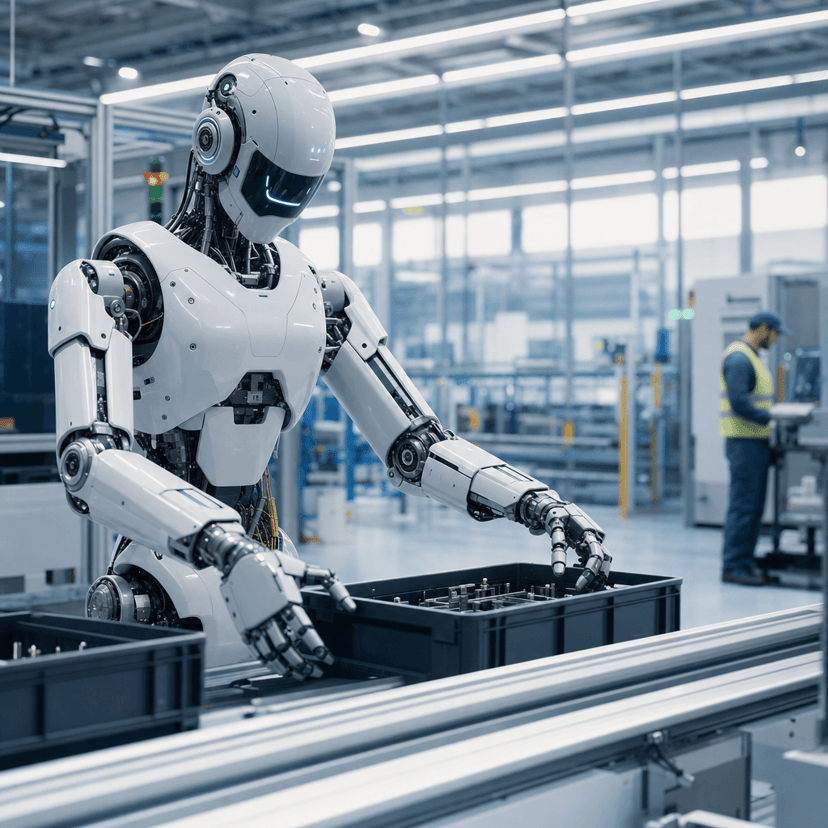
European researchers just released SPEAR-1, an open-source AI model that gives industrial robots 3D spatial intelligence - matching the performance of billion-dollar commercial competitors. The breakthrough could democratize advanced robotics development, letting startups and researchers build smarter factory automation without paying licensing fees to tech giants.
European roboticists just dropped a game-changer that could reshape the entire robotics industry. Researchers at Bulgaria's Institute for Computer Science, Artificial Intelligence and Technology (INSAIT) released SPEAR-1 today - an open-source AI model that gives industrial robots unprecedented 3D spatial intelligence.
The release sends shockwaves through a market where billions are at stake. SPEAR-1 performs nearly as well as Pi-0.5 from Physical Intelligence, the billion-dollar startup that's been hoarding similar capabilities behind closed doors. When tested on RoboArena benchmarks, SPEAR-1 matched commercial models at tasks like squeezing ketchup bottles and stapling papers together.
"Open-weight models are crucial for advancing embodied AI," Martin Vechev, the computer scientist leading the project at INSAIT and ETH Zurich, told WIRED ahead of today's launch. The timing couldn't be more strategic - as robotics startups like Skild and Generalist race to lock up the market with proprietary models.
What makes SPEAR-1 different isn't just its open-source nature - it's the breakthrough in how it processes the physical world. Most robot foundation models build on vision language models trained on flat, 2D images. SPEAR-1 incorporates actual 3D data, giving it deeper understanding of how objects move through real space. "Our approach tackles the mismatch between the 3D space the robot operates in and the knowledge of the VLM," Vechev explains.
The implications ripple far beyond academic labs. Factory automation companies that couldn't afford licensing deals with OpenAI, Google, or Anthropic now have access to comparable robot intelligence. Smaller manufacturers could deploy smarter assembly lines without paying premium fees to Silicon Valley giants.
But the robotics revolution remains frustratingly fragile. Current AI models still need complete retraining if you swap robot arms or change environments - a limitation that keeps industrial deployment expensive and complex. "Robot intelligence is still in its infancy," the WIRED report notes, highlighting how even advanced models struggle with basic adaptability.
Karl Pertsch from Physical Intelligence acknowledges the rapid progress, telling reporters it's "really cool to see academic groups building quite general policies that can actually be evaluated across a diverse set of environments out-of-the-box." His admission reveals how quickly open-source efforts are catching commercial leaders.
The release follows the same playbook that democratized language models. Just as Meta's Llama models challenged OpenAI's dominance, SPEAR-1 could spark an open-source robotics boom. Startups building warehouse automation or manufacturing systems no longer need to choose between expensive licensing or building models from scratch.
Vechev's team tapped into the same formula powering large language models - massive training data and compute power - but applied it to physical manipulation. The result bridges the gap between digital AI and real-world robotics, potentially accelerating development cycles across the industry.
The competitive landscape shifts as commercial players scramble to respond. Physical Intelligence's billion-dollar valuation suddenly faces pressure from free alternatives, while Tesla's humanoid robot projects compete against democratized AI brains that any hardware company can deploy.
SPEAR-1's release marks a pivotal moment where open-source robotics could follow the same trajectory as language models - democratizing advanced capabilities and accelerating innovation across the industry. While robot intelligence remains limited by adaptability challenges, this breakthrough gives smaller companies and researchers access to billion-dollar AI capabilities for free, potentially reshaping who controls the future of automation.