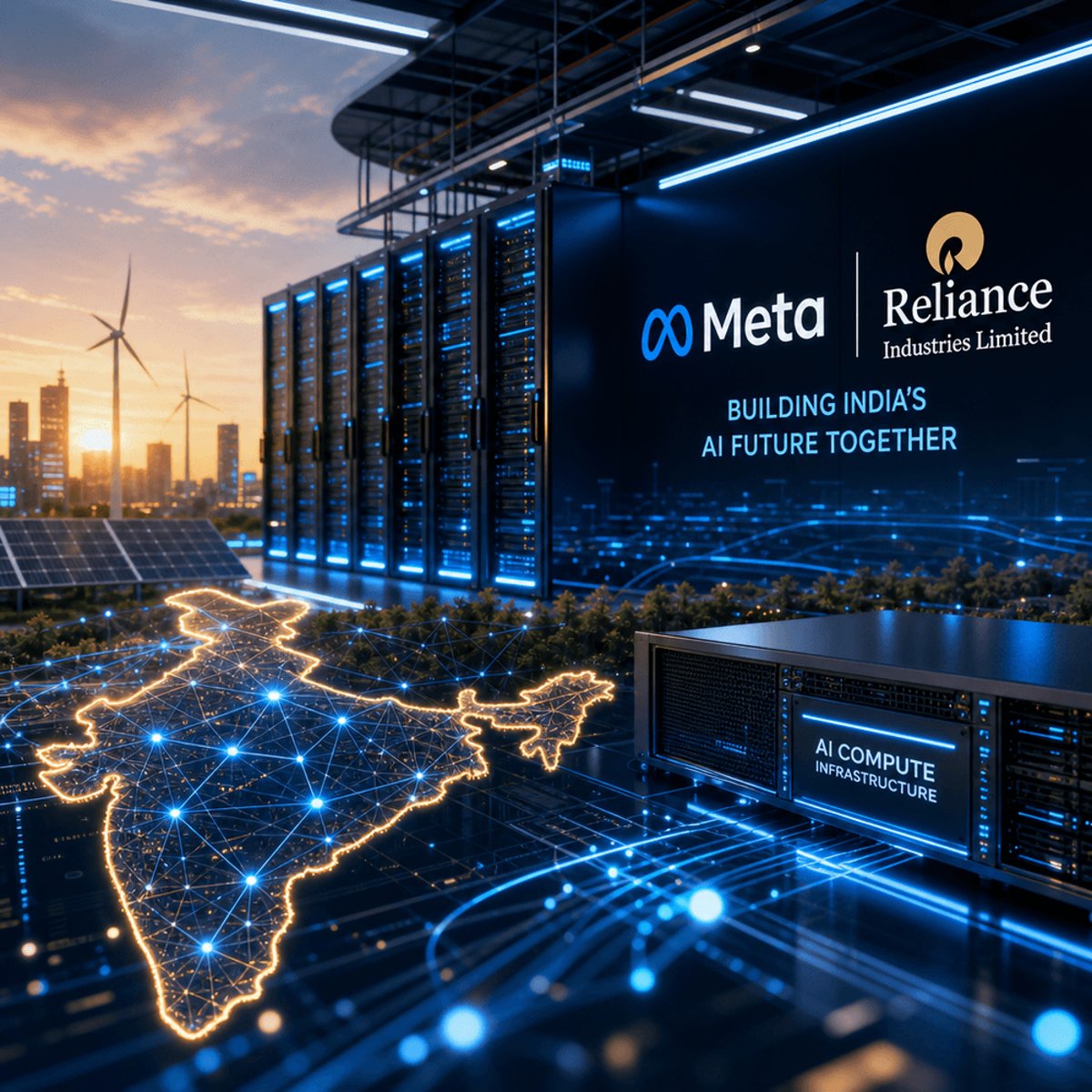
Meta just planted its flag in India's booming AI infrastructure race. The social media giant signed its first-ever data center deal in the country with Reliance Industries, securing a 168-megawatt facility to power its global AI computing needs. The move signals Meta's urgent need for compute capacity as it scales up AI training and positions India as a critical piece of its worldwide infrastructure puzzle.
Meta is betting big on India, and the stakes have never been higher. The company's freshly inked partnership with Reliance Industries marks a watershed moment for both tech giants - Meta gets the AI compute capacity it desperately needs, while Reliance cements its position as India's data center kingmaker.
The 168-megawatt facility represents serious horsepower. For context, that's enough energy to power a small city, and Meta's making it clear this is just the opening salvo. The deal includes provisions for expansion, a hedge against the company's rapidly escalating AI ambitions. As Meta pours billions into developing its Llama language models and AI-powered features across Facebook, Instagram, and WhatsApp, the compute demands keep climbing.
Why India, and why now? The timing reveals Meta's infrastructure strategy under pressure. Global data center capacity is tight, energy costs are soaring in traditional markets like the US and Europe, and India offers a compelling mix of growing energy infrastructure, favorable economics, and - crucially - proximity to one of Meta's largest user bases. With over 500 million users across its platforms in India, the company's been essentially serving that massive audience from halfway around the world.
Reliance Industries, led by billionaire Mukesh Ambani, brings more than just real estate to the table. The conglomerate's sprawling energy infrastructure, from power generation to renewable projects, solves Meta's biggest data center headache - reliable, scalable electricity. Reliance has been aggressively building out its digital infrastructure play, already operating data centers through its Jio Platforms subsidiary and positioning itself as India's answer to Amazon Web Services and Microsoft Azure.
But this isn't just about keeping the lights on. India's emerged as a battleground for AI supremacy, with every major tech player scrambling for position. Google has been expanding its cloud regions across the country, Microsoft committed billions to Indian data center investments, and Amazon Web Services continues to build out capacity. Meta's deal with Reliance is a calculated move to avoid getting boxed out of critical infrastructure in a market that's expected to become one of the world's top three digital economies by 2030.
The 168-megawatt capacity also hints at Meta's training ambitions. Modern AI model training requires enormous parallel computing power, often concentrated in single locations to minimize latency between GPUs. A facility this size could theoretically house tens of thousands of high-performance chips - the kind of setup needed to train the next generation of Llama models or power real-time AI features for hundreds of millions of users simultaneously.
What makes this deal particularly interesting is the expandability clause. Meta's not just renting space - it's building a foundation for long-term AI infrastructure in India. As the company races to keep pace with OpenAI and Google in the generative AI arms race, having flexible, scalable compute capacity becomes a strategic imperative. The ability to expand on-site means Meta can respond quickly to training demands without navigating new real estate deals or regulatory approvals.
For Reliance, this validates years of infrastructure investment and signals to other hyperscalers that India's ready for prime time. The company's been methodically building the pieces - fiber networks through Jio, renewable energy projects, and now enterprise-grade data centers. Landing Meta as an anchor tenant demonstrates technical credibility and could open doors to similar deals with other AI-hungry tech giants.
The regulatory environment deserves attention too. India's been tightening data localization requirements and scrutinizing how foreign tech companies operate. Partnering with Reliance, a homegrown powerhouse with deep government connections, gives Meta political cover and operational flexibility. It's a playbook other Western tech firms have followed - ally with local champions to navigate complex regulatory terrain.
Energy sourcing will be the next shoe to drop. Data centers of this scale consume massive amounts of electricity, and Meta's committed to powering its operations with 100% renewable energy. Reliance's renewable portfolio - including major solar and green hydrogen initiatives - positions the partnership to meet those sustainability targets. Expect announcements about dedicated renewable energy projects tied to this facility.
The deal also reflects broader shifts in global AI infrastructure. As US-China tech tensions persist and supply chains fragment, companies are diversifying their geographic footprint. India offers political stability, a massive talent pool of engineers, and increasingly competitive operating costs. Meta's move could accelerate a broader trend of AI training and inference workloads shifting to emerging markets with better energy economics.
Meta's India gambit is about more than just megawatts - it's a referendum on where AI infrastructure gets built in the next decade. By locking down capacity now with a proven local partner, the company's securing compute resources that could become increasingly scarce as AI training demands explode. For Reliance, it's validation of a long-term bet on digital infrastructure and a signal to other hyperscalers that India's ready to play in the big leagues. Watch for Meta to announce additional capacity deals in India and other emerging markets as the AI infrastructure arms race accelerates. The real question isn't whether other tech giants will follow Meta to India - it's how quickly they can catch up.