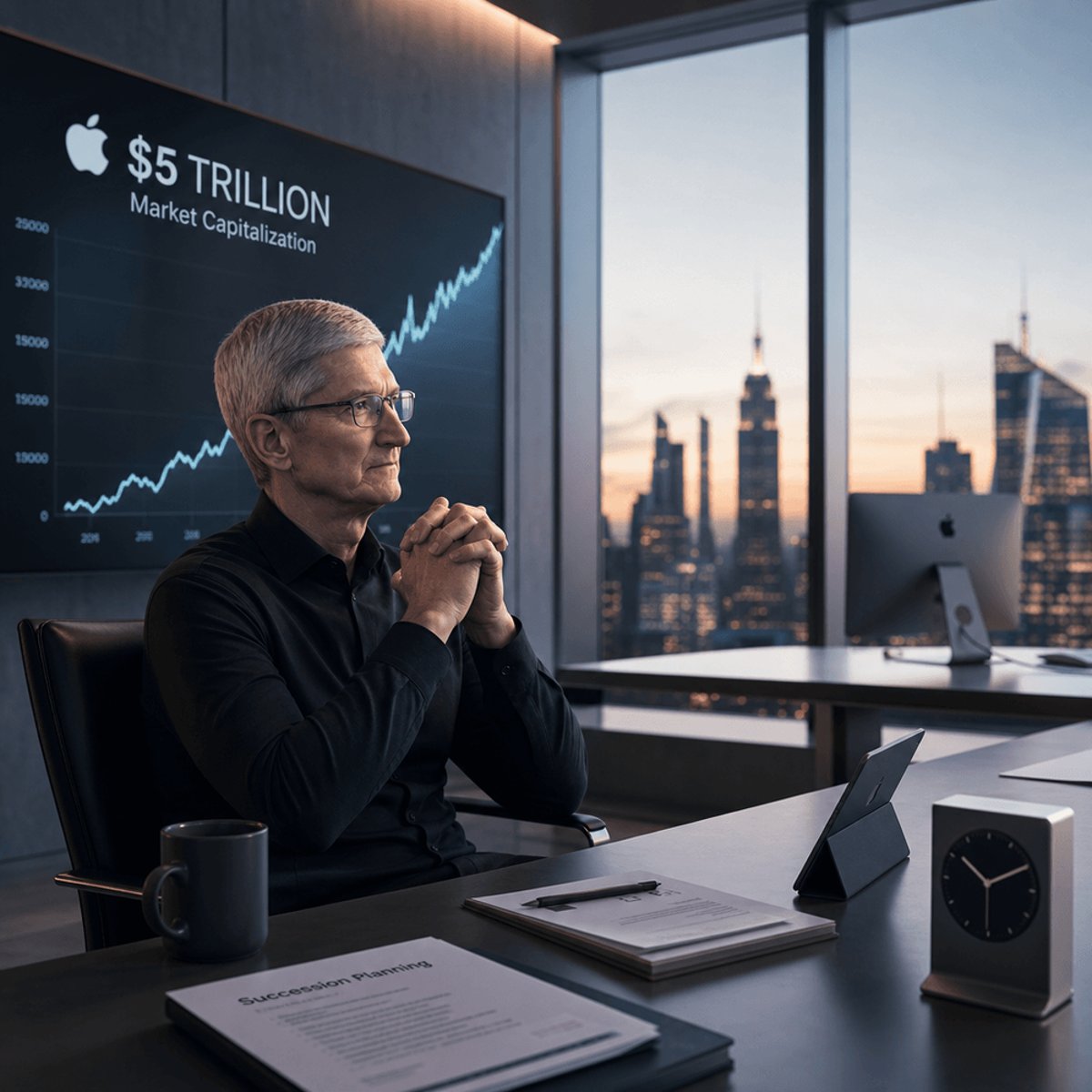
Apple just crossed the $5 trillion market cap threshold for the first time in its history, but the celebration comes with a bittersweet twist - CEO Tim Cook is preparing for his final earnings call at the helm. The timing couldn't be more dramatic: Apple's sitting at an all-time high while facing mounting questions about AI strategy, China headwinds, and who'll fill one of tech's most powerful seats. After 13 years steering the ship, Cook's swan song earnings report will cap a tenure that transformed Apple from a $350 billion company into a $5 trillion juggernaut.
Apple is having a moment. The company just punched through the $5 trillion market cap ceiling, a milestone no other public company has ever reached. But there's an elephant in the room during what should be a pure victory lap - this is Tim Cook's last rodeo as CEO.
The timing is almost too perfect. Cook took over from Steve Jobs in August 2011 with Apple valued at roughly $350 billion and skeptics questioning whether an operations guy could fill the visionary's shoes. Thirteen years later, he's handing off a company worth more than 14 times that figure. The numbers tell a story of relentless execution: Apple's revenue more than doubled under Cook's watch, the services business exploded into a $100 billion annual juggernaut, and the company navigated everything from trade wars to pandemics without missing a beat.
But Wall Street doesn't pay you for yesterday's wins. According to analysts tracking the stock, investors are laser-focused on three pressure points heading into this earnings call. First, there's the AI question that won't quit. While Microsoft, Google, and Meta have been shouting their AI strategies from rooftops, Apple's played it characteristically close to the vest. Cook's expected to detail the company's AI roadmap and whether Apple Intelligence features are actually moving the needle on iPhone upgrades.
China remains the second major concern. Apple's revenue in Greater China has been under pressure as nationalist sentiment and local competitors like Huawei chip away at market share. Investors will be parsing every word about the region's performance and outlook. One wrong comment could send the stock tumbling despite the historic valuation.
Then there's the succession question that's dominated boardroom whispers for months. Cook hasn't publicly named his successor, and Apple's notorious secrecy means the transition plan remains locked tighter than Fort Knox. Will he use this final call to hint at who's next? The betting among analysts suggests he'll keep that card close, but the market's hungry for any signal about continuity.
The $5 trillion valuation itself tells you how much confidence investors have placed in Cook's operational machine. Apple's become the ultimate cash-generating beast, throwing off roughly $100 billion in free cash flow annually and returning mountains of capital to shareholders through buybacks and dividends. That financial discipline - pure Cook DNA - turned Apple from a product company into an investor's dream.
But here's what makes this moment genuinely interesting: Cook's navigating this transition from a position of absolute strength. There's no crisis, no scandal, no board pressure. This appears to be a planned, orderly handoff at the peak. That's rare in tech, where CEO exits usually come with drama attached. Think of the chaos around OpenAI's Sam Altman situation or the forced departures that mark so many leadership changes.
The services business Cook built deserves special attention. When he took over, services barely registered as a line item. Now it's a $100 billion behemoth with App Store, Apple Music, iCloud, and Apple TV+ all printing money at margins that make the hardware business look pedestrian. That diversification gave Apple breathing room when iPhone sales plateaued and proved Cook understood that recurring revenue beats one-time hardware sales every time.
Investors will also be watching for commentary on the Vision Pro and Apple's broader bet on spatial computing. The headset's launch earlier this year drew mixed reviews - impressive tech, unclear use case, eye-watering price. Whether Cook doubles down or acknowledges it's a long-term play will signal how much rope his successor has to chase moonshots versus grinding out incremental iPhone improvements.
The Mac and iPad businesses have been surprisingly resilient, with the M-series chip transition breathing new life into products many wrote off as mature. Cook's decision to bring chip design in-house - arguably his boldest strategic move - is paying dividends across the product line. That vertical integration play echoes Jobs but came from Cook's supply chain mastery.
One thing's certain: this earnings call will be dissected with unusual intensity. Every pause, every hedge, every bit of guidance will be analyzed for clues about what comes next. Cook's earned the right to a graceful exit, but the market's merciless. Miss on iPhone unit sales or whiff on guidance, and that $5 trillion market cap could shrink faster than you can say "supply chain constraints."
Cook's final earnings call represents more than just another quarterly report - it's the closing chapter of one of tech's most successful CEO tenures. The $5 trillion valuation provides a quantitative answer to the question that dogged him from day one: could the operations guy match the visionary? Turns out, operational excellence at scale creates its own kind of magic. But now comes the hard part. Whoever steps into Cook's chair inherits a company at peak altitude with nowhere to go but down, facing AI disruption, geopolitical turbulence, and the weight of impossible expectations. Cook built a machine that prints money, but machines need great operators. The market's about to find out if Apple can clone that particular skillset.