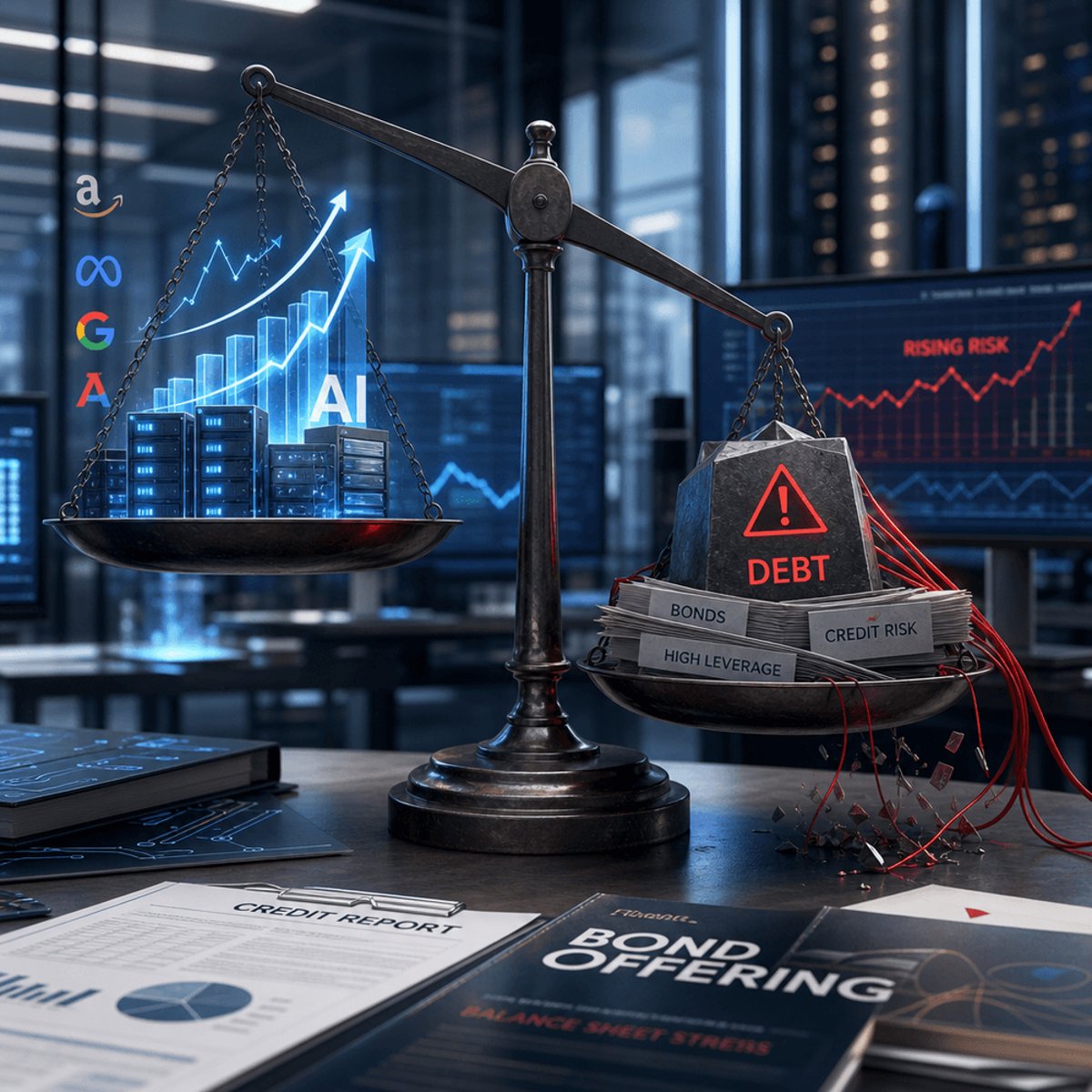
The world's most cash-rich tech giants are maxing out their credit cards for AI, and Moody's just sounded the alarm. In a stark warning issued Friday, the credit rating agency flagged that 'unprecedented' artificial intelligence infrastructure spending is forcing companies like Amazon, Meta, and Alphabet to lean heavily on debt, stock sales, and creative off-balance-sheet financing—threatening the very credit quality that's long defined Silicon Valley's elite. It's a warning shot that cuts to the heart of the AI boom's sustainability.
Moody's just threw cold water on the AI party. According to a report from CNBC, the credit rating agency is raising red flags about how the world's wealthiest corporations are financing their artificial intelligence ambitions. The verdict? Even companies sitting on massive cash piles are turning to debt markets, equity raises, and complex off-balance-sheet arrangements to fund what Moody's describes as 'unprecedented' AI spending.
The warning specifically calls out Amazon, Meta, and Alphabet—companies that have collectively announced hundreds of billions in planned AI infrastructure investments over the next several years. What's striking isn't that they're spending big. It's that they're borrowing big to do it, despite having some of the strongest balance sheets in corporate America.
This marks a fundamental shift in Silicon Valley's financial playbook. Tech giants built their empires on the promise of capital-light business models—software scales infinitely, after all. But large language models and the infrastructure behind them require something decidedly old-economy: massive physical data centers packed with expensive Nvidia chips, all consuming enormous amounts of power. That's forcing a reckoning with debt loads that would make traditional industrial companies blush.
The timing of Moody's warning matters. Amazon recently disclosed capital expenditure plans exceeding $150 billion through 2027, much of it earmarked for AI and cloud infrastructure. Meta has similarly committed to spending upwards of $40 billion annually on AI development and the computing power to support it. Alphabet, parent company of Google, isn't far behind with its own aggressive AI infrastructure roadmap.
What makes Moody's assessment particularly striking is the mechanism these companies are using. Rather than simply drawing down cash reserves, they're tapping debt markets at scale. Amazon issued $8 billion in corporate bonds earlier this year. Meta completed its first bond offering in years. Even Alphabet, long resistant to debt financing, has explored credit facilities to preserve cash flexibility while funding AI expansion.
But it's not just straight debt that's concerning the rating agency. The 'off-balance-sheet moves' Moody's references point to increasingly creative financing structures—sale-leasebacks of data centers, special purpose vehicles for equipment financing, and joint ventures that keep liabilities at arm's length. These arrangements allow companies to maintain the appearance of financial strength while leveraging up in ways that don't immediately hit their reported debt ratios.
The stakes extend beyond individual company balance sheets. If Moody's or other rating agencies actually downgrade these tech giants, it could trigger a cascade of consequences. Higher borrowing costs would make the AI buildout more expensive. Bond covenants might restrict financial flexibility. And investor confidence could waver if the companies that defined the last decade of market returns suddenly look financially stretched.
Wall Street is already sensing the tension. Tech stocks have shown volatility whenever companies report quarterly capex figures that exceed analyst expectations. The market wants the AI revolution, but it's getting nervous about the price tag—especially when that price tag is increasingly funded with borrowed money rather than the free cash flow that made tech investing so attractive.
The competitive dynamics make it nearly impossible for any single company to pull back. Microsoft, not specifically mentioned in Moody's warning but spending just as aggressively, has made OpenAI partnership and AI integration central to its entire strategy. Amazon Web Services can't afford to fall behind in AI capabilities without risking its cloud computing dominance. Google is fighting for its core search business against AI-powered alternatives.
So everyone's locked in an arms race where pulling back means competitive death, but pushing forward means balance sheet risk. It's precisely the kind of industry-wide trap that credit rating agencies watch for—when rational individual decisions create collective financial vulnerability.
Moody's isn't predicting imminent downgrades, but the warning is clear: the current trajectory isn't sustainable without either slowing spending, generating significantly more revenue from AI products, or accepting materially weaker credit profiles. For companies that have long prided themselves on fortress balance sheets, that's an uncomfortable set of choices.
Moody's warning crystallizes the central tension of the AI era: the technology everyone agrees will define the next decade requires spending levels that even the richest companies can't sustain from cash flow alone. As debt piles up and creative financing multiplies, the question isn't whether AI will transform business—it's whether the companies racing to build it will emerge with their credit quality intact. For investors, employees, and the broader tech ecosystem, the answer will determine whether this boom ends in dominance or financial stress. What's clear is that the AI revolution is no longer just a technology story. It's increasingly a balance sheet story, and Moody's just put the spotlight on the numbers that matter most.