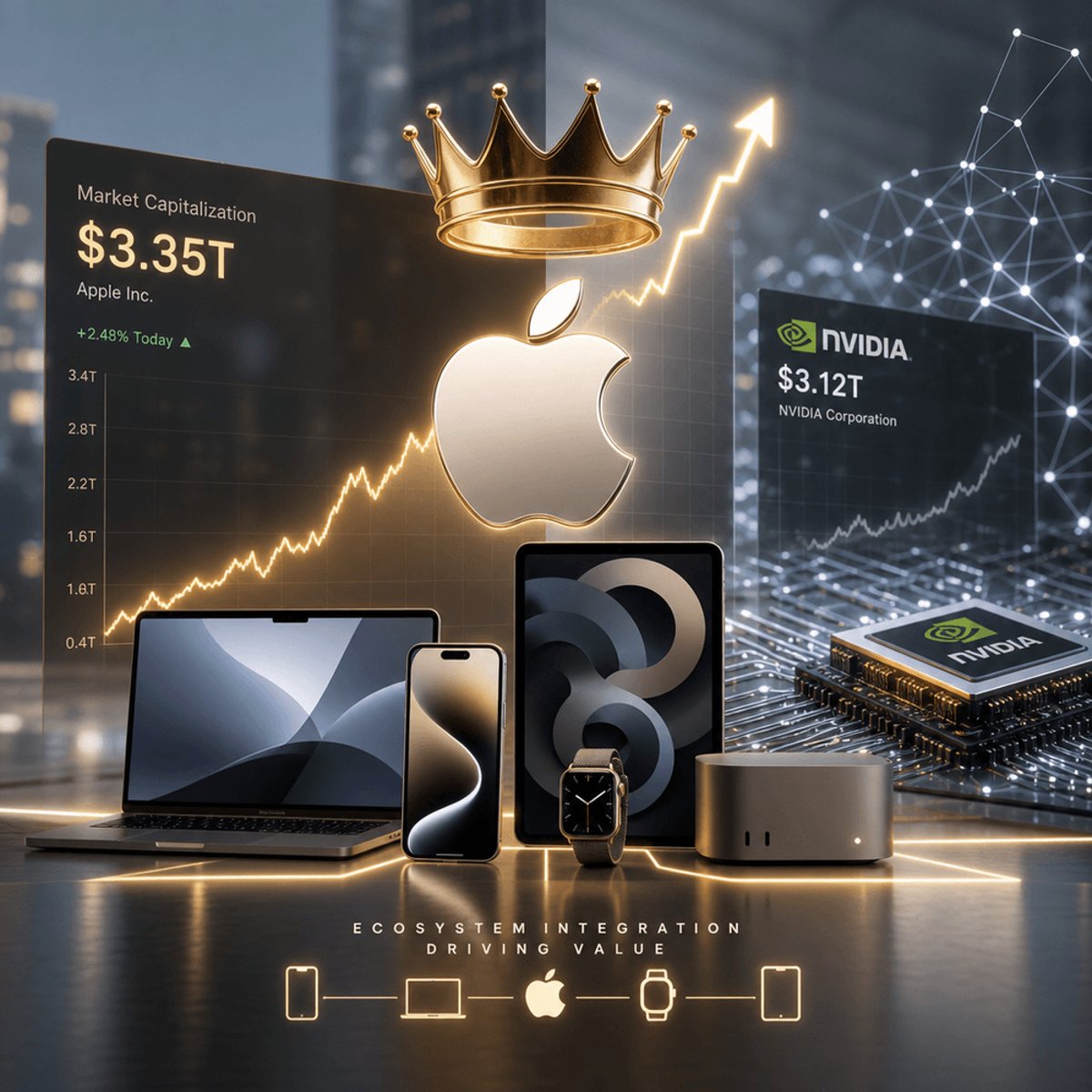
Apple just reclaimed its throne. In a stunning reversal of fortune, the iPhone maker surpassed Nvidia to become the world's most valuable company, ending the chipmaker's reign at the top. The shift comes as Wall Street reassesses its AI bets, pivoting from pure-play semiconductor stocks toward companies building the broader infrastructure powering the AI revolution. It's a moment that captures the market's evolving narrative about who really wins in the age of artificial intelligence.
Apple is back on top. The Cupertino giant officially surpassed Nvidia in market capitalization on Friday, reclaiming the title of world's most valuable company in a move that punctuates a remarkable shift in investor sentiment around the AI boom.
The milestone marks the end of Nvidia's extraordinary run at the summit, a position the chipmaker seized as demand for its AI accelerators sent shares skyrocketing through 2024 and 2025. But 2026 has told a different story. According to CNBC, Nvidia shares have notably underperformed this year as Wall Street pivots toward companies building the infrastructure layer of the AI buildout rather than just the silicon powering it.
The reversal reflects a maturing thesis among investors. While Nvidia's H100 and B200 chips remain the gold standard for training large language models, the market is increasingly betting that the real value creation happens further up the stack. Apple, with its tightly integrated ecosystem spanning hardware, services, and now on-device AI capabilities, represents the kind of diversified AI play that suddenly looks more attractive as semiconductor margins face pressure.
It's not that Nvidia's business is struggling. The company continues to dominate data center GPU sales, with hyperscalers like Microsoft, Google, and Amazon competing for limited chip supply. But the stock's premium valuation has come under scrutiny as competitors like AMD and startup challengers begin chipping away at market share. Meanwhile, questions about capex sustainability among cloud providers have introduced new uncertainty into growth forecasts.
Apple, by contrast, is executing a quieter but potentially more durable AI strategy. The company's Apple Intelligence features, rolling out across iPhone, iPad, and Mac, bring generative AI directly to consumers without requiring cloud connectivity for many tasks. That on-device approach not only addresses privacy concerns but positions Apple to monetize AI through hardware upgrades and services rather than pure computing cycles. Investors are rewarding that model with renewed confidence.
The competitive landscape tells the broader story. While Nvidia battles to maintain its near-monopoly in training chips, Apple is stitching AI into a billion-device installed base. The company's services revenue continues climbing, app store economics remain robust, and the upcoming product cycle promises AI-enhanced experiences that could drive a meaningful refresh wave. Wall Street is betting on ecosystem lock-in over component sales.
Timing matters too. The market cap flip comes as semiconductor stocks broadly face headwinds from inventory corrections and geopolitical tensions around chip manufacturing. Taiwan-based production remains a pressure point, and export restrictions continue complicating supply chains. Apple's diversified manufacturing and assembly strategy, while not immune to these issues, spreads risk in ways pure-play chip companies can't match.
Analysts have been telegraphing this shift for months. The narrative around AI investing has evolved from "who makes the picks and shovels" to "who captures value from deployment at scale." Infrastructure companies building the rails for AI applications - whether through cloud platforms, enterprise software, or integrated consumer experiences - are suddenly commanding premium multiples relative to component suppliers.
Nvidia isn't disappearing from the conversation. The company's roadmap extends through multiple generations of increasingly powerful accelerators, and demand from AI labs shows no signs of slowing. But the stock's explosive growth phase may be behind it, at least until the next major platform shift emerges. Apple, meanwhile, is in the early innings of monetizing AI across its installed base.
The changing of the guard also signals something about market maturity. The AI trade is moving beyond the infrastructure buildout phase into deployment and application. Companies that can deliver AI features users will actually pay for - through device upgrades, subscription services, or productivity gains - are becoming the new darlings. That's Apple's game, and Wall Street is pricing it accordingly.
For investors, the milestone raises questions about where AI value will ultimately concentrate. Will it be in the chip layer, the model layer, the application layer, or somewhere else entirely? Today's market cap rankings suggest confidence is flowing toward integrated platforms that control multiple parts of the stack. Apple epitomizes that approach, while Nvidia remains a specialist play.
Apple's return to the top spot isn't just a market cap milestone - it's a signal about how Wall Street is reframing the AI investment thesis. As the technology matures beyond infrastructure spending into real-world deployment, companies that can monetize AI at consumer and enterprise scale are commanding premium valuations. Nvidia's chips remain essential, but Apple's integrated approach to bringing AI to a billion users represents a different kind of bet - one the market is backing with conviction right now. The question isn't whether Nvidia will remain crucial to AI, but whether component suppliers can sustain the valuations they commanded during the buildout phase. For now, investors are voting with their capital, and they're choosing ecosystem plays over pure silicon.