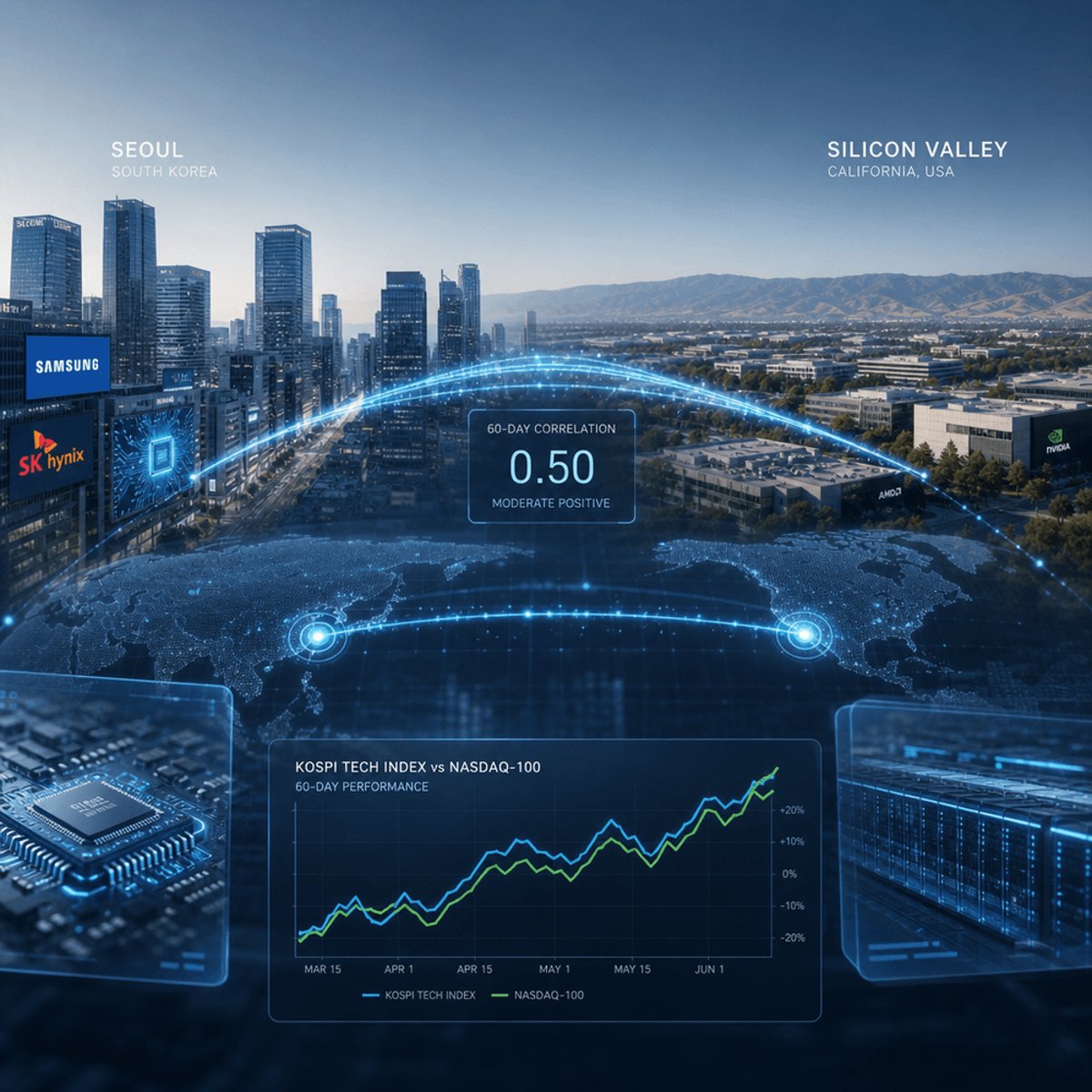
Wall Street and Seoul's tech markets are moving in lockstep like they haven't in years, and that's setting off alarm bells for portfolio managers betting on geographic diversification. The 60-day correlation between South Korea's Kospi index and the Nasdaq 100 just hit 0.50, the tightest relationship since 2021, according to data from Rayliant. It's a stark reminder that in today's interconnected chip and AI economy, betting on Korean tech giants like Samsung and SK Hynix doesn't insulate you from Silicon Valley's swings anymore.
The numbers tell a story that's making global fund managers nervous. When the 60-day correlation between two markets hits 0.50, it means they're moving in the same direction half the time - a level that effectively undermines the core principle of international diversification. According to data released by Rayliant, this is the tightest the relationship has been since 2021, when the post-pandemic tech rally was lifting all boats simultaneously.
The driver behind this convergence isn't hard to pinpoint. Samsung and SK Hynix, which together dominate the Kospi's weighting, aren't just Korean companies anymore - they're integral cogs in the same AI and semiconductor machine that powers Nvidia, Microsoft, and the rest of Silicon Valley's AI infrastructure buildout. When Jensen Huang sneezes in Santa Clara, memory chip orders in Seoul catch a cold.
This matters because it fundamentally changes the risk equation for investors who've traditionally viewed Korean equities as a way to diversify away from U.S. tech exposure. You can't hedge Apple's supply chain risks by buying its suppliers - and increasingly, that's exactly what investing in Korean tech has become. The AI boom has created such tight interdependencies that a slowdown in U.S. data center spending immediately translates to softer demand for Korean-made HBM memory and advanced chips.
The correlation metric itself deserves some unpacking. A correlation of 0.50 means the markets are positively correlated but not perfectly synchronized - there's still some independent movement. But it's high enough to seriously dilute the diversification benefits that international allocation is supposed to provide. For context, a correlation of 0.0 would mean the markets move completely independently, while 1.0 would mean they move in perfect lockstep.
What changed since 2021? Back then, both markets were riding the pandemic tech wave together. The correlation eventually cooled as regional factors reasserted themselves - Korea's domestic economy, currency fluctuations, and local policy decisions drove divergence. But the AI revolution of 2024-2026 has re-coupled these markets with a vengeance. Samsung's fortunes are now inexorably tied to whether Microsoft and Google keep expanding their AI infrastructure at breakneck speed.
SK Hynix's trajectory illustrates this perfectly. The company's HBM3E memory chips have become mission-critical components for AI accelerators, meaning its stock price increasingly tracks AI sentiment rather than traditional memory market cycles. When Nvidia reports strong data center revenue, SK Hynix benefits. When there's anxiety about AI capex sustainability, both suffer together.
For portfolio managers, this presents a genuine dilemma. Korean tech stocks still trade at a valuation discount to their U.S. counterparts - the so-called "Korea discount" hasn't disappeared. But if they're going to move in tandem with the Nasdaq anyway, that discount needs to be substantial enough to justify the additional currency risk, geopolitical exposure, and liquidity constraints that come with international investing.
The geopolitical dimension adds another layer of complexity. U.S.-China tech tensions affect both markets simultaneously now. Export controls on advanced chips impact Nvidia's China business and Korean chipmakers' mainland operations in one fell swoop. Trade policy isn't creating divergence - it's creating synchronized volatility.
Some analysts argue this tight correlation might actually be temporary, tied specifically to the current AI infrastructure buildout phase. Once the market matures and Korean tech companies diversify their revenue streams beyond AI components, the correlation could ease. But there's little evidence that's happening yet. If anything, Korean firms are doubling down on AI-related components, betting that this is a multi-year supercycle rather than a fleeting opportunity.
The currency factor, traditionally a source of divergence between Korean and U.S. equities, hasn't been enough to break the correlation this time around. Even won fluctuations aren't creating the independent movement they once did, suggesting the fundamental business drivers have simply become too aligned.
The era of treating Korean tech as a true diversifier from U.S. markets might be over, at least for now. With the Kospi-Nasdaq correlation at its highest point in five years, investors need to recognize they're not getting the geographic hedge they think they are. The AI supply chain has essentially turned Samsung and SK Hynix into leveraged plays on Silicon Valley's AI ambitions. That doesn't make them bad investments - but it does mean portfolio construction needs to account for the fact that a Nasdaq correction will likely drag Seoul down with it. For those still seeking genuine diversification, the search needs to look beyond the semiconductor-AI complex that's currently binding these markets together.