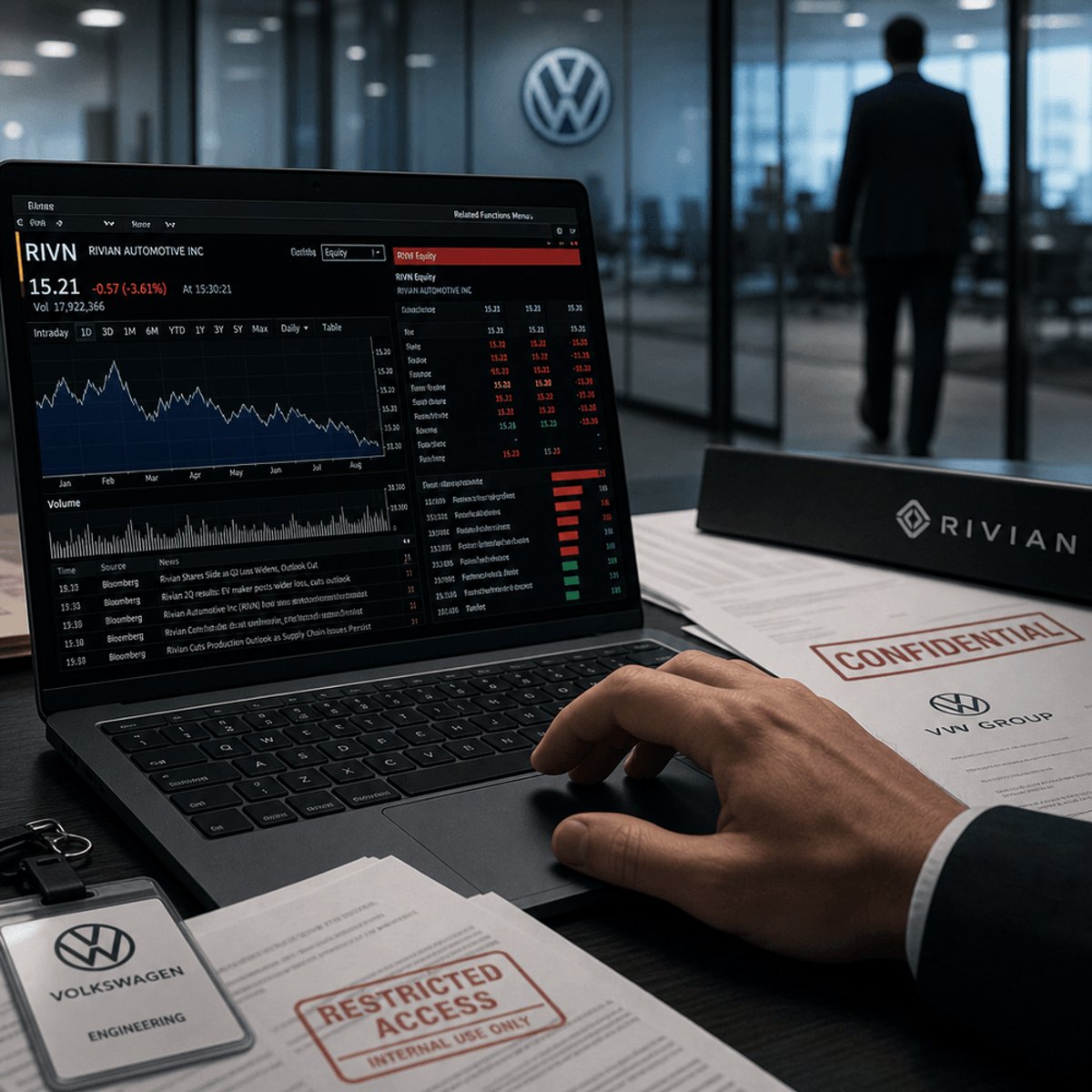
Federal prosecutors just dropped insider trading charges against multiple Volkswagen engineers who allegedly exploited confidential knowledge of the automaker's joint venture with Rivian to profit on stock trades. The indictment, unsealed Friday, marks one of the most significant insider trading cases to hit the electric vehicle sector and raises fresh questions about information security at legacy automakers racing to catch up in the EV transition.
The walls just closed in on several Volkswagen engineers who thought they'd found an easy path to profit. Federal prosecutors unsealed an indictment Friday charging the engineers with securities fraud for purchasing Rivian stock while armed with confidential information about an upcoming joint venture between the two companies.
The charges represent a significant escalation in regulatory scrutiny of the electric vehicle sector, where partnerships and technology deals can send stock prices soaring overnight. Rivian's shares have been particularly volatile, making them attractive targets for anyone with advance knowledge of major corporate developments.
According to the indictment filed in federal court, the Volkswagen engineers accessed non-public information about negotiations between the German automaker and the California-based EV startup. Armed with this insider knowledge, they allegedly purchased Rivian shares before the partnership became public, positioning themselves to profit when the announcement inevitably drove the stock price higher.
The case shines an uncomfortable spotlight on information security practices at traditional automakers as they scramble to forge alliances in the electric vehicle space. Unlike pure-play tech companies with established protocols for handling market-moving information, legacy manufacturers are still adapting to an era where engineering partnerships carry massive financial implications.
Volkswagen has been aggressively pursuing electric vehicle partnerships as part of its broader transformation following the diesel emissions scandal. The company's collaboration with Rivian represents a strategic bet on leveraging the startup's technology and manufacturing expertise to accelerate VW's own EV ambitions.
For Rivian, partnerships with established automakers provide crucial validation and potential revenue streams as the company works to scale production and achieve profitability. Any whiff of impropriety surrounding these deals threatens to complicate future negotiations and raise questions about information handling on both sides.
The Securities and Exchange Commission has ramped up enforcement actions targeting insider trading in recent years, particularly in high-growth sectors like electric vehicles, cryptocurrency, and artificial intelligence. But criminal prosecutions remain relatively rare, suggesting prosecutors believe they have a strong case built on trading records and internal communications.
Insider trading cases in the automotive sector have historically been uncommon compared to traditional tech or pharmaceutical industries. The charging decision signals that federal authorities view the EV space as requiring the same level of scrutiny typically reserved for biotech firms awaiting FDA approvals or tech companies before major product launches.
The indictment doesn't specify exactly how many engineers face charges or the total value of their alleged illegal trades. Those details will likely emerge as the case proceeds through the courts. What's already clear is the message prosecutors are sending: the rules apply equally whether you're trading on knowledge of a drug trial or an electric vehicle partnership.
For companies navigating the complex landscape of EV partnerships and technology transfers, the case serves as a stark reminder that information security isn't just about protecting trade secrets. It's about ensuring employees with access to market-moving information understand the legal boundaries and consequences of acting on that knowledge.
The timing couldn't be more sensitive for Volkswagen, which has invested billions in its electric vehicle transition and can't afford distractions from legal scandals. The company will likely face questions about its internal controls and whether it adequately restricted access to information about the Rivian negotiations.
Rivian, meanwhile, finds itself caught in the crossfire of a case that has nothing to do with its own conduct but everything to do with the value the market places on its partnerships and technology. The startup has faced its own challenges scaling production and managing cash burn, making reputation management crucial.
This case marks a watershed moment for the electric vehicle industry, signaling that the sector has matured enough to attract serious regulatory attention typically reserved for Wall Street and Silicon Valley. As traditional automakers and EV startups forge increasingly complex partnerships, expect companies to tighten information controls and employees to face stricter trading restrictions. The engineers facing charges thought they'd found a shortcut to profit, but they may have instead accelerated the industry's reckoning with the responsibilities that come with handling market-moving information. For investors, the message is equally clear: when prosecutors start filing criminal charges, it means the EV space has officially arrived as a major focus of securities enforcement.