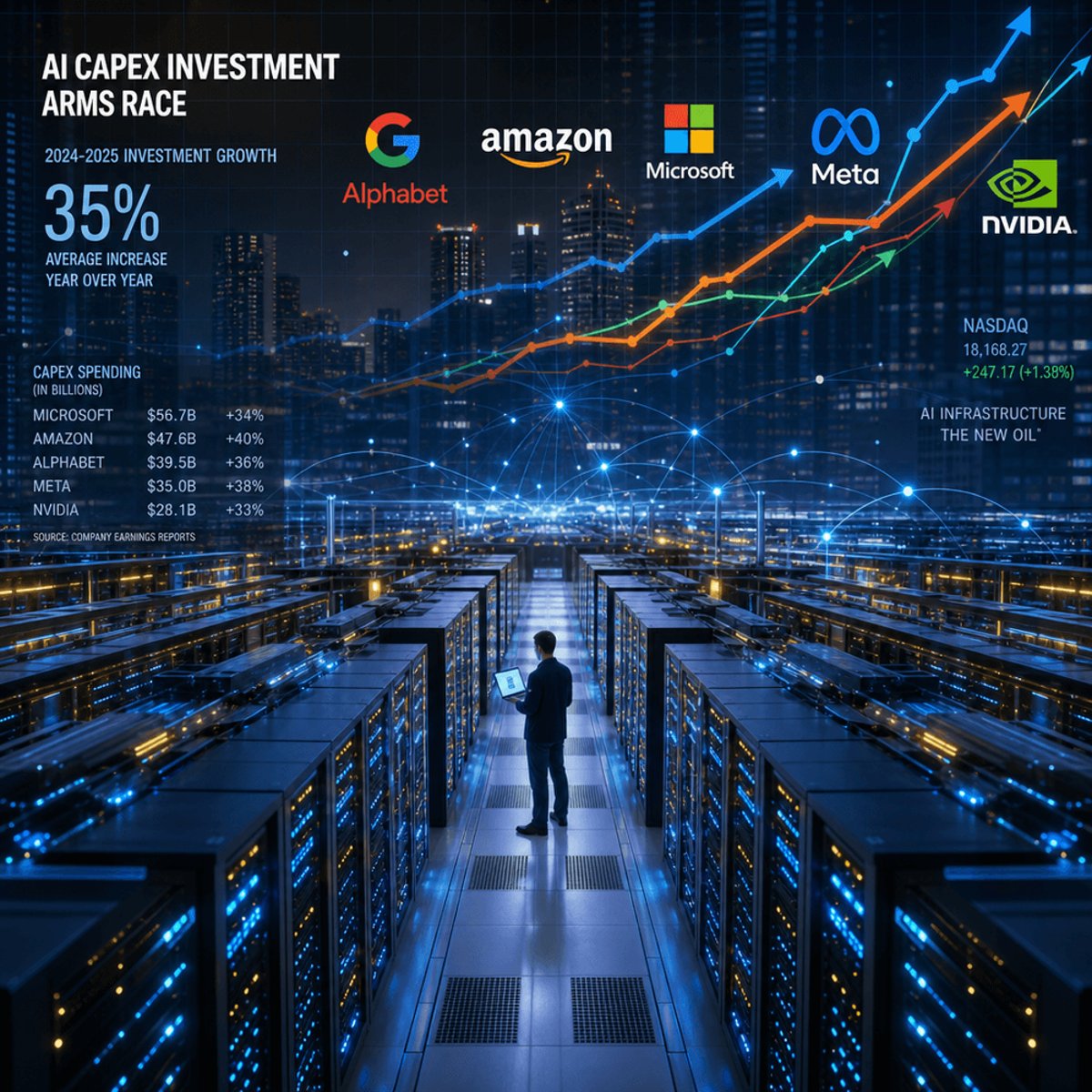
The AI infrastructure arms race just got its first benchmark for earnings season. With Alphabet having reported and three more hyperscale cloud giants queuing up next week, Wall Street analysts are laser-focused on one metric above all others: how much Big Tech is willing to spend to win the AI future. Capital expenditure trends have become the clearest signal of who's serious about competing in the generative AI era, and early indications suggest the spending spree is far from over.
Alphabet just fired the opening shot in what's shaping up to be the most scrutinized earnings week of 2026. The company's latest financial disclosure has analysts and investors fixated on a single question: how much are the hyperscalers willing to spend to capture the AI revolution?
"Capex trends are going to be the number one focus," said Jeff Marks, portfolio director at CNBC's Investing Club, capturing the sentiment rippling through Wall Street ahead of next week's parade of Big Tech earnings reports. With Amazon, Microsoft, and Meta all scheduled to report, the traditional earnings metrics - revenue growth, profit margins, user engagement - have taken a backseat to infrastructure spending.
The shift reflects a fundamental recalculation happening across the tech industry. Capital expenditure, once viewed as a drag on short-term profitability, has become the primary signal of competitive intent in the AI era. Companies that underspend risk losing ground in the race to provide the computational backbone for enterprise AI applications. Those that overspend face investor skepticism about returns on massive infrastructure investments.
Google has apparently chosen its lane, raising the stakes on AI spending in ways that will force its hyperscale rivals to show their cards. The company's aggressive posture comes as cloud infrastructure demand continues to surge, driven primarily by enterprises racing to deploy large language models and AI-powered applications. According to industry analysts, the hyperscalers collectively spent over $200 billion on infrastructure in 2025, with projections suggesting that figure could climb another 30-40% this year.
The spending isn't just about raw compute power. It encompasses data center construction, custom AI chip development, networking infrastructure, and energy systems capable of powering increasingly power-hungry AI workloads. Nvidia has been the primary beneficiary so far, with its H100 and newer H200 GPUs commanding premium prices and months-long waiting lists. But the hyperscalers are also investing heavily in their own silicon - Google's TPUs, Amazon's Trainium chips, and Microsoft's reported custom AI accelerators all represent attempts to reduce dependence on external chip suppliers.
What makes this earnings season particularly critical is timing. The initial wave of generative AI enthusiasm has matured into actual enterprise adoption, with companies moving from pilot projects to production deployments. That transition requires the kind of scaled, reliable infrastructure that only hyperscalers can provide. Microsoft has leveraged its partnership with OpenAI to embed AI capabilities across its product suite, while Amazon Web Services has focused on providing the foundational infrastructure for companies building their own AI applications.
Meta represents a different calculus entirely. Unlike the cloud-focused hyperscalers, Meta's AI spending supports its own product ecosystem - recommendation algorithms, content moderation, and increasingly, the company's metaverse ambitions. Yet the company's willingness to spend aggressively on AI infrastructure, even without direct cloud revenue to offset costs, has set a baseline that public cloud providers feel compelled to match or exceed.
The investor community remains divided on how to value these massive infrastructure investments. Bulls argue that controlling AI infrastructure will be as valuable as controlling search or social networks proved to be in previous tech eras. Bears worry about a potential overbuilding scenario where supply outpaces demand, leading to stranded assets and compressed margins. The next week of earnings reports should provide critical data points for both camps.
Beyond the headline capex numbers, analysts will scrutinize the composition of spending - how much goes toward AI-specific infrastructure versus general cloud expansion - and the guidance for future quarters. Any company that signals a pullback in AI investments risks being labeled a laggard in the most important technology transition in a generation. Conversely, those that push spending even higher will need to articulate clear paths to monetization that justify the outlay.
The competitive dynamics add another layer of complexity. If one hyperscaler significantly outspends rivals, it could gain meaningful advantages in capability and capacity. But if all players escalate spending in lockstep, the result might be industry-wide margin compression without clear winners emerging. That prisoner's dilemma is playing out in real-time, with each earnings report potentially reshaping the strategic calculations of competitors.
The AI infrastructure buildout represents the largest coordinated technology investment since the mobile revolution, and possibly since the original internet boom. What distinguishes this cycle is the concentration of spending among a handful of hyperscale players with the balance sheets and strategic imperative to make multi-billion dollar bets. Next week's earnings cascade will reveal not just how much Big Tech spent last quarter, but how much more they're willing to commit to an AI future that's still taking shape. For investors, customers, and competitors alike, the capex numbers will matter more than the earnings beats.