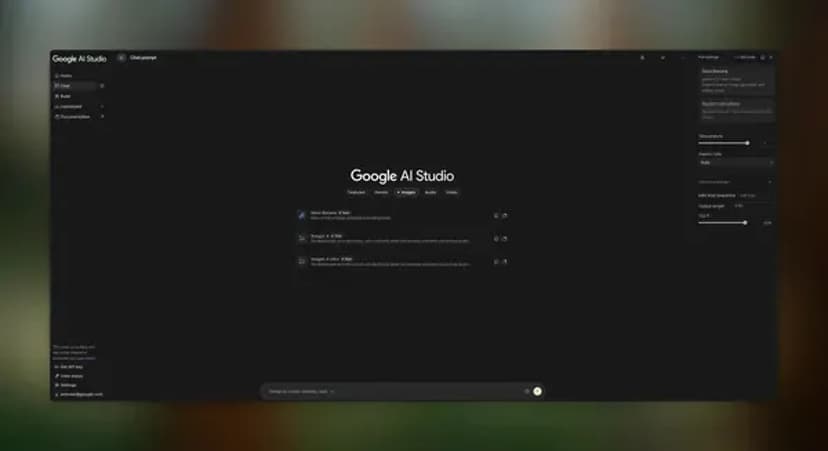
Google just rolled out logs and datasets features in AI Studio that could change how developers debug AI applications. The new tools automatically track all API calls without requiring code changes, giving developers instant visibility into how their AI apps perform in real-world usage. For a developer community struggling with inconsistent AI outputs, this represents Google's most practical debugging solution yet.
Google just handed developers something they've been asking for since AI apps started hitting production - proper logging and debugging tools that actually work without breaking your workflow. The company's new logs and datasets feature in Google AI Studio tackles one of the biggest pain points in AI development: figuring out why your model suddenly started giving weird responses to users.
The timing couldn't be better. As AI applications move from proof-of-concept to production, developers are hitting a wall when it comes to debugging. "A key challenge in developing AI-first applications is getting consistent, high-quality results — especially as you iterate and grow," Google's Seth Odoom explained in the announcement. The new tools aim to solve this by giving developers "quick and simple insights into how your application is working for both you and your end users."
What makes this launch significant isn't just the feature set - it's how stupidly simple Google made it. Developers just click "Enable logging" in the AI Studio dashboard, and boom, every API call from their billing-enabled project gets tracked automatically. No SDK updates, no code rewrites, no architectural changes. The system captures everything: successful calls, failed requests, inputs, outputs, and even API tool usage patterns.
This puts Google in direct competition with developer-focused platforms like Anthropic's Claude Console and emerging observability players in the AI space. While OpenAI has been focused on model capabilities, Google's betting that developer experience will be the real differentiator as the market matures.
The data export capabilities show Google thinking beyond just debugging. Developers can export logs as datasets in CSV or JSONL format, turning real user interactions into training data for evaluations. "By identifying examples in your logs where quality and performance dipped (or excelled), you can build a reliable and reproducible baseline of expected results," according to the company's documentation.
Here's where it gets interesting for Google's broader AI strategy. The platform lets developers share specific datasets back to Google "to provide feedback on end-to-end model behavior for your specific use case." Those shared datasets will be used to "improve and develop Google products and services, including improving and training our models." Translation: Google's turning every debugging session into potential model training data.
The integration with Google's existing infrastructure shows in the details. The logging works across all regions where the Gemini API is available, costs nothing extra, and connects directly with the Gemini Batch API for running evaluations. Google's also provided a Datasets Cookbook showing developers exactly how to use exported logs for batch evaluations.
This launch signals Google's recognition that the AI development experience has become a competitive battleground. While Microsoft focuses on enterprise integration through Azure and Amazon pushes its Bedrock platform, Google's betting on making development itself easier. The company's pitched this as laying "the groundwork for a broader set of evaluation capabilities," suggesting more developer tools are coming.
For developers already using Google's AI stack, this is an immediate quality-of-life improvement. For those still choosing between platforms, it's another data point in Google's favor. The real test will be whether these tools can help developers ship more reliable AI applications faster than competing platforms allow.
Google's new logging tools represent a crucial shift toward making AI development more practical and debuggable. By removing friction from the debugging process and creating feedback loops that improve both individual apps and Google's models, the company is positioning AI Studio as the go-to platform for serious AI development. The real winner here might be developers who finally get the visibility they need to build reliable AI applications without the usual debugging nightmare.