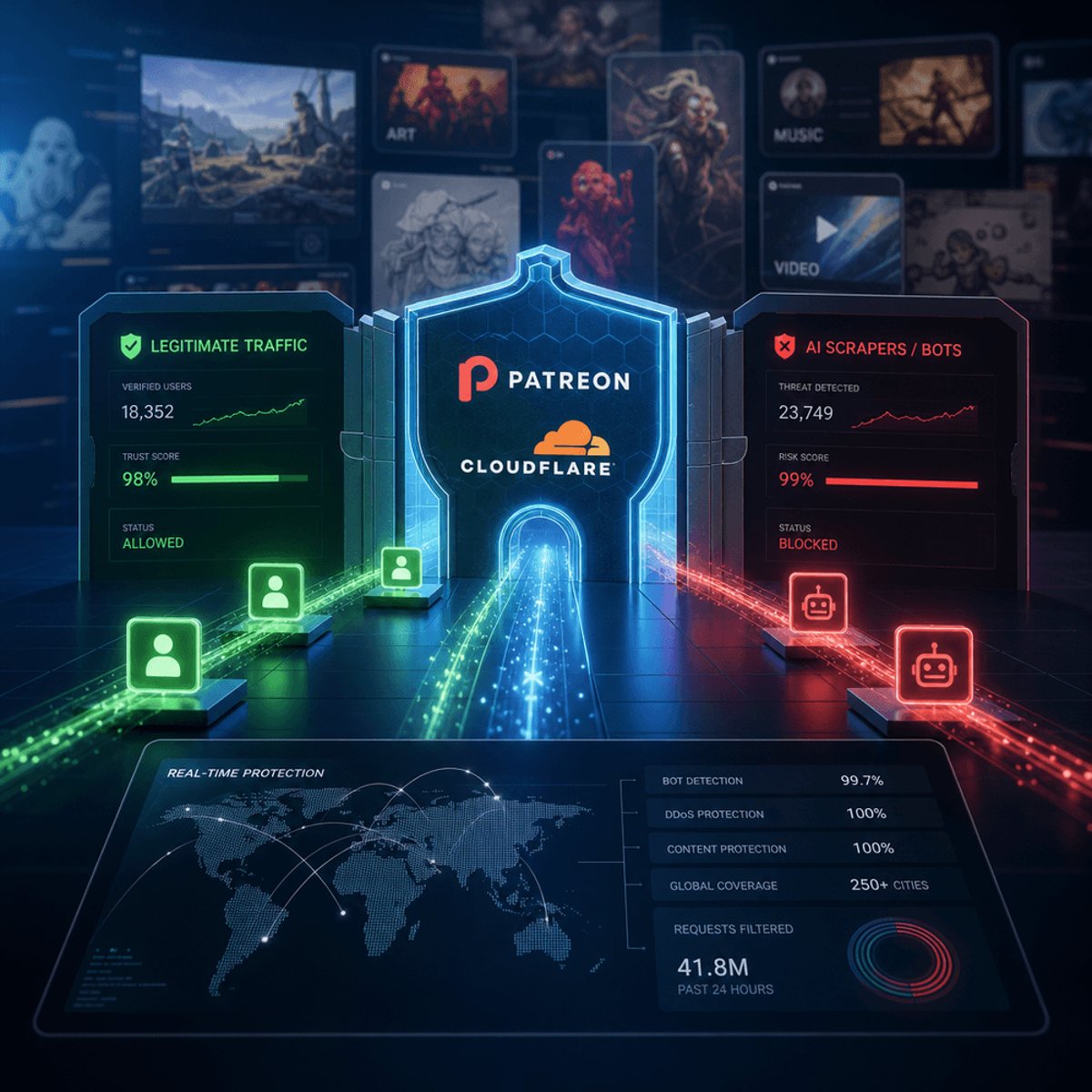
Patreon just declared war on AI scrapers. The creator platform announced it's partnering with Cloudflare to actively block bots that hoover up creator content for AI training, abandoning the honor-system approach of robots.txt files that AI companies have increasingly ignored. It's a watershed moment for the creator economy - and a signal that platforms are done asking nicely.
Patreon is flipping the script on AI scraping. The membership platform that hosts millions of creators just announced it's working with Cloudflare to physically block bots that train AI models on creator content - no more polite requests through robots.txt files that get routinely ignored.
The timing isn't coincidental. Over the past year, AI companies have been caught scraping content from platforms despite clear robots.txt instructions asking them not to. OpenAI, Anthropic, and others have faced mounting criticism for treating these files as suggestions rather than rules. For creator platforms like Patreon, where artists, writers, and podcasters depend on exclusive content to earn income, the stakes are existential.
"We're moving beyond asking permission to enforcing boundaries," the company's approach signals - though specific implementation details remain sparse in the initial announcement. What's clear is that Cloudflare's bot management tools will sit between Patreon's servers and the internet, identifying and blocking known AI scraping bots before they ever touch creator content.
The technical shift is straightforward but significant. Robots.txt files are essentially text documents that tell automated crawlers which parts of a website they shouldn't access. But they rely entirely on good faith - there's no enforcement mechanism. A bot can read the file, shrug, and scrape anyway. Cloudflare's solution operates at the network level, analyzing traffic patterns, identifying bot behavior, and cutting off access before the request reaches Patreon's servers.
This matters because Patreon hosts content that creators explicitly paywall. When someone pays $5 a month to access exclusive podcasts or artwork, they're not expecting that content to end up training the next generation of AI image generators or language models. The platform has long walked a tightrope between being open enough to help creators build audiences and closed enough to protect paid content.
The move puts Patreon at the forefront of a broader platform revolt against unauthorized AI training. Reddit famously started charging for API access partly to prevent free AI training scrapes. Twitter implemented rate limits that CEO Elon Musk partially attributed to AI scraping concerns. Stack Overflow began requiring attribution when AI models train on its content. But actively blocking bots at the infrastructure level represents an escalation.
Cloudflare has been positioning itself as the go-to defense against AI scraping for months. The company's bot management service claims to distinguish between legitimate crawlers - search engines, monitoring tools, accessibility services - and aggressive AI trainers. It's a lucrative position as platforms scramble for solutions, though questions remain about how AI companies will adapt their scraping techniques in response.
The arms race is just beginning. As platforms deploy more sophisticated blocking, AI companies develop more sophisticated evasion. Some already rotate IP addresses, mimic human browsing patterns, or use residential proxies to bypass bot detection. Cloudflare's tools will need constant updates to stay ahead - a cat-and-mouse game that could define the next phase of the AI training data wars.
For creators on Patreon, the announcement offers reassurance but raises questions. Will legitimate uses of their content get caught in the crossfire? How will this affect discoverability if search engines get too aggressive with scraping? And most critically - will it actually work, or will determined AI companies find workarounds within weeks?
The legal landscape remains murky. Courts haven't definitively ruled whether scraping publicly accessible content for AI training constitutes copyright infringement or fair use. Patreon's move sidesteps the legal debate entirely by making scraping technically impractical rather than legally questionable. It's digital self-help in the absence of clear regulation.
Other creator platforms are watching closely. If Patreon successfully blocks AI scrapers without breaking legitimate functionality, expect Substack, Ko-fi, and similar services to follow suit within months. The creator economy has too much at stake to keep relying on the honor system.
Patreon's partnership with Cloudflare represents a turning point in how platforms protect creator content from AI training scrapers. By moving from polite robots.txt requests to active network-level blocking, the company is betting that technical enforcement beats legal ambiguity. If successful, this approach could become the new standard for creator platforms - but it also kicks off an arms race between increasingly sophisticated blocking and evasion techniques. For the millions of creators depending on exclusive content for their income, the question isn't whether platforms should fight AI scraping, but whether they can win. Patreon just fired the opening shot.