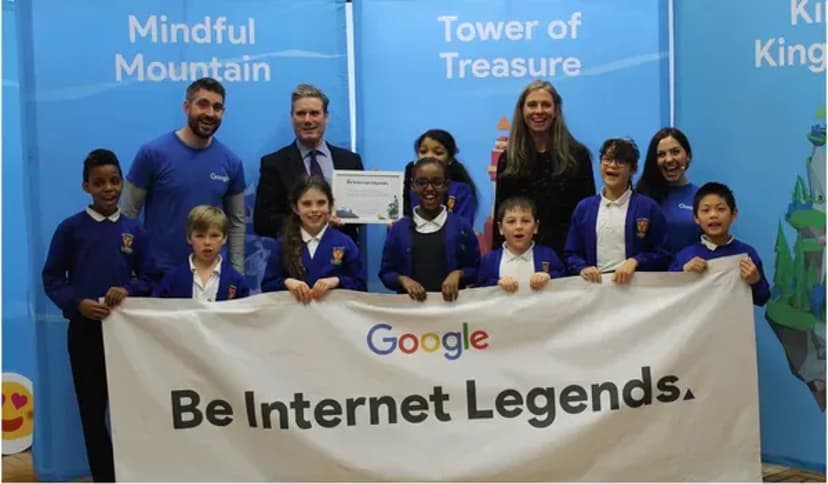
Google just doubled down on AI education with over $5 million in new funding for computer science teaching and a hands-on AI Quest that puts students in the role of medical researchers. During Computer Science Education Week, the tech giant is deploying hundreds of volunteer Googlers to classrooms worldwide while launching an eye disease detection simulator that mirrors real-world AI applications.
Google is making its biggest push yet to bring AI literacy into classrooms, announcing over $5 million in fresh Google.org funding while launching an ambitious new educational quest that puts students in the shoes of medical researchers.
The timing couldn't be more strategic. As the tech industry grapples with AI's rapid evolution, Google is positioning itself as the leader in educational preparedness. The announcement comes during Computer Science Education Week, when hundreds of Google volunteers are fanning out across schools worldwide to demonstrate the company's latest AI Quests program.
The centerpiece is a new quest where students use AI models to detect eye disease and prevent blindness - directly inspired by Google's real-world research on diabetic retinopathy. "While coding tasks may change in the AI era, the foundational principles of computer science remain more vital than ever," Google.org VP Maggie Johnson told educators in the company's announcement.
This isn't Google throwing money at a problem and hoping for the best. The funding targets specific pain points in CS education, helping organizations like California State University Dominguez Hills prepare teachers for AI-integrated curriculum and supporting the Computer Science Teachers Association in publishing revised K-12 standards with a modern web presence.
The move puts Google in direct competition with Microsoft's education initiatives and Apple's Everyone Can Code program. But Google's approach feels different - more hands-on, more immediately relevant to current AI developments. Students aren't just learning about AI; they're using it to solve real problems that mirror what Google's own researchers tackle daily.
Google has quietly built serious momentum here. The new $5 million builds on a recent $30 million global commitment and brings Google's total investment in computer science education to over $240 million. That's not pocket change, even for a company with Google's resources.
The AI Quests platform, developed with Stanford's Accelerator for Learning, represents a fascinating gamification of serious AI concepts. Students can already access a flood forecasting quest alongside the new eye disease detection module, with accompanying resources for teachers who may be navigating AI education for the first time.
Partnership momentum is building too. The Raspberry Pi Foundation and Google DeepMind have integrated AI Quests into their Experience AI program, which UNESCO recently recognized for promoting responsible AI education. That program now reaches millions of students with Google.org funding.
But here's what's really interesting: Google is betting that hands-on AI experience beats theoretical knowledge. While competitors focus on coding fundamentals, Google is putting actual AI tools in students' hands. The eye disease quest isn't a simulation - it's built on the same technology Google uses for real medical applications.
The timing aligns with a broader industry scramble for AI talent. As companies like OpenAI, Microsoft, and Meta compete for scarce AI expertise, Google is essentially creating its own pipeline by teaching students to think like AI researchers from middle school onwards.
There's also a defensive element here. As AI becomes more accessible, Google needs users who understand how to prompt, evaluate, and integrate AI tools effectively. Better to teach those skills early than compete with inferior implementations later.
The classroom deployment strategy shows Google's seriousness about execution. Hundreds of employee volunteers aren't just showing up with laptops - they're bringing real expertise from teams working on production AI systems. That kind of direct knowledge transfer is hard to replicate and gives Google a significant advantage over competitors relying purely on curriculum partnerships.
Google's $5 million education investment signals more than corporate goodwill - it's a strategic play for the future of AI literacy. By putting real AI tools in students' hands rather than just teaching theory, Google is creating the next generation of AI-native users while positioning itself as the go-to platform for AI education. As the industry races to democratize AI, Google's classroom-first approach could prove decisive in shaping how young minds understand and interact with artificial intelligence.