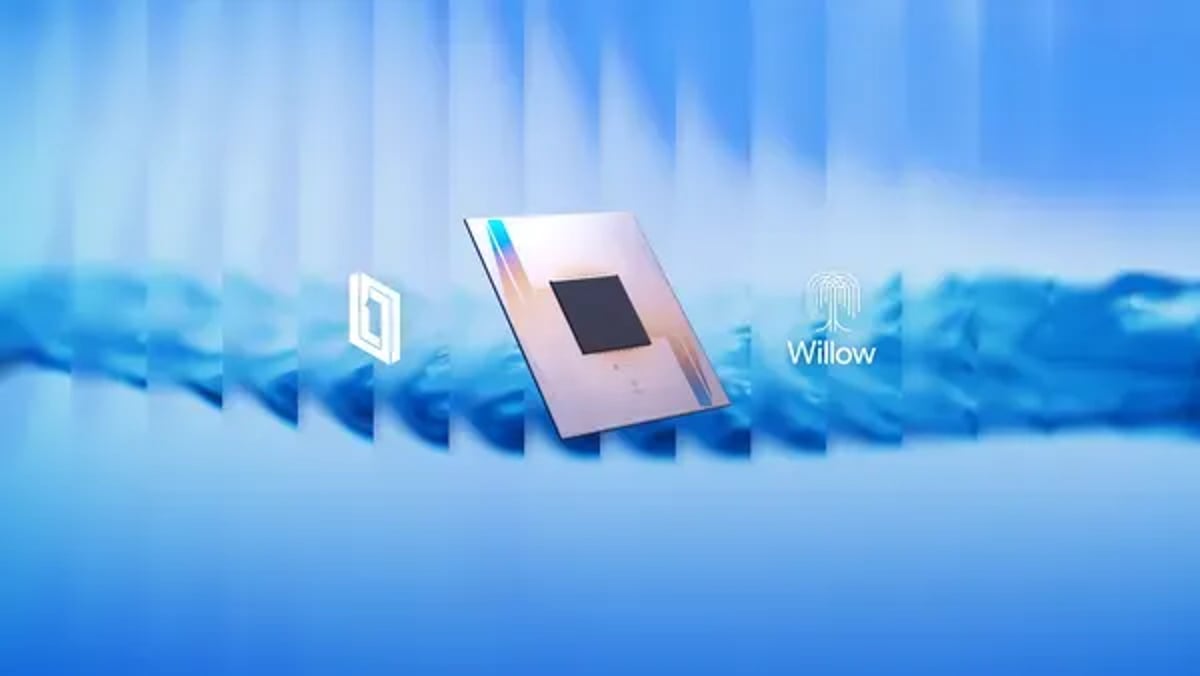
Google just crossed a quantum computing milestone that industry experts thought was years away. The company's Willow chip has achieved the first-ever demonstration of verifiable quantum advantage, proving its quantum computer can solve problems no classical supercomputer can handle. This breakthrough represents a fundamental shift in how we think about computational limits and brings practical quantum applications closer to reality.
Google just rewrote the quantum computing playbook. The company's Willow chip has achieved something the industry has been chasing for decades - the first verifiable quantum advantage that proves quantum computers can outperform classical systems on practical problems.
The breakthrough centers on Google's execution of the Quantum Echoes algorithm, a complex computational challenge that reveals hidden information about quantum systems like molecules. According to Yu Chen, Director of Quantum Processor at Google Quantum AI, the algorithm "relies on reversing the flow of quantum data in quantum computers," placing extraordinary demands on the hardware's precision and speed.
Willow's performance numbers read like science fiction. The 105-qubit chip maintains 99.97% fidelity for single-qubit gates, 99.88% for entangling gates, and 99.5% for readout operations - all executing at speeds of tens to hundreds of nanoseconds. These aren't just impressive benchmarks; they're the technical foundation that enabled Google to perform one trillion quantum measurements during this project.
To put that scale in perspective, Google claims this represents "a significant portion of all measurements ever performed on all quantum computers combined." The company's quantum systems can now execute millions of Quantum Echoes measurements in mere seconds, a speed that was instrumental in reaching computational regimes "beyond the capabilities of classical computers."
The timing couldn't be more significant for the broader quantum race. While IBM has been pushing its own quantum roadmap and Microsoft continues developing its topological approach, Google's verifiable advantage represents the first concrete proof that quantum computers can solve real problems classical systems cannot handle.
This achievement builds on Google's 2019 quantum supremacy demonstration, but with a crucial difference. Where the earlier milestone involved artificial problems designed to favor quantum computers, Quantum Echoes tackles genuine scientific challenges. "To reveal hidden information about the inner dynamics of quantum systems, such as molecules, we successfully executed the Quantum Echoes algorithm," Chen explained in the company's technical breakdown.
The hardware foundation enabling this breakthrough traces back to 40 years of superconducting quantum circuit research. Google's approach utilizes what Chen describes as macroscopic "artificial atoms" - superconducting qubits that balance performance with scalability. This platform choice has proven prescient, as competitors struggle with coherence times and error rates that plague other quantum technologies.
Google's confidence shows in their strategic roadmap transparency. The company has publicly outlined six milestones toward fault-tolerant quantum computing, already completing beyond-classical computation (2019) and quantum error correction prototypes (2023). With Willow's 2024 release demonstrating below-threshold quantum error correction, Google claims to be approaching Milestone 3.
But the real implications extend far beyond technical achievements. Quantum advantage in molecular simulation could revolutionize drug discovery, materials science, and chemical engineering. The ability to "distill useful signals from background noise" through quantum interference opens doors to previously impossible computational challenges.
Industry analysts are taking notice of Google's methodical approach. Unlike the hype cycles that have plagued quantum computing announcements, this demonstration provides verifiable results that independent researchers can validate. The trillion-measurement scale offers statistical confidence that classical computers cannot replicate these results.
The competitive landscape just shifted dramatically. Amazon's Braket quantum cloud service and Microsoft's Azure Quantum platform now face a competitor with proven quantum advantage, not just theoretical potential. Enterprise customers evaluating quantum investments have their first concrete evidence of computational superiority.
Looking ahead, Google acknowledges the challenges remain immense. Chen notes that reaching their ultimate goal "will require orders-of-magnitude improvement in system performance and scale, with millions of components to be developed and matured." The path to practical quantum applications still spans years, not months.
But today's announcement changes everything about that timeline. Verifiable quantum advantage isn't a distant promise anymore - it's a demonstrated reality running in Google's labs right now.
Google's verifiable quantum advantage marks the moment quantum computing transitioned from experimental curiosity to computational reality. While challenges remain in scaling toward fault-tolerant systems, Willow's demonstration proves quantum computers can solve problems classical systems cannot handle. For enterprises, researchers, and competitors, the quantum future just became the quantum present. The race now shifts from proving quantum advantage exists to determining who can harness it first for practical applications.