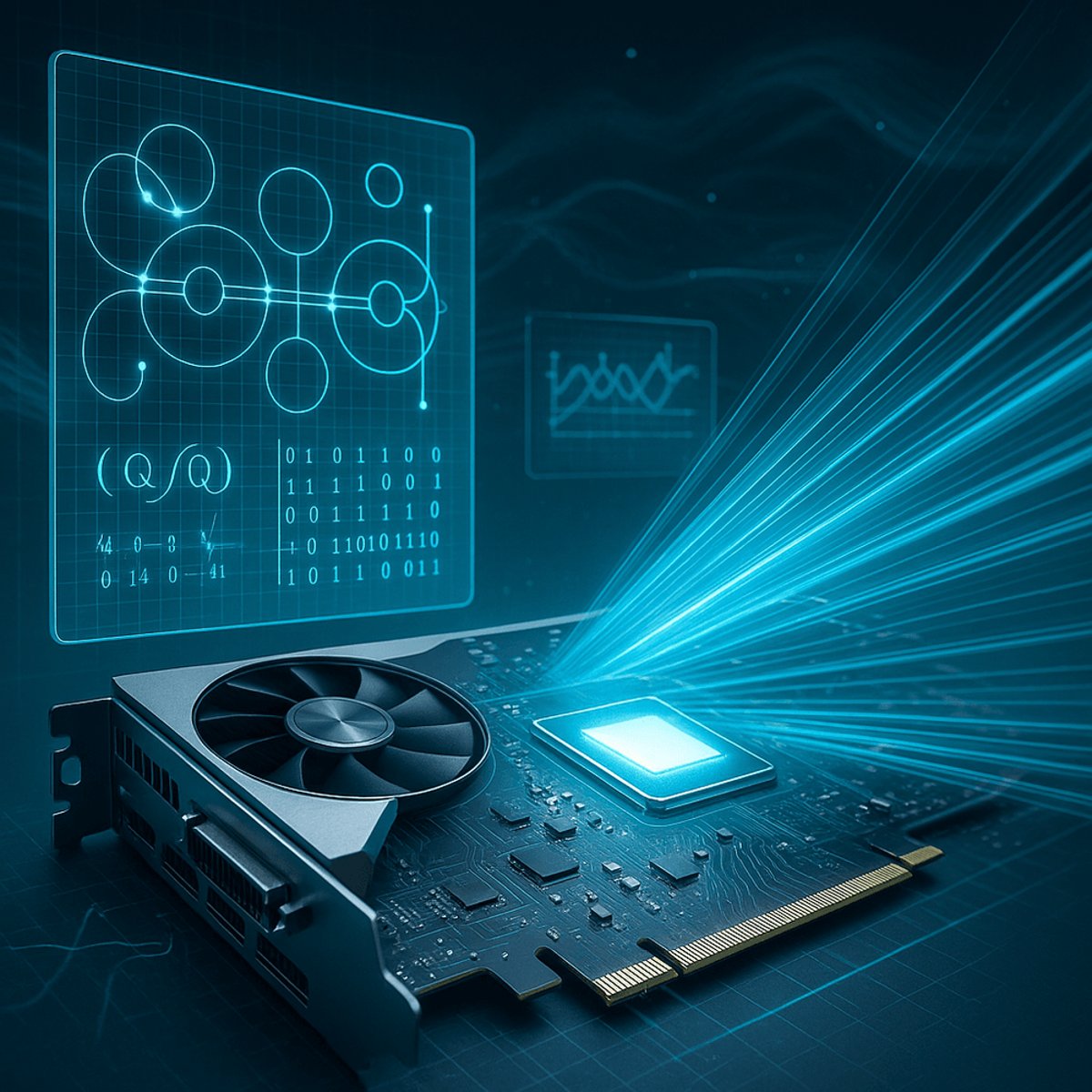
Nvidia is cracking quantum computing's biggest roadblocks with GPU power that's delivering breakthrough speed gains. The company's CUDA-Q libraries are helping researchers achieve up to 4,000x performance boosts in quantum simulations and 50x faster error correction, potentially accelerating the timeline for practical quantum applications across industries.
Nvidia just dropped a quantum bombshell that could reshape the entire computing landscape. The chip giant's latest research reveals how GPU acceleration is solving quantum computing's most stubborn problems - and the performance gains are staggering.
Quantum error correction, the holy grail of quantum computing stability, just got a massive boost. Working with the University of Edinburgh, Nvidia's CUDA-Q QEC library powered a new quantum low-density parity-check decoding method called AutoDEC that doubled both speed and accuracy. But that's just the appetizer.
The real breakthrough came through Nvidia's collaboration with quantum startup QuEra. Using the company's PhysicsNeMo framework and cuDNN library, researchers developed an AI-powered decoder with transformer architecture that achieved a mind-bending 50x boost in decoding speed while improving accuracy. "AI methods offer a promising means to scale decoding to the larger-distance codes needed in future quantum computers," Nvidia's technical team explained.
This isn't just about faster number crunching - it's about making quantum computers actually useful. Quantum error correction has been the industry's biggest headache because quantum bits are incredibly fragile, prone to errors from the tiniest environmental changes. Traditional approaches required massive computational overhead that made real-world applications nearly impossible.
But Nvidia's GPU muscle is changing that equation entirely. The company's approach frontloads the computationally intensive work by training AI models ahead of time, then runs efficient inference during actual quantum operations. It's like giving quantum computers a supercharged classical co-processor that handles the heavy lifting.
The acceleration doesn't stop at error correction. Nvidia partnered with Q-CTRL and Oxford Quantum Circuits to tackle quantum circuit compilation - the process of mapping abstract quantum algorithms to physical qubit layouts on actual chips. Their GPU-accelerated ∆-Motif method delivered up to 600x speedup by using cuDF, Nvidia's data science library, to solve graph isomorphism problems that have plagued quantum researchers for years.
Perhaps most impressive is what happened when Nvidia teamed up with the University of Sherbrooke and Amazon Web Services. They integrated the widely-used QuTiP quantum toolkit with Nvidia's cuQuantum SDK, creating a plugin called qutip-cuquantum. The result? A jaw-dropping 4,000x performance boost when simulating large quantum systems like transmon qubits coupled with resonators.
"Numerical simulation of quantum systems is critical for understanding the physics of quantum devices and for developing better qubit designs," according to Nvidia's research documentation. These simulations help researchers predict how quantum hardware will behave before they build it, potentially saving millions in development costs.
The timing couldn't be better. While competitors struggle with quantum hardware scaling, Nvidia is solving the software bottlenecks that have kept quantum computing in research labs. Google recently made headlines with quantum supremacy claims, but practical applications remained elusive due to error rates and simulation limitations.
Nvidia's approach is particularly clever because it leverages the company's existing GPU ecosystem. Researchers don't need specialized quantum hardware to make these breakthroughs - they can use the same CUDA-accelerated infrastructure that powers AI training and cryptocurrency mining.
The implications stretch far beyond quantum computing. Industries from pharmaceuticals to financial modeling have been waiting for quantum advantages in optimization and simulation. Nvidia's acceleration tools could finally make those applications economically viable by dramatically reducing the classical computing overhead required to support quantum operations.
What's next? Nvidia is showcasing quantum computing sessions at its upcoming GTC conference in Washington D.C. this October, suggesting more announcements are coming. The company's CUDA-Q platform is already available to researchers, meaning these performance gains aren't just lab curiosities - they're production-ready tools that could accelerate quantum breakthroughs across the industry.
Nvidia's quantum acceleration breakthrough represents more than just faster processing - it's potentially the missing link that brings quantum computing from research curiosity to commercial reality. By solving the classical computing bottlenecks that have held back quantum applications, Nvidia is positioning itself as the essential infrastructure provider for the quantum era. For researchers and enterprises watching quantum developments, these tools could compress years of development timelines into months, making 2024 a pivotal year for practical quantum applications.