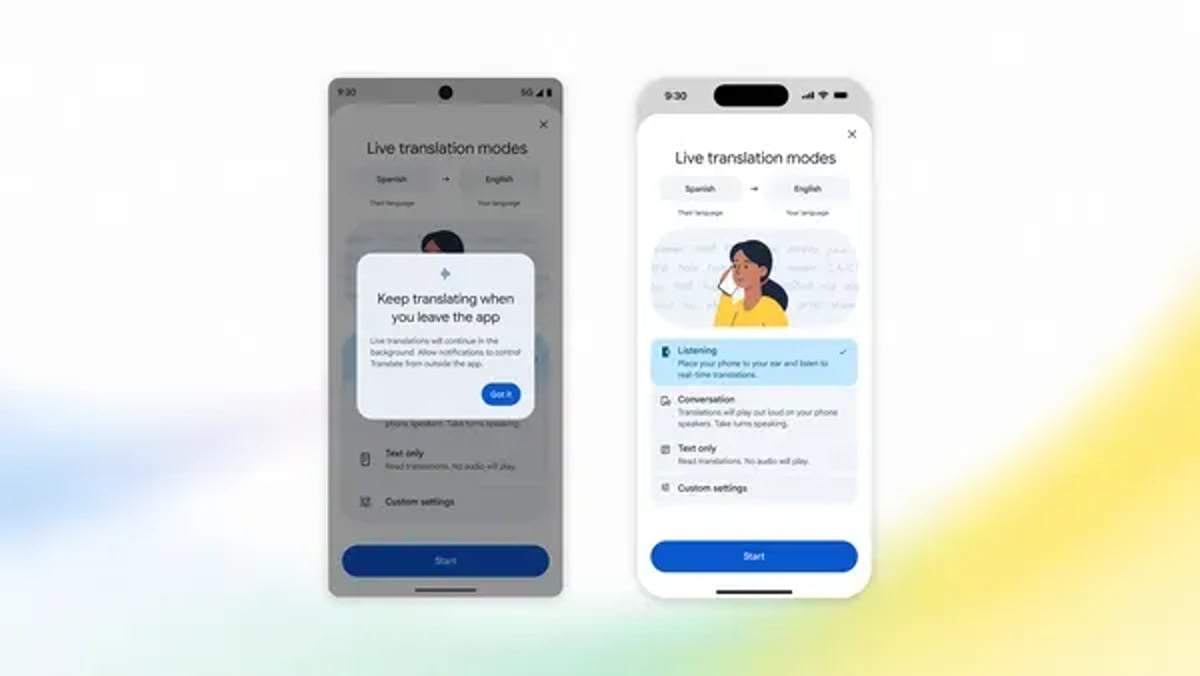
Google Translate just got a meaningful upgrade for anyone who's ever fumbled with their phone mid-conversation abroad. The app is rolling out listening mode to iOS users for the first time, while Android users can now keep live translations running even when they switch apps or lock their screen. It's a small change on paper, but for the roughly one billion people who use Translate regularly, it removes one of the app's most persistent friction points.
Google is pushing a fresh round of updates to Google Translate, and this time the improvements are less about flashy AI demos and more about fixing the everyday annoyances that make translation apps frustrating to use in real life. According to a post from Google product manager Sasha Kapur, the company is bringing listening mode to iOS for the first time, and giving Android users the ability to keep live translations running in the background, even when they've switched to another app or locked their phone screen.
For anyone who's used Translate while traveling, the pain point here is obvious. Live conversation mode has always required keeping the app open and front-and-center, which means the second you need to check a map, answer a text, or just put your phone in your pocket for a minute, the translation session stops cold. That's a bigger deal than it sounds. Real conversations don't happen in neat, uninterrupted five-minute windows, they get interrupted by phone calls, notifications, and the simple need to glance at a menu or a street sign using a different app entirely.
"We're bringing listening mode to iOS, and on Android, keep live translations running while you're using other apps or when your screen is locked," Google said in its announcement. It's a short, matter-of-fact description for what's actually a fairly significant quality-of-life shift for the app's massive global user base.
Listening mode itself isn't new. Google introduced the feature on Android a while back, letting the app passively pick up on spoken language and translate it without requiring the user to tap a microphone icon every time someone starts talking. Bringing that same capability to iOS closes a gap that's existed between the two platforms for years, and it's notable given how much of Google's mobile-first feature testing has historically leaned Android-first before eventually making its way to Apple's ecosystem.
The background translation piece for Android solves a different but related problem. Rather than losing your place every time you tap out of the Translate app, the live session now persists, meaning a traveler could have a translated conversation running while simultaneously pulling up a ride-hailing app or checking a hotel confirmation email. It's the kind of feature that sounds minor until you're the one standing in a foreign airport trying to juggle three apps at once with spotty WiFi.
This rollout comes as competition in the real-time translation space has quietly intensified. Apple has been building out its own translation capabilities baked into iOS, and hardware makers including Samsung have leaned on on-device AI translation as a selling point for their latest phones. Google's advantage has long been the sheer scale and accuracy of Translate's language models, built on years of machine translation research, but rivals closing the gap on convenience features like background operation puts some pressure on Google to keep shipping incremental improvements rather than resting on model quality alone.
There's also a broader pattern here worth noting. Google has increasingly framed Translate not as a standalone destination app but as connective tissue across its ecosystem, tying into Google Lens, Maps, and now deeper OS-level integration on both platforms. Kapur's post frames these updates as part of a continued investment in "real-world usability," language that signals Google sees Translate's future less in flashy new AI party tricks and more in removing the small frictions that determine whether people actually reach for the app in the moment they need it.
Google hasn't announced a broad timeline for global rollout beyond saying the features are shipping now, and it's unclear whether additional languages or regions will see staggered access. But for an app used daily by travelers, students, and international businesses alike, even modest usability fixes tend to move the needle on retention. The real test will be whether these changes hold up in the messy, unpredictable environments where people actually need live translation most: crowded markets, noisy restaurants, and airport gates with terrible signal.
None of this is revolutionary in the way a new AI model launch might be, but that's kind of the point. Google is betting that closing small gaps in everyday usability, like keeping a translation session alive when you check a map or lock your phone, matters more to retention than another headline-grabbing feature. For the countless travelers, students, and businesses leaning on Translate daily, this is a quiet but welcome fix, and it puts a bit more pressure on Apple and Samsung to match the convenience Google's baking into its own ecosystem.