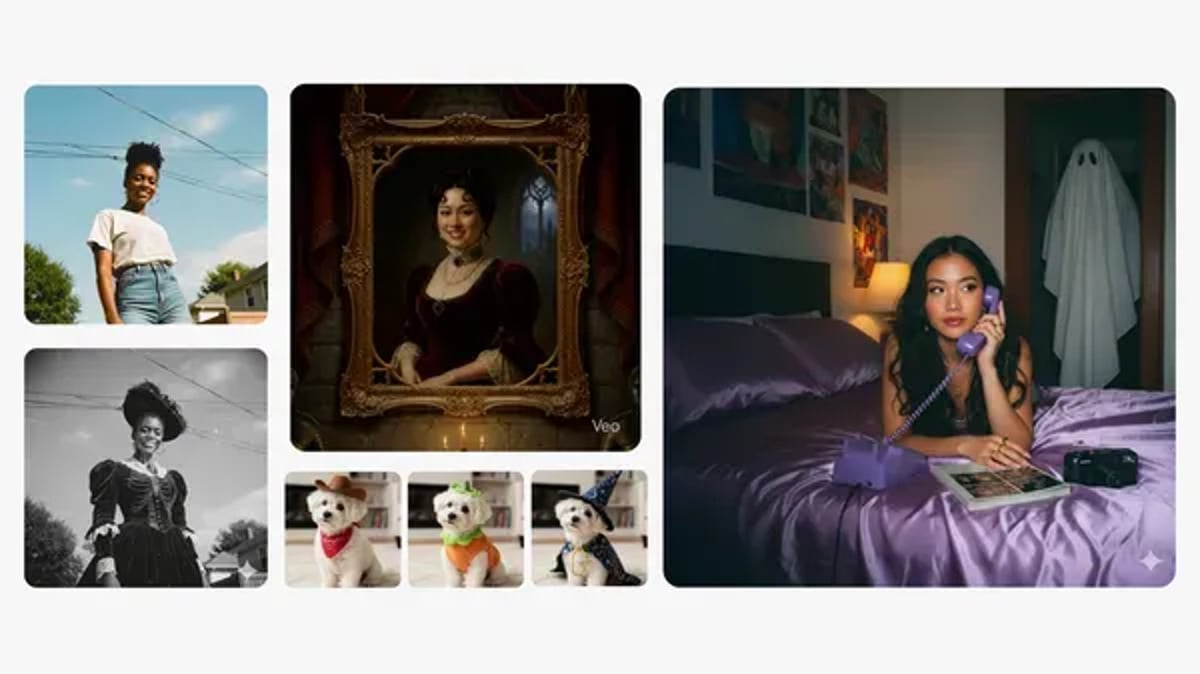
Google just dropped its most creative AI toolkit yet, perfectly timed for Halloween. The tech giant's new Nano Banana image generator and upgraded Veo 3.1 video model are turning ordinary photos into Victorian ghost portraits and everyday pets into costumed characters. With Halloween less than a week away, these tools are already generating viral content across social platforms.
Google is making this Halloween its most AI-powered yet. The company just unveiled a comprehensive suite of creative tools that turn anyone into a digital artist, whether you're designing party invites or figuring out what costume makes your dog look most adorable.
The star of the show is Nano Banana, Google's latest image generation model that's surprisingly good at understanding complex Halloween scenarios. "Transform this person into a semi-skeletal spectral translucent Victorian ghost," reads one of the suggested prompts, complete with instructions for "black and white Daguerreotype" styling. The results are genuinely impressive - users are already sharing Victorian ghost selfies that look like they stepped out of a 19th-century photograph.
Google Photos users in the US are getting an early Halloween treat too. The app's new Remix feature can transform any photo into Halloween-themed artwork using what Google calls "AI-powered style transfer." The Halloween Remix option joins new Claymation, Pixel Art, and Ukiyo-e styles that launched alongside the seasonal feature.
But Google's not stopping at still images. The company quietly upgraded its Veo video generation model to version 3.1, adding what Google describes as "richer audio, more narrative control" and better prompt adherence. Early users are creating everything from spooky moving portraits to cute autumn scenes featuring trick-or-treating pets.
"We recently released Veo 3.1, our latest state-of-the-art video generation model," Google explained in their blog post. The upgrade comes just as video generation is becoming the next battleground in AI creativity tools, with OpenAI's Sora still in limited testing.
The timing couldn't be better. Social media platforms are already flooded with AI-generated Halloween content, from TikTok users showing off their Nano Banana creations to Instagram stories featuring Veo-generated spooky scenes. One particularly viral example shows a Victorian woman literally climbing out of her portrait frame - the kind of content that would have required a Hollywood VFX team just a few years ago.
Google Labs is also getting into the Halloween spirit with Mixboard, an experimental AI tool that helps visualize costume ideas. Users can input basic concepts and watch as the AI generates multiple variations, whether for individuals, couples, or even pets. It's the kind of creative brainstorming tool that shows where AI assistance is headed - not replacing human creativity, but amplifying it.
Perhaps most practically, Google's Canvas tool can now turn any photo into a pumpkin carving template. "Make an app that turns my selfie into a jack-o'-lantern and gives me a design I can carve at home," is all it takes to get a custom carving pattern. The feature taps into Canvas's ability to create interactive web applications on the fly.
The rollout represents Google's broader strategy of making AI tools more accessible through seasonal, practical applications. Rather than focusing purely on technical capabilities, these Halloween features demonstrate real-world utility that gets people experimenting with AI in low-stakes, fun ways.
For Android users in the US, there's an additional treat: Google Photos' "Help me edit" feature can now suggest festive and spooky edits directly in the photo editor. It's another example of Google embedding AI assistance into existing workflows rather than requiring users to learn entirely new applications.
The competitive implications are significant. While Meta focuses on AI integration across its social platforms and OpenAI perfects its text-to-video capabilities, Google is taking a different approach - making AI creativity tools part of everyday apps that people already use.
The Halloween timing also serves as a testing ground for Google's creative AI capabilities ahead of the crucial holiday shopping season. If these tools generate significant user engagement and social media buzz, expect to see similar themed releases around Christmas and New Year's.
Google's Halloween AI toolkit represents more than seasonal marketing - it's a glimpse into how AI creativity tools are becoming mainstream consumer products. By packaging advanced image and video generation capabilities into fun, accessible features, Google is quietly building the foundation for widespread AI adoption. As these tools prove their value during Halloween, expect similar AI-powered creativity features to become standard across Google's ecosystem. The real test isn't just whether people use these tools once, but whether they become part of how we naturally express creativity in our digital lives.