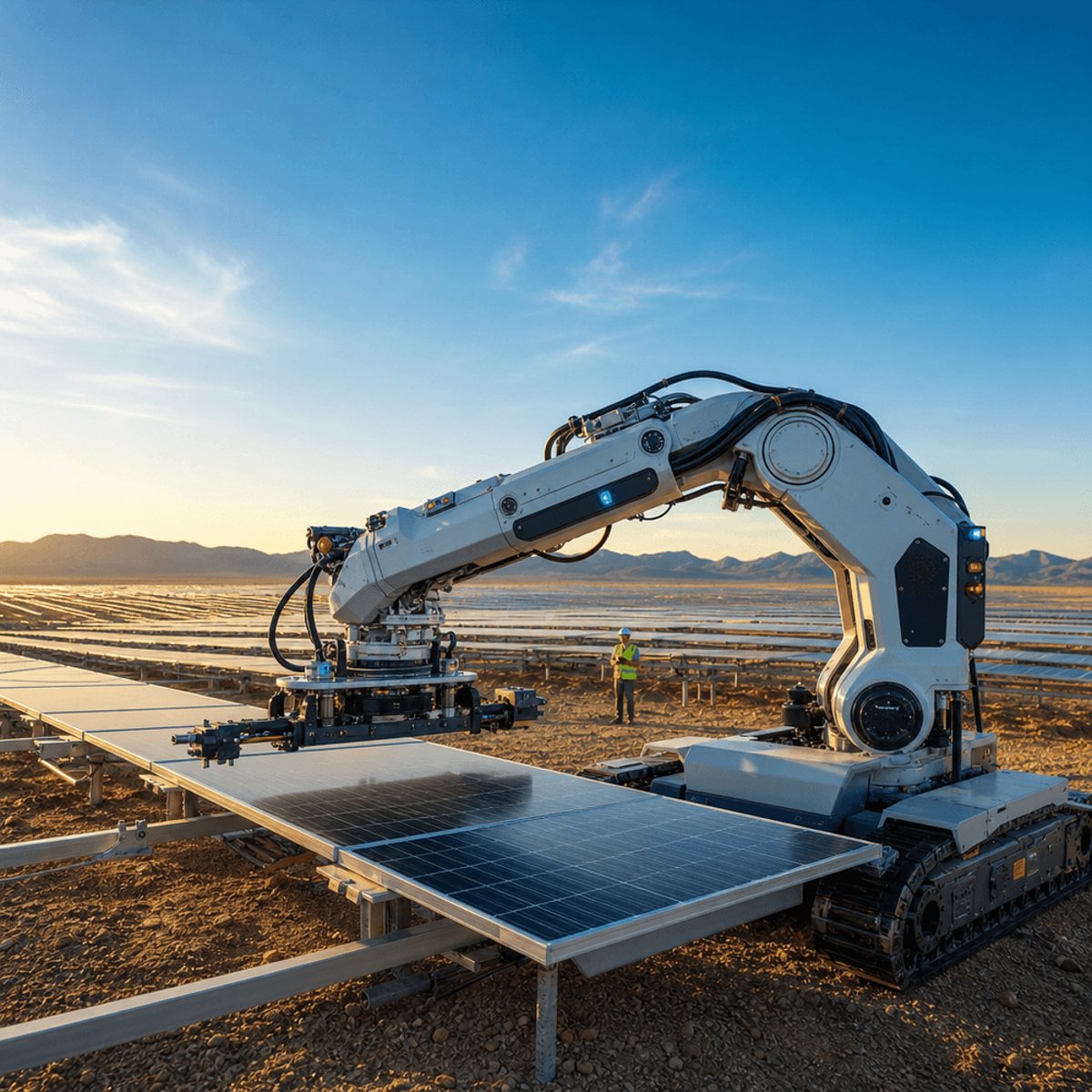
Construction sites are about to get a robotic makeover. Gritt, a stealth-mode startup building AI-powered robots for solar farm installation, just emerged with $34 million in funding and a bold plan to automate the industry's toughest jobs. The company is betting that the renewable energy construction boom—projected to hit $1.5 trillion globally by 2030—needs automation to keep pace with demand.
Gritt is placing a big bet on an unsexy problem: there aren't enough humans willing to do the backbreaking work of building solar farms. The startup's solution? Robots that can handle the repetitive, physically demanding tasks that slow down renewable energy projects and drive up costs.
The $34 million round positions Gritt in a construction automation race that's heating up fast. The U.S. construction industry faces a worker shortage of over 650,000 people, according to Associated Builders and Contractors data, while solar installations alone are expected to triple by 2030 under current climate policies. That gap between ambition and execution is exactly what Gritt is targeting.
What makes construction robotics so challenging isn't just the physical demands—it's the unstructured environments. Unlike factory floors where robots thrive on predictability, construction sites are chaotic, weather-dependent, and constantly changing. Gritt's machines will need advanced computer vision and adaptive AI to navigate terrain, adjust to site conditions, and work safely alongside human crews.
The company's stealth period suggests they've been quietly testing and refining their technology before going public. That's a smart play in robotics, where premature launches can burn through capital on hardware iterations. By emerging with substantial funding already secured, Gritt signals they've likely demonstrated proof-of-concept to investors.
Solar farm construction is a strategic first target. The work is highly repetitive—mounting panels, driving posts, running conduit—making it ideal for automation. Projects are also massive in scale, with utility-scale solar farms covering hundreds of acres. Speed up installation by even 20%, and the economics become compelling fast.
But Gritt's ambitions clearly extend beyond solar. The "then, everything else" pitch suggests they're building platform technology that can adapt to different construction verticals. That modular approach mirrors successful robotics companies like Boston Dynamics, which developed core locomotion tech before targeting specific applications.
The funding environment for construction tech has been mixed lately. While infrastructure robotics attracted $2.3 billion in venture investment in 2025, several high-profile construction automation startups have struggled with unit economics. Built Robotics, which makes autonomous earthmoving equipment, laid off staff last year amid slower-than-expected adoption. Canvas, the drywall-installing robot maker, pivoted its business model twice before finding traction.
Gritt will need to prove it can deliver robots that actually pencil out for contractors. That means machines reliable enough to run with minimal supervision, fast enough to justify their cost versus human labor, and adaptable enough to handle site variations. It's a tall order, but the $34 million war chest gives them runway to iterate.
The competitive landscape is getting crowded. Toggle, Dusty Robotics, and several others are attacking different construction automation niches. What might differentiate Gritt is their apparent focus on outdoor, large-scale infrastructure rather than interior building tasks. Solar farms, wind installations, and utility projects share characteristics that could let Gritt's tech transfer more easily than general construction robotics.
Timing could work in Gritt's favor. The Inflation Reduction Act is pumping billions into renewable energy projects, creating urgency around installation capacity. Contractors who can deploy faster and cheaper will win massive contracts. If Gritt's robots can shave weeks off project timelines, they'll have customers lining up.
The next 18 months will be telling. We'll see whether Gritt can move from stealth-mode prototypes to field deployments at scale, and whether their tech holds up under real-world construction site punishment. The company will also need to navigate complex relationships with construction unions and contractors wary of automation displacing workers.
What's clear is that construction automation is no longer science fiction. It's becoming a necessity as the gap between infrastructure ambitions and available labor keeps widening. Gritt is making a calculated bet that robots can finally bridge that gap—starting with the solar farms that will power our electric future.
Gritt's emergence from stealth with serious funding reflects a broader shift in how we think about solving labor shortages—not by attracting more workers to demanding jobs, but by redesigning the jobs themselves. If they can deliver on the promise of reliable, cost-effective construction automation, they won't just build solar farms faster. They'll prove that robotics can finally crack one of the last industries to resist automation. For an economy racing to build clean energy infrastructure at unprecedented scale, that could be the breakthrough we've been waiting for. Watch whether Gritt can announce actual deployment partners in the next quarter—that'll be the real test of whether this technology is ready for prime time.