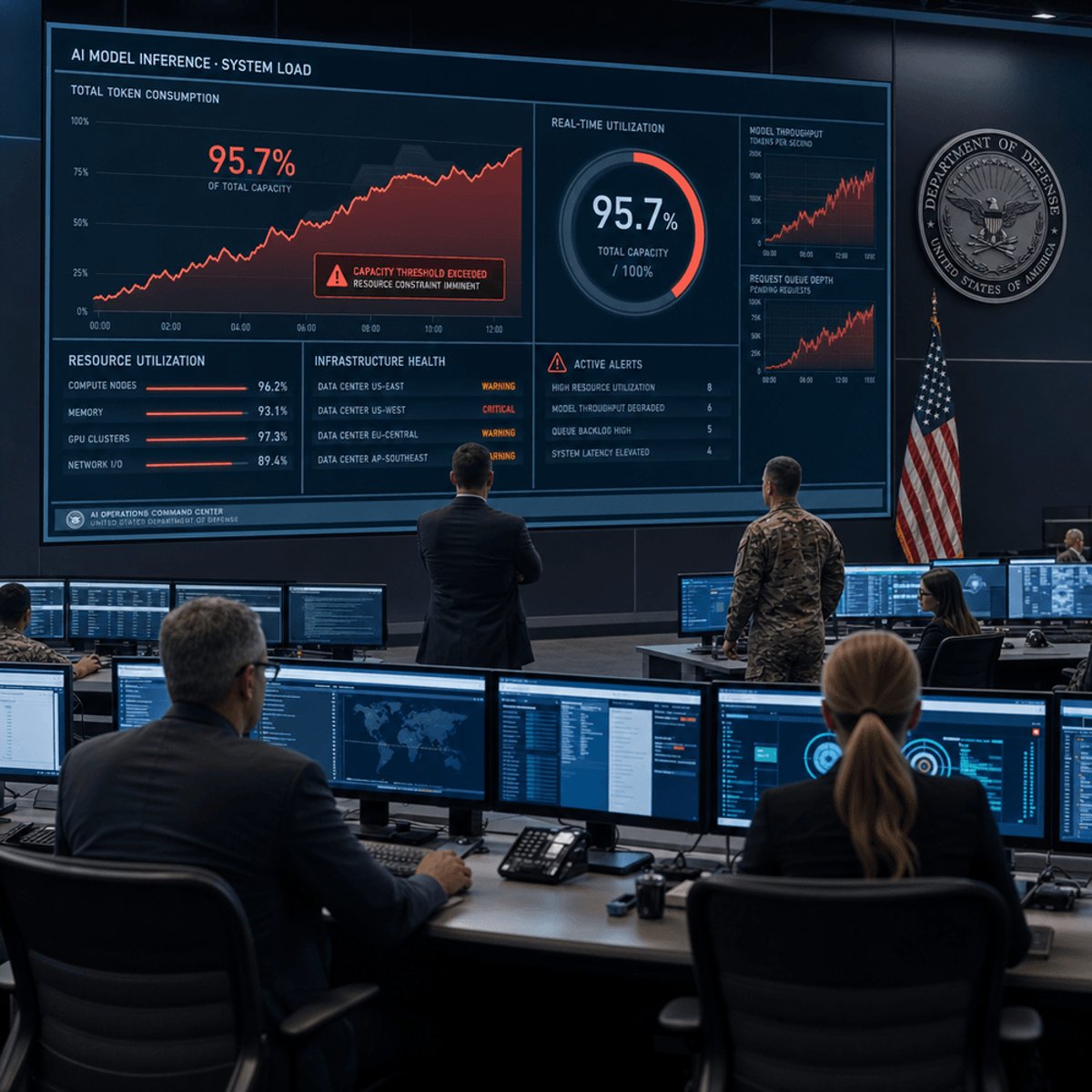
The U.S. Army just hit a wall that every enterprise dreads - running out of AI capacity faster than expected. Army members received an internal email warning they've been depleting their AI token allocation at an unsustainable rate and need to pump the brakes immediately, according to Wired. The incident exposes a critical blind spot in enterprise AI deployments: organizations are consistently underestimating how quickly users will adopt and consume AI resources once they're available.
The U.S. Army is learning a hard lesson about AI adoption that most enterprises face eventually - users consume AI resources way faster than anyone plans for. Army personnel received internal communications this week alerting them to a critical problem: they're burning through their allocated AI tokens at an alarming rate and need to scale back usage immediately.
The warning, first reported by Wired, signals a problem that extends far beyond military operations. It's a canary in the coal mine for every organization deploying AI tools across large user bases. The Army's token crisis exposes the massive gap between theoretical AI budgets and actual consumption patterns when thousands of users get their hands on these tools.
Here's what's really happening: the Army likely based its token allocation on conservative usage estimates, assuming personnel would use AI tools sparingly for specific tasks. But that's not how AI adoption works in practice. Once people discover they can offload cognitive work to AI - whether it's drafting reports, analyzing data, or generating summaries - usage explodes exponentially. What starts as occasional assistance becomes an always-on productivity multiplier.
The token economics are brutal. Major AI providers like OpenAI, Anthropic, and Google charge based on token consumption, where both input prompts and output responses count against your allocation. A single lengthy document analysis or complex query can burn through thousands of tokens in seconds. Multiply that across thousands of Army personnel using AI throughout their workday, and you get a budget crisis.
This isn't just an Army problem - it's an enterprise AI problem. Companies deploying tools like Microsoft Copilot, Google Workspace AI, or custom LLM integrations are facing similar shocks. Early enterprise AI adopters consistently report that actual usage runs 3-5x higher than initial projections, according to industry analysis. The difference is that private companies can often purchase additional capacity on the fly, while government agencies face rigid budget constraints and procurement processes.
The military context adds another layer of complexity. The Department of Defense has been aggressively pushing AI adoption across all branches as part of its modernization strategy. The Army's Joint Artificial Intelligence Center and other DoD initiatives have been rolling out AI tools for everything from logistics optimization to intelligence analysis. But the infrastructure planning apparently didn't account for the reality that soldiers and officers would embrace these tools as enthusiastically as they have.
What makes this situation particularly revealing is the solution the Army chose: rationing. Instead of immediately procuring more tokens, they're asking personnel to limit usage. That suggests either budget inflexibility, procurement bottlenecks, or both - classic government technology challenges that private sector organizations don't face as acutely. It also hints at the possibility that the Army didn't build sufficient buffer into their initial token purchase, a planning failure that enterprise IT leaders should note carefully.
The incident also raises questions about AI governance and prioritization. When tokens become scarce, who gets priority access? Critical intelligence operations? Administrative efficiency? Training and education? The Army now faces the uncomfortable task of deciding which AI use cases matter most, something they probably should have determined before deployment.
For the broader enterprise AI market, the Army's token crisis is a wake-up call. Organizations need to build significantly more capacity headroom than they think they'll need, implement real-time usage monitoring, and establish clear governance policies before usage spirals. The alternative is exactly what the Army is experiencing - scrambling to ration access after users have already become dependent on AI tools for daily productivity.
The timing couldn't be more awkward for the Pentagon's AI ambitions. The Department of Defense has positioned itself as a leader in responsible AI adoption, and running out of tokens two years into a major AI push doesn't exactly project cutting-edge capability. It suggests the military's AI strategy might be running ahead of its operational planning - lots of vision about AI-powered warfare and intelligence, but insufficient attention to the mundane details of capacity planning and cost management.
The Army's token crisis is a cautionary tale for every organization betting big on AI. It doesn't matter how transformative your AI strategy is if you can't keep the lights on because users embraced it faster than you planned. The real story here isn't about the military specifically - it's about the universal challenge of matching AI infrastructure to actual human behavior. Organizations need to assume users will consume 3-5x more AI than projected, build that buffer into initial deployments, and establish governance frameworks before hitting the usage ceiling. The Army will figure this out and procure more tokens, but the lesson for enterprise IT leaders is clear: in AI adoption, it's better to over-provision and look wasteful than under-provision and face rationing. The cost of running out isn't just financial - it's the productivity loss and user frustration when people who've come to depend on AI suddenly can't access it.