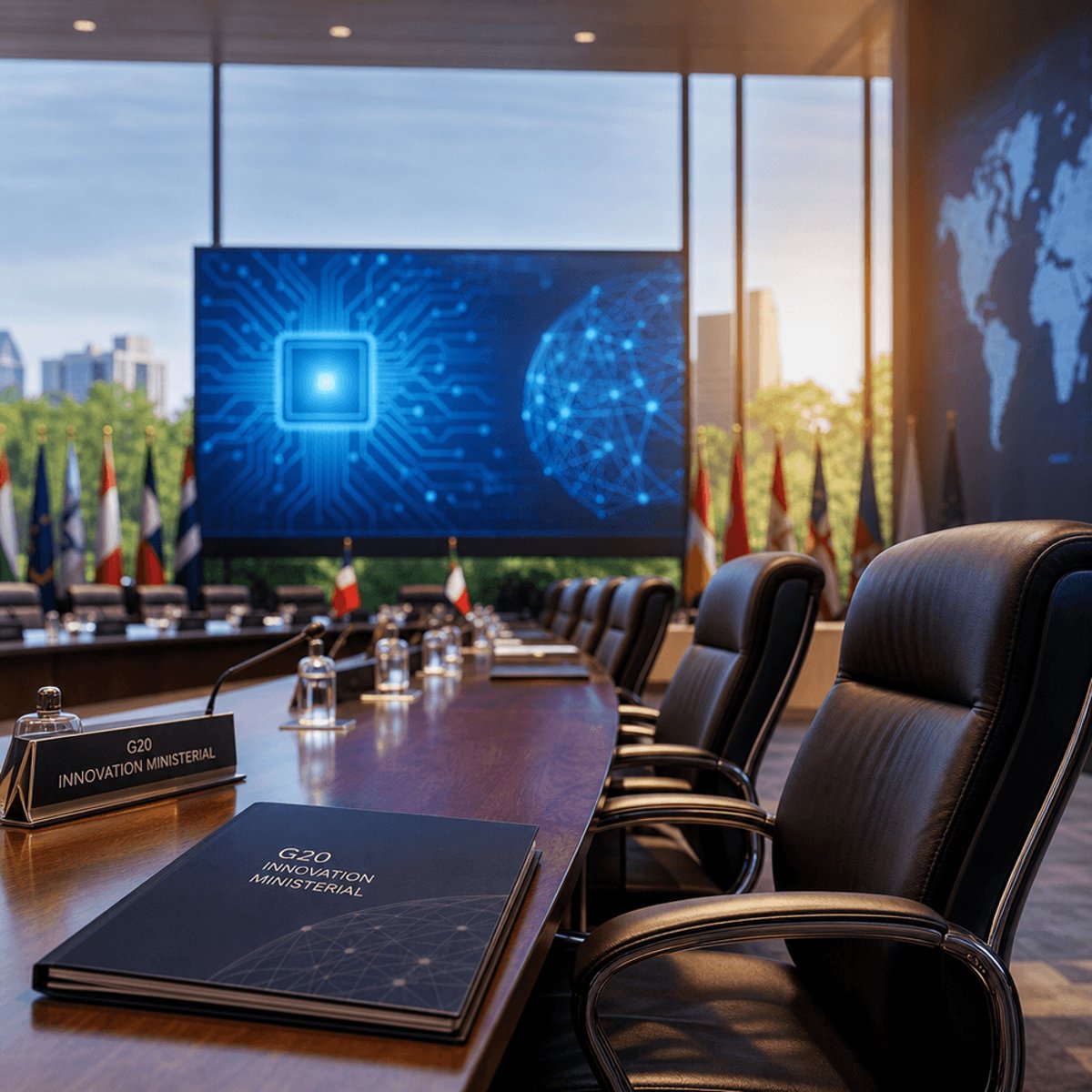
Commerce Secretary Howard Lutnick is set to host Day 2 of the G20 Innovation Ministerial in Chapel Hill, North Carolina, bringing together Nvidia CEO Jensen Huang and OpenAI chief Sam Altman for high-stakes talks on AI policy and trade. The gathering, which pulls in ministers from across the G20, signals just how central chipmakers and AI labs have become to global economic diplomacy.
The G20 Innovation Ministerial rolled into its second day in Chapel Hill, North Carolina, and this time the guest list reads like a who's who of the AI industry. CNBC's live blog has Commerce Secretary Howard Lutnick running the show, with Nvidia CEO Jensen Huang and OpenAI chief Sam Altman both expected to weigh in on where AI policy is headed next. That's not a small thing. When you've got the guy who makes the chips powering nearly every major AI model sitting across the table from the guy who built ChatGPT, and both of them are talking to actual government ministers instead of investors, it tells you the conversation has shifted from Silicon Valley boardrooms to the halls of trade diplomacy.
It's easy to forget how fast this happened. Just a few years ago, G20 innovation talks were mostly about broadband access and digital taxation. Now the agenda is dominated by questions of who gets access to advanced chips, how export controls should work, and whether AI labs need international oversight at all. Huang has spent much of the past two years crisscrossing the globe making the case that Nvidia's hardware should flow more freely to allied nations, arguing that restricting access just pushes countries toward domestic alternatives or, worse, Chinese suppliers. Altman, meanwhile, has become something of a fixture at these government gatherings, pitching a version of AI governance that keeps innovation moving while giving regulators just enough guardrails to feel comfortable.
What makes Chapel Hill notable isn't just the star power, it's the venue. Hosting a G20-level AI summit outside the usual Washington or Geneva circuit signals that the current U.S. administration wants to frame this as a homegrown tech diplomacy win, not just another multilateral photo-op. Lutnick's Commerce Department has been increasingly vocal about positioning American AI infrastructure and chip supply chains as strategic assets, and putting Huang and Altman in the same room as foreign ministers is about as direct a statement as you can make without a press release.
The timing also lines up with ongoing friction over chip export rules. Nvidia has publicly pushed back against tighter restrictions on shipments to certain markets, warning that overly aggressive controls could hand market share to rivals rather than actually slow down adversarial AI development. Ministers from other G20 nations, several of whom are trying to build out their own domestic AI ecosystems, have their own interests here too. Some want easier access to Nvidia's GPUs. Others are more focused on making sure AI labs like OpenAI comply with data and safety rules specific to their countries. Getting all of that into a coherent joint statement, if that's even the goal, is no small task.
For Altman, the stakes are a bit different. OpenAI has been navigating a patchwork of AI regulation across the U.S., EU, and Asia, and events like this give the company a chance to shape the conversation before rules get locked in. Company representatives have said in past forums that they'd rather work with regulators early than get surprised by rules written without their input, a sentiment Altman has echoed in interviews tied to previous policy events.
What happens next matters more than the panel discussions themselves. If the ministerial produces any kind of framework on chip export norms or AI safety standards, it could ripple through how companies like Nvidia, OpenAI, and their competitors plan product rollouts and market expansion for the next few years. If it doesn't, and this turns into another round of talking without concrete commitments, that's arguably just as telling about how fractured global AI governance still is. Either way, having the industry's most influential voices in the same room as the people writing the rules is a shift worth watching closely.
This ministerial is another sign that AI policy has fully left the realm of tech-industry self-regulation and entered the world of international trade negotiation. With Nvidia's hardware dominance and OpenAI's model leadership both on the table, decisions made in rooms like this one in Chapel Hill could shape chip export rules, AI safety norms, and market access for years to come. Readers should keep an eye on whether concrete commitments emerge from Day 2, or whether this ends up being another high-profile conversation without binding outcomes.