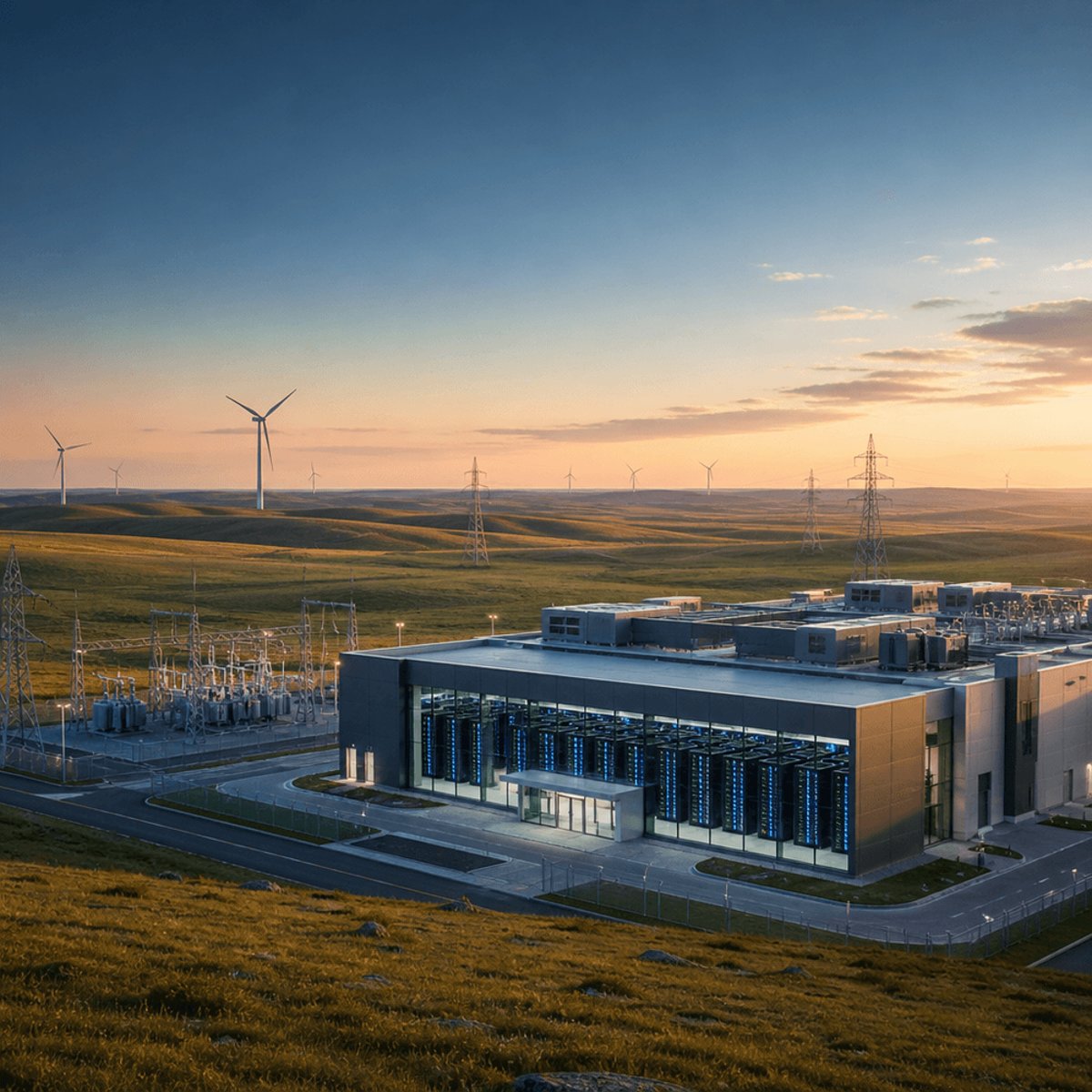
China's AI boom has an unlikely epicenter: a city in Inner Mongolia that's rapidly becoming the country's most strategic data center hub. Driven by cheap energy, vast land availability, and crucial proximity to Beijing, this remote region is now powering the computational demands of Chinese AI companies racing to compete globally. The development reveals how China's approach to AI infrastructure differs sharply from Western strategies, prioritizing geographic advantages over traditional tech hubs.
While Silicon Valley and Seattle dominate headlines about AI infrastructure, China's betting on a very different geographic strategy. An Inner Mongolia city is quietly becoming the backbone of the country's AI ambitions, and the reasons why reveal something fundamental about how the global AI race is actually being fought.
The transformation didn't happen by accident. Chinese AI companies and data center operators faced a problem: training large language models and running AI inference at scale requires massive amounts of electricity and physical space. Beijing and Shanghai, the traditional tech powerhouses, offer neither affordably. Enter Inner Mongolia, where coal-fired power plants and renewable energy projects provide electricity at a fraction of coastal city prices, and land stretches endlessly across the steppe.
Proximity matters more than you'd think. The region sits close enough to Beijing that latency remains manageable for real-time applications, but far enough that land and energy costs plummet. It's the goldilocks zone for infrastructure that needs to be both powerful and economical. For companies building China's answer to ChatGPT and other AI systems, this geographic arbitrage makes the difference between profitable operations and burning through capital.
The build-out happening across Inner Mongolia represents billions in infrastructure investment. Massive data centers, some spanning hundreds of thousands of square feet, are rising from what was recently empty land. These facilities house the GPUs and specialized AI chips powering everything from facial recognition systems to autonomous vehicles to the large language models Chinese companies are racing to perfect.
But there's a deeper strategy at play. US export controls have restricted China's access to the most advanced chips from Nvidia and other American manufacturers. By building out massive data center capacity now, Chinese companies are preparing to maximize whatever computational resources they can secure or manufacture domestically. It's infrastructure-first thinking: build the facilities, optimize for efficiency, and scale whatever hardware becomes available.
The energy equation is particularly crucial. Training a single large AI model can consume as much electricity as hundreds of homes use in a year. Inner Mongolia's energy mix, while still heavily reliant on coal, is rapidly incorporating wind and solar projects. The region's vast open spaces make it ideal for renewable installations, and local governments are pushing hard to attract tech investment with favorable energy rates and tax incentives.
This isn't just about one city. Inner Mongolia's emergence reflects China's broader approach to technology infrastructure: decentralize computing power away from expensive coastal cities, leverage regional advantages, and build capacity that can support long-term technological ambitions. Other provinces are watching closely and offering their own incentives to attract data center investment.
The implications extend beyond China's borders. As AI companies worldwide grapple with the environmental and financial costs of training ever-larger models, China's willingness to build massive infrastructure in lower-cost regions could provide a sustainable advantage. While US companies debate building new data centers in expensive markets or dealing with local opposition to energy-intensive facilities, Chinese competitors are simply building at scale wherever it makes economic sense.
For global AI competition, geography might matter more than most analysts assumed. The country that can deploy the most computational power at the lowest cost gains advantage in the race to train better models, serve more users, and iterate faster. Inner Mongolia's transformation from pastoral economy to AI infrastructure hub shows how quickly that geography can shift.
The development also highlights how US chip restrictions, while limiting China's access to cutting-edge hardware, may have inadvertently pushed Chinese companies toward more efficient infrastructure strategies. When you can't simply throw the most powerful chips at every problem, you optimize everything else: facility design, cooling systems, energy sourcing, and geographic placement.
Inner Mongolia's unlikely rise as China's AI infrastructure hub reveals how the global technology race is being fought on multiple fronts. While much attention focuses on chip technology and model capabilities, the unglamorous work of building cost-effective, scalable infrastructure may prove equally decisive. As Chinese companies continue expanding computational capacity in regions offering geographic and economic advantages, Western competitors will need to reconsider whether concentrated tech hubs remain the optimal strategy. The AI boom's next chapter might be written not in Silicon Valley boardrooms, but across the windswept plains where cheap energy meets unlimited ambition.