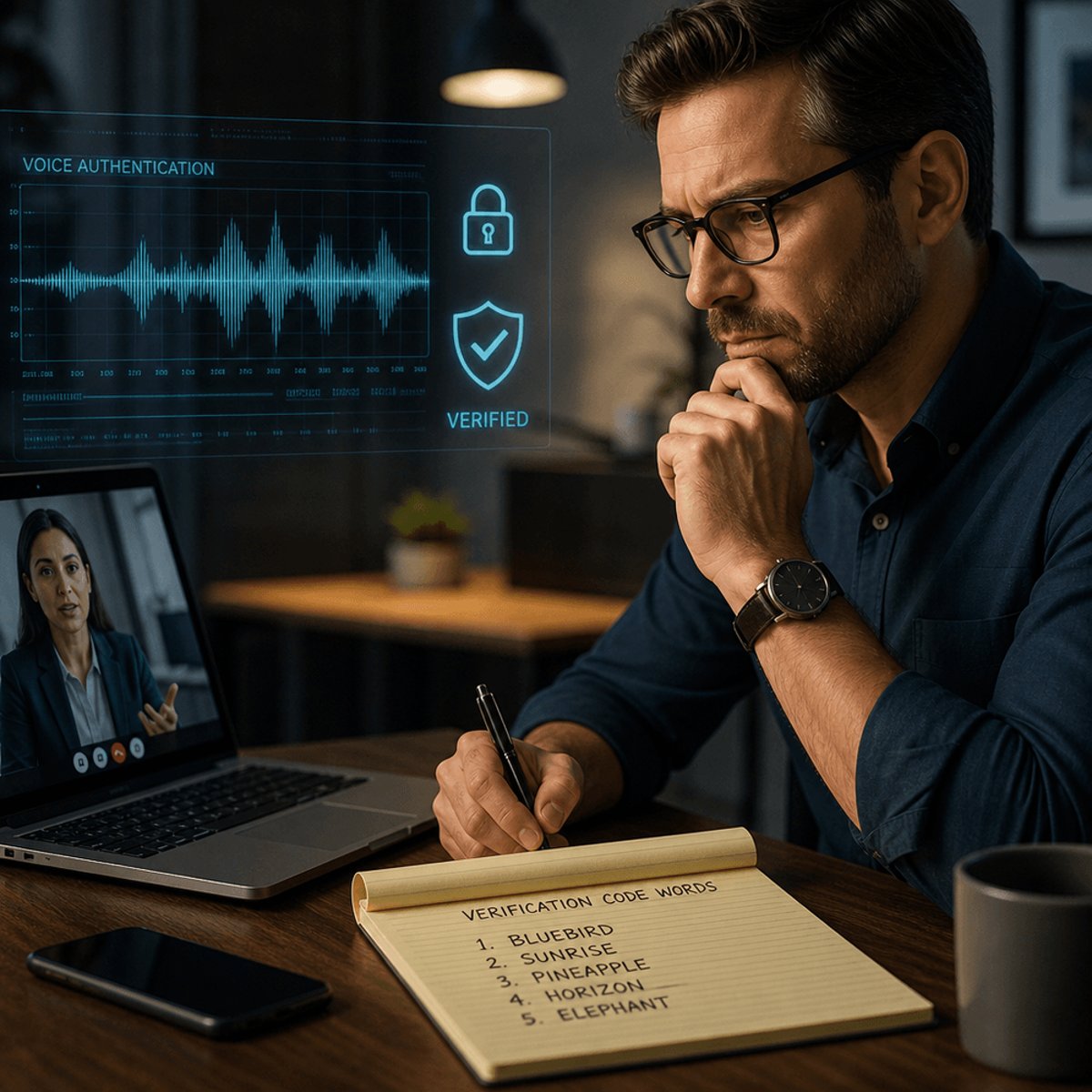
The arms race against AI deepfakes just took an unexpected turn backward. As synthetic voice cloning and video manipulation grow too sophisticated for traditional detection methods, cybersecurity experts are dusting off a decidedly analog defense: predetermined code words and security phrases. The shift marks a stark acknowledgment that AI-generated impersonations have crossed a threshold where technical tells no longer reliably separate real from fake.
The deepfake problem has officially outrun the technology meant to stop it. Security researchers are now advocating for something that sounds lifted from a spy novel: families and colleagues should establish secret code words to verify each other's identity during phone calls or video chats. It's a remarkable retreat from digital solutions, but one that reflects just how convincing AI-generated impersonations have become.
The recommendation comes as financial institutions and law enforcement report a sharp uptick in fraud cases where criminals use AI voice cloning to impersonate executives, family members, or trusted contacts. Unlike earlier deepfakes that carried telltale glitches or uncanny valley artifacts, modern generative AI models can replicate vocal patterns, speech cadences, and even emotional inflections with alarming accuracy. The traditional advice to listen for odd phrasing or robotic delivery no longer holds.
What makes this defense strategy particularly notable is its complete bypass of the technological detection arms race. Rather than relying on AI to spot AI - a cat-and-mouse game that attackers currently seem to be winning - the verbal password approach leverages something deepfakes fundamentally can't access: shared memories and pre-established secrets between real people. If your sister calls asking for an urgent wire transfer, asking her to recall your childhood pet's name becomes a authentication layer no language model can penetrate without prior knowledge.
The tactic isn't entirely without precedent. Intelligence agencies and high-security organizations have long used duress codes and verification protocols for exactly this purpose. But recommending it for everyday consumer use signals how democratized and accessible deepfake technology has become. Tools that once required specialized expertise and computing resources now run on consumer hardware, putting sophisticated identity theft capabilities within reach of low-skill attackers.
Cybersecurity experts emphasize the approach requires advance planning to be effective. Establishing code words during a crisis, when someone may already be targeted, defeats the purpose. Instead, families should have these conversations proactively, choosing phrases or questions that would be difficult for an outsider to research through social media or public records. The password could be as simple as a shared inside joke or as specific as a detail from a private conversation.
The strategy also extends beyond just voice calls. With AI video generation improving rapidly, even video chat verification is becoming unreliable. Researchers have demonstrated real-time face-swapping technology that can manipulate live video feeds with minimal latency. In that environment, asking someone to perform a specific physical action or reference a recent in-person interaction becomes crucial.
But the verbal password approach isn't without limitations. It assumes both parties remember to use it, that conversations happen in real-time rather than through recordings, and that attackers haven't somehow compromised the pre-shared secret. It also creates friction in legitimate communications, adding an extra verification step to what should be straightforward interactions. The challenge is balancing security with usability in a way that doesn't fatigue people into abandoning the practice.
What this shift really underscores is a broader inflection point in AI security. For years, the assumption was that better AI detection tools would eventually catch up to generative capabilities. That confidence is eroding as models grow more sophisticated and detection methods struggle with false positives. The result is a grudging acknowledgment that some security problems might require human-centric solutions rather than purely technological ones.
Financial institutions are already adapting. Some banks now recommend customers establish verbal passwords for phone support interactions, particularly for high-value transactions. Corporate security teams are implementing similar protocols for executive communications, especially around sensitive requests like fund transfers or access grants. The practice is spreading from high-risk scenarios to everyday precautions.
The irony isn't lost on security researchers. After decades of pushing toward passwordless authentication, biometric verification, and AI-powered security systems, the answer to AI-generated threats circles back to something that predates the digital age entirely. It's a reminder that sophisticated attacks sometimes demand elegantly simple defenses - and that the human element remains both the weakest link and the strongest verification layer in cybersecurity.
The resurgence of verbal passwords as a deepfake countermeasure represents more than just a tactical shift - it's a recognition that the AI detection race has hit a wall. While technological solutions continue to evolve, the immediate reality demands practical defenses that work today, not theoretical tools that might catch up tomorrow. For individuals and organizations alike, the message is clear: start having those awkward conversations about code words now, before the call comes from someone who sounds exactly like your boss but isn't. In the age of perfect digital mimicry, sometimes the oldest tricks really are the best ones.