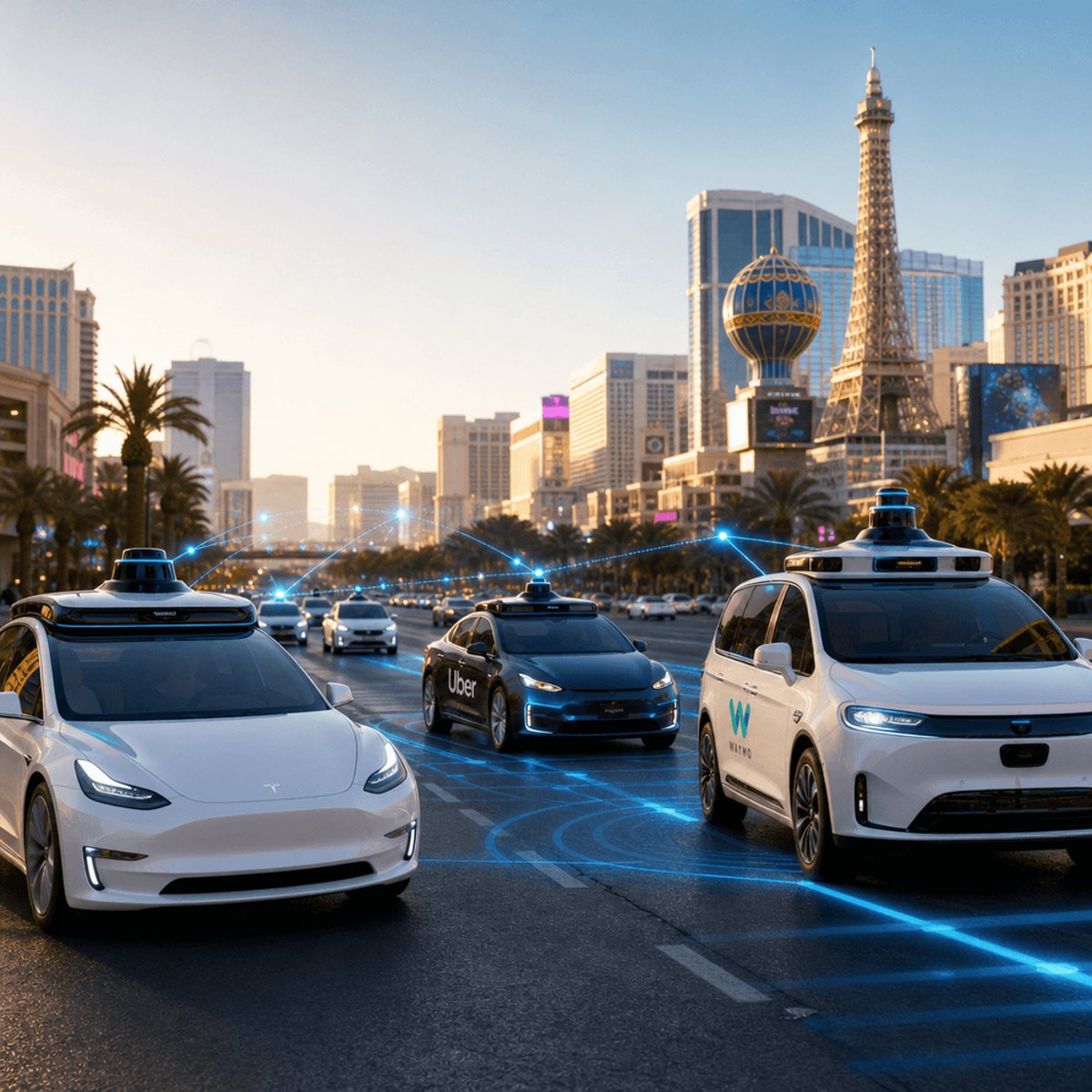
Nevada just handed the autonomous vehicle industry its biggest regulatory win yet. State officials approved permits allowing Tesla, Uber, and Waymo to deploy up to 8,000 robotaxis across the state over the next 12 months, according to filings reported by TechCrunch. It's the clearest signal yet that autonomous ride-hailing is moving from pilot programs to mass deployment, and Nevada's betting its tourism and transportation economy on three tech giants getting self-driving right.
Nevada just became the autonomous vehicle industry's most important battleground. State regulators approved a massive expansion that allows Tesla, Uber, and Waymo to collectively operate up to 8,000 robotaxis on Nevada roads over the next year. The permits, issued according to TechCrunch, represent the largest coordinated autonomous vehicle deployment approved by any state to date.
The timing couldn't be more significant. While Waymo has been quietly racking up millions of autonomous miles in cities like San Francisco and Phoenix, and Tesla has promised its robotaxi network for years, Nevada's approval gives all three companies the regulatory runway to prove their technology works at scale. For Uber, which shut down its own self-driving unit after a fatal 2018 crash, the permits mark a return to autonomous ambitions through partnerships rather than proprietary tech.
Nevada's been flirting with autonomous vehicles since 2011, when it became the first state to authorize self-driving car testing. But this expansion is different - it's not about controlled experiments on empty desert roads. Las Vegas, with its 24/7 tourism economy, congested Strip traffic, and constant demand for rides, offers the perfect stress test for robotaxi services that need to work in dense urban environments.
The competitive dynamics are fascinating. Waymo, backed by Alphabet, enters with the most autonomous miles logged and arguably the most conservative approach - its vehicles use expensive lidar sensors and operate in carefully mapped areas. Tesla, meanwhile, has bet everything on camera-based vision and neural networks, claiming its approach will scale faster and cheaper once the software matures. Uber is taking the platform play, partnering with autonomous vehicle makers to integrate self-driving cars into its existing ride-hailing network.
What's not clear from the permits is how the 8,000-vehicle allocation breaks down between the three companies, or what specific operational restrictions apply. Nevada's Department of Motor Vehicles hasn't released detailed terms, and none of the companies have disclosed their individual fleet plans. But the sheer number suggests regulators are confident enough in the technology to allow meaningful commercial operations, not just token pilot programs.
The approval also puts pressure on other major players. Motional, the joint venture between Hyundai and Aptiv, has been testing in Las Vegas since 2018 but isn't mentioned in this latest permit round. Zoox, Amazon's autonomous unit, has been working toward commercial launch but also appears to be sitting out Nevada's big expansion. That could signal those companies are focusing resources elsewhere, or that they're not ready for the scale Nevada's now allowing.
For Nevada, the economic calculation is straightforward. The state's tourism industry depends on moving people around efficiently, and labor costs for human drivers keep rising. Autonomous vehicles promise cheaper rides, less congestion through coordinated routing, and the kind of futuristic appeal that fits Las Vegas's brand. But the risks are real too - one high-profile accident involving a robotaxi could tank public confidence and invite federal intervention that Nevada has so far managed to avoid.
The next 12 months will reveal whether the technology's actually ready for this moment. Previous robotaxi deployments have stumbled over edge cases - construction zones, emergency vehicles, unpredictable pedestrians - that human drivers navigate instinctively. Scaling from a few hundred vehicles to thousands amplifies those challenges exponentially. And unlike pilot programs where companies can cherry-pick ideal conditions, a commercial operation in Las Vegas means handling drunk tourists, weekend traffic surges, and the occasional Elvis impersonator jaywalking across the Strip.
What happens in Nevada won't stay in Nevada. Other states are watching to see if this experiment works or crashes spectacularly. California's already locked in a regulatory battle over Cruise's expansion after a series of incidents, while Texas has taken a hands-off approach that's attracted testing but not large-scale deployment. Nevada's threading a middle path - permissive enough to attract the industry's biggest players, but structured enough to maintain oversight. Whether that balance holds will determine if robotaxis become a mainstream transportation option or remain an expensive tech curiosity.
Nevada's 8,000-robotaxi approval is the autonomous vehicle industry's biggest regulatory bet yet. If Tesla, Uber, and Waymo can prove their technology works at this scale in Las Vegas's demanding environment, expect other states to follow quickly. But if the deployment hits major safety issues or operational failures, it could set the entire industry back years. The next 12 months will either validate a decade of autonomous vehicle promises or expose the gap between lab demos and real-world transportation. For anyone watching the future of mobility, Nevada just became ground zero.