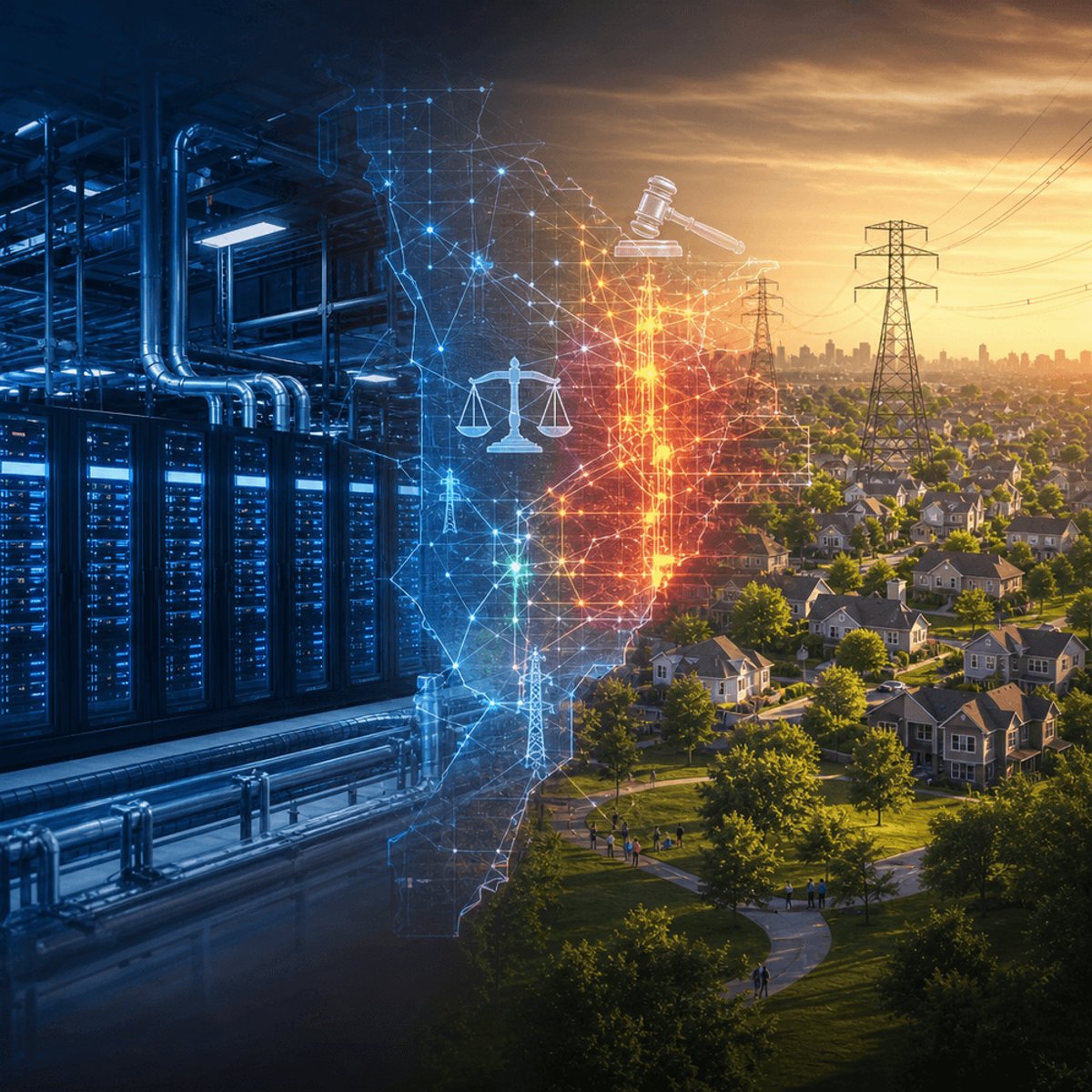
Rep. Ro Khanna is set to introduce the first major federal legislation targeting data center expansion, marking a pivotal shift in how Washington approaches AI infrastructure's massive energy demands. The 'Data Center Bill of Rights' comes as communities across the country push back against the power-hungry facilities needed to train and run AI models, with Michigan Senate candidate Abdul El-Sayed becoming the first major politician to explicitly endorse local moratoriums on new data center construction.
The AI boom is hitting a wall - and it's made of local zoning boards and power grid concerns. Rep. Ro Khanna, representing Silicon Valley, is preparing to introduce what he's calling a 'Data Center Bill of Rights,' federal legislation that could fundamentally reshape how tech companies build the massive computing facilities required for AI development.
The timing isn't coincidental. Communities from Virginia to Iowa have watched their power bills climb and their grids strain as hyperscalers race to build capacity for the next generation of AI models. Now they're fighting back, and they've found an unlikely champion in Abdul El-Sayed, who just won Michigan's Democratic Senate primary Tuesday and immediately endorsed state and local moratoriums on new data center construction.
It's a remarkable political shift. Just two years ago, states were competing to offer tax breaks and incentives to lure data center projects. Today, El-Sayed's moratorium stance - which would've been political poison in a primary - helped him win. That tells you everything about how quickly sentiment has turned on AI infrastructure.
The numbers explain the backlash. A single large-scale AI training facility can consume as much electricity as a small city. Microsoft, Google, Amazon, and Meta have collectively announced plans for over $200 billion in data center investments through 2027, according to recent earnings calls. That infrastructure doesn't just appear - it plugs into local power grids that were never designed for this kind of load.
Khanna's bill reportedly includes provisions requiring data centers to demonstrate sustainable power sourcing, give communities input on siting decisions, and potentially share economic benefits more directly with host regions. The details haven't been released yet, but sources familiar with the draft legislation say it's far more aggressive than industry lobbyists expected from a Silicon Valley representative.
The political calculus has shifted because the constituent complaints have become impossible to ignore. Virginia's Loudoun County, which hosts the world's largest concentration of data centers, has seen residential electricity rates jump 18% since 2023. Local officials there have started rejecting new data center permits despite the tax revenue, citing infrastructure strain and quality of life concerns.
Nvidia and other chip makers have poured resources into making AI inference more efficient, but training the largest models still requires massive centralized compute. That creates a fundamental tension: the AI capabilities that tech companies promise require physical infrastructure that communities increasingly don't want.
The industry response so far has been to emphasize investments in renewable energy and grid improvements. Microsoft recently committed to matching 100% of its data center electricity consumption with zero-carbon energy purchases by 2025. Google says it's working with utilities on grid modernization. But those promises haven't satisfied critics who argue that adding massive new loads - even theoretically green ones - strains systems that already struggle with peak demand.
El-Sayed's moratorium stance represents the first time a major Senate candidate has made data center opposition a campaign plank. His victory suggests the issue has real electoral weight, particularly in swing states where data center development has been concentrated. Michigan itself has seen several proposed mega-projects in the past year, all now potentially in jeopardy if El-Sayed wins in November and follows through.
For Amazon Web Services, Microsoft Azure, and Google Cloud, the stakes couldn't be higher. Their entire AI strategies depend on having enough compute capacity to train increasingly large models and serve inference at scale. Regulatory constraints on where and how they can build could hand advantages to overseas competitors facing fewer restrictions.
The legislation also arrives as tech companies are scrambling to secure power contracts. OpenAI CEO Sam Altman has publicly discussed the need for breakthrough energy sources to sustain AI development. Some companies are exploring everything from small modular nuclear reactors to dedicating entire solar farms to data center operations. Khanna's bill may effectively mandate such approaches rather than leaving them optional.
What makes this particularly thorny is that there's no easy compromise. AI model performance scales with compute - you can't train GPT-5 or its competitors without massive infrastructure. But you also can't force communities to accept facilities that strain their power grids and infrastructure. Someone's growth plans are about to hit hard limits.
The tech industry has faced regulatory pushback before on privacy, content moderation, and antitrust issues. But this is different - it's not about how they use data or how big they get, it's about whether they can physically build what they need to compete. That makes it existential in a way previous regulatory fights weren't.
Khanna's 'Data Center Bill of Rights' represents the first serious federal attempt to regulate AI infrastructure's physical footprint. Whether it passes or not, the fact that a Silicon Valley congressman is introducing it - and a Senate candidate won a primary by opposing data centers - signals that the AI industry's infrastructure ambitions are on a collision course with local communities and political reality. Tech companies that spent the past two years racing to secure compute capacity now face a different challenge: convincing Americans that the costs to their power grids and communities are worth the promised AI benefits. How this tension resolves will shape not just where data centers get built, but whether the current pace of AI development can even continue.