Researchers at the University of Texas at Austin just cracked one of cancer treatment's biggest challenges - killing tumor cells without destroying healthy tissue. Their breakthrough combines LED lights with ultra-thin tin oxide nanoflakes to generate precision heat that eliminates up to 92% of skin cancer cells in 30 minutes, all while leaving normal cells completely untouched.
The war on cancer just got a powerful new weapon, and it fits in your pocket. Scientists at the University of Texas at Austin and University of Porto have developed a light-based treatment that destroys cancer cells with surgical precision while leaving healthy tissue completely unharmed - a holy grail that's eluded researchers for decades.
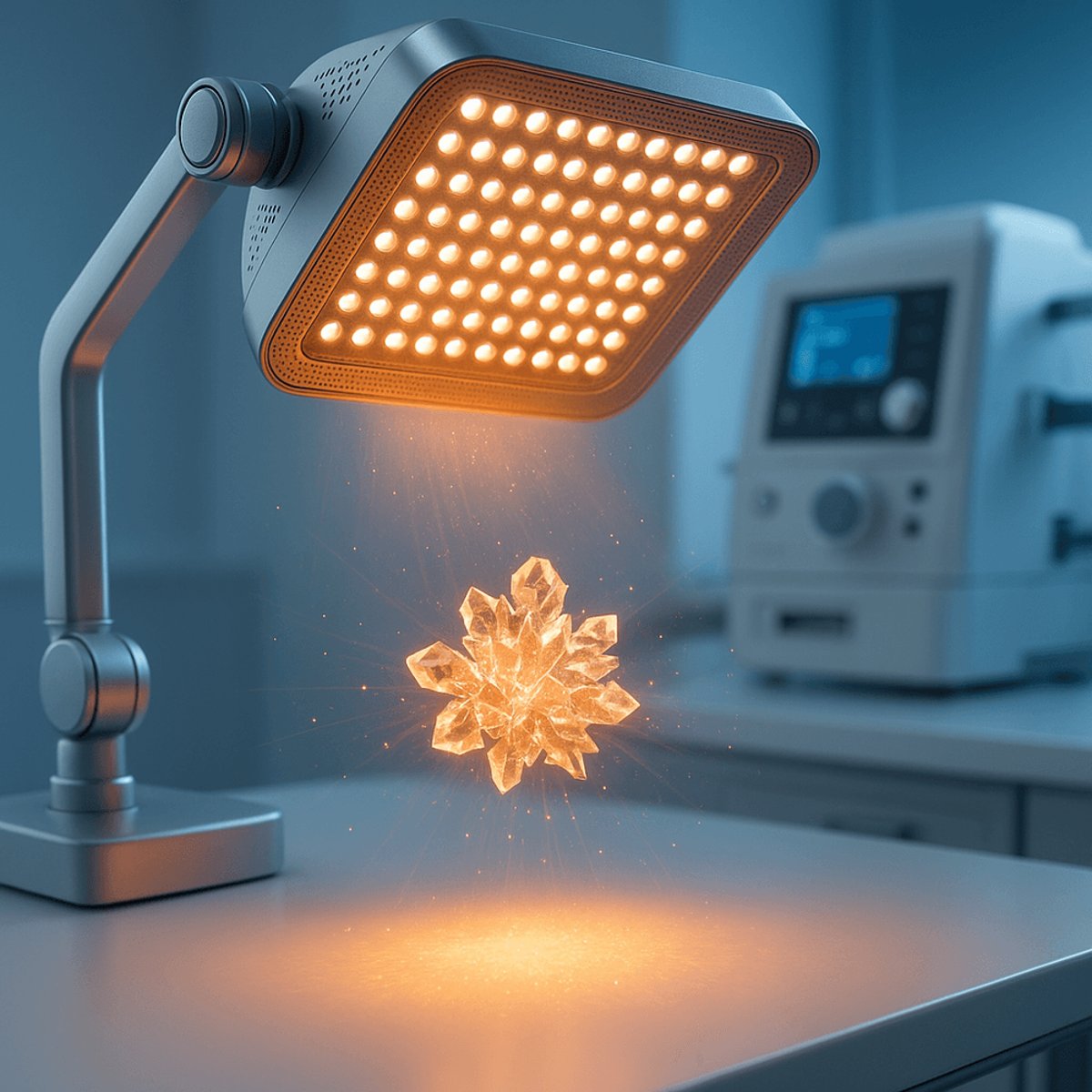
The breakthrough combines LED technology with tin oxide nanoflakes thinner than 20 nanometers to create what researchers call photothermal therapy. When these microscopic particles infiltrate cancer cells and get hit with near-infrared light, they generate enough localized heat to kill tumors without touching surrounding healthy tissue.
"Our goal was to create a treatment that is not only effective but also safe and accessible," UT engineering professor Jean Anne Incorvia told researchers. "With the combination of LED light and tin oxide nanoflakes, we've developed a method to precisely target cancer cells while leaving healthy cells untouched."
The results published in ACS Nano are striking. In just 30 minutes of LED exposure, the treatment eliminated 92% of skin cancer cells and 50% of colorectal cancer cells. More importantly, zero healthy skin cells were damaged - a stark contrast to chemotherapy and radiation, which attack everything in their path.
What makes this particularly compelling is the economics. The entire experimental setup costs around $530 and can treat 24 samples simultaneously. Traditional laser-based photothermal systems require massive investments and specialized facilities, putting them out of reach for many medical centers.
The team's near-infrared LEDs emit light at 810 nanometers - a wavelength that's inherently safe for biological tissues but perfect for activating their tin oxide nanoflakes. Unlike lasers, these LEDs provide consistent, stable illumination without the risk of dangerous overheating that has plagued other approaches.
"We envision that one day the treatment could be moved from the hospital to the patient's home," said University of Porto researcher Artur Pinto. "A portable device could be placed on the skin after surgery to irradiate and destroy any remaining cancer cells, thus reducing the risk of recurrence."
This isn't just lab curiosity - it's potentially transformative for cancer care accessibility. While chemotherapy requires specialized infusion centers and radiation demands massive linear accelerators, this LED-based approach could work in any clinic with basic electrical infrastructure.
The timing couldn't be better. Cancer treatment costs continue spiraling upward while accessibility remains a global challenge. Traditional therapies often force patients to choose between effectiveness and quality of life, with chemo's brutal side effects sometimes worse than the disease itself.
Photothermal therapy sidesteps this entirely by targeting only cancerous tissue. The tin oxide nanoflakes can be engineered to accumulate specifically in tumors, then activated on demand with LED light. It's like having a precision-guided missile that only destroys its intended target.
Of course, significant hurdles remain. The research needs extensive clinical trials to prove safety and efficacy in humans. Questions about how well the nanoflakes penetrate different tumor types and whether the approach works for deeper cancers still need answers.
But the potential applications extend far beyond skin cancer. Colorectal cancer's 50% cell death rate in initial tests suggests the technology could tackle internal tumors too. Future iterations might combine multiple nanoparticle types or integrate with existing immunotherapy approaches.
For investors watching the medtech space, this represents exactly the kind of breakthrough that reshapes entire treatment paradigms. Simple, affordable, effective treatments that improve patient outcomes while reducing costs don't come along often.
This LED-based cancer treatment represents more than just another incremental advance - it's potentially the kind of paradigm shift that makes effective cancer care accessible worldwide. By combining dirt-cheap LED technology with precision nanomaterials, researchers have created something that could work just as well in a rural clinic as a major cancer center. The real test comes next: whether this promising lab breakthrough can navigate the complex path to human trials and eventual clinical adoption. But for the first time in decades, we're looking at cancer therapy that doesn't require patients to suffer through the cure.