Europe's most promising AI challenger is making waves. Mistral AI, the French startup founded in 2023, has positioned itself as a formidable competitor to OpenAI by betting on open source AI models and the bold mission to "put frontier AI in the hands of everyone." With significant funding already secured and a growing portfolio of competitive models, the Paris-based company represents Europe's best shot at challenging American AI dominance.
Mistral AI burst onto the global AI scene in 2023 with a simple but ambitious promise - to make frontier artificial intelligence accessible to everyone, not just those with contracts at big tech companies. Founded by former Google DeepMind and Meta researchers, the Paris-based startup has quickly become Europe's answer to OpenAI, raising significant funding and shipping competitive models at a pace that's caught the industry's attention.
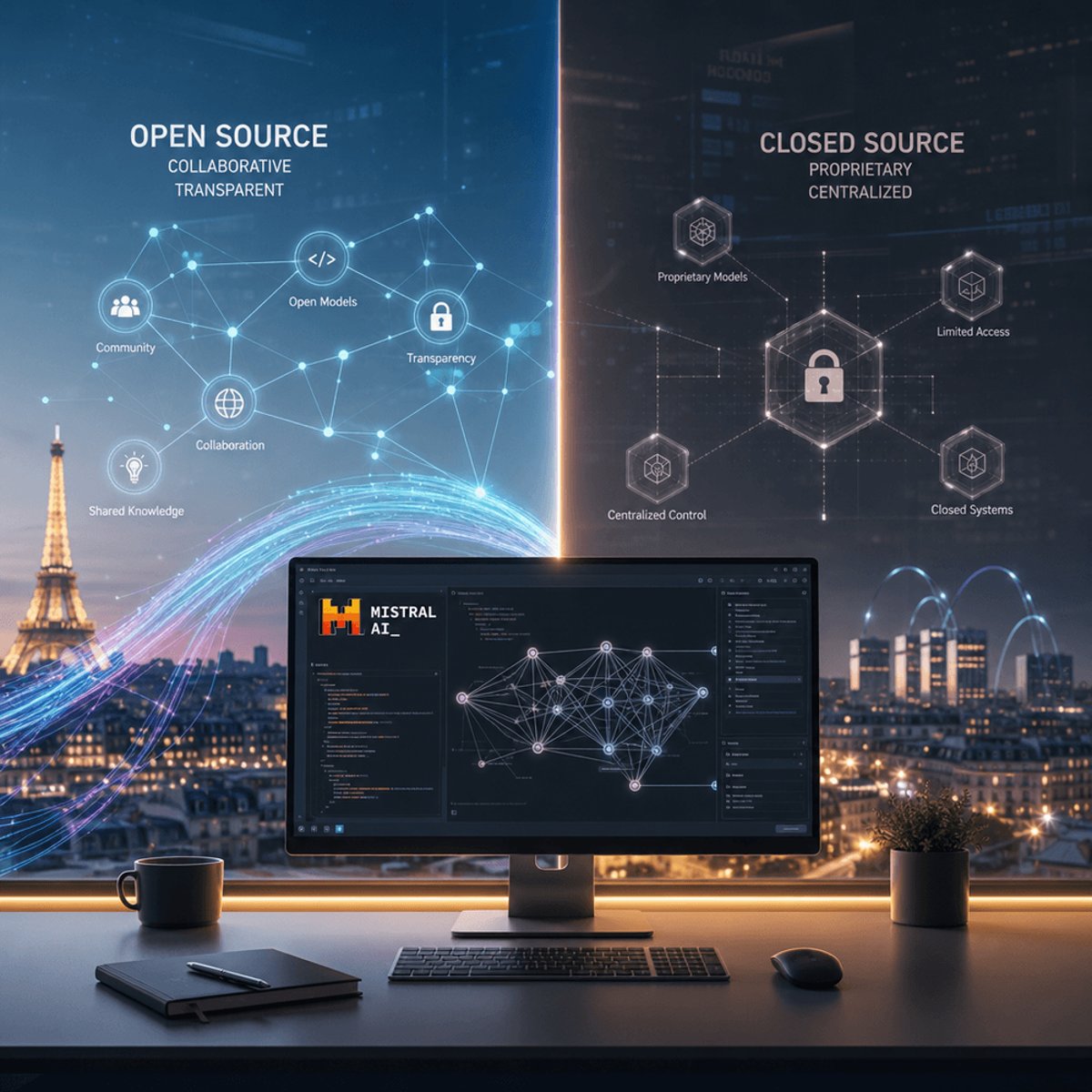
The company's approach differs fundamentally from OpenAI's increasingly proprietary strategy. While OpenAI has moved away from its original open source roots, Mistral has doubled down on releasing some of its models openly. This philosophical divide isn't just academic - it's attracted a passionate developer community that values transparency, customization, and the ability to run powerful AI models without dependency on external APIs.
Since its founding, Mistral has secured substantial venture capital from prominent investors who see the strategic importance of a European AI champion. The funding rounds have valued the company at eye-watering figures despite its youth, reflecting both the capital-intensive nature of training large language models and investor confidence in the team's technical pedigree. The startup's founders brought deep expertise from their time building AI systems at some of the world's leading research labs.
Mistral's model releases have consistently punched above their weight. The company has shipped multiple versions of its core models, each iteration demonstrating improvements in reasoning, coding ability, and multilingual performance. Unlike the massive compute budgets required by OpenAI's GPT-4 or Google's Gemini, Mistral has focused on efficiency - building models that deliver competitive performance while requiring less computational resources to run.
The open source strategy serves multiple purposes. It builds goodwill with developers, allows for community-driven improvements, and positions Mistral as the transparent alternative in an industry increasingly dominated by closed, proprietary systems. Developers can inspect the models, fine-tune them for specific use cases, and deploy them on their own infrastructure - freedom that's impossible with API-only services.
But Mistral isn't purely altruistic. The company also offers commercial products, including API access to its most advanced models and enterprise licensing arrangements. This dual approach - open source models for community building, proprietary offerings for revenue - mirrors the playbook that's worked for companies like Meta with its Llama models.
The competitive landscape has intensified throughout 2026. OpenAI continues to set benchmarks with its GPT series, while Google's Gemini and Anthropic's Claude models push different aspects of AI capability. Meta has released increasingly capable Llama iterations. Against these well-funded competitors, Mistral's ability to ship quality models quickly has been its strongest card.
European regulators have taken notice. As the EU implements its AI Act and grapples with how to foster homegrown AI champions while managing risks, Mistral has become a case study in European AI ambition. The company's success or failure will partly determine whether Europe can maintain technological sovereignty in the AI era or become dependent on American and Chinese systems.
The technical team continues expanding, recruiting top researchers and engineers from across the global AI community. The company has also begun forming strategic partnerships with cloud providers and enterprise customers, building the commercial relationships necessary to turn cutting-edge research into sustainable business.
Mistral's roadmap remains aggressive. The company has signaled intentions to continue pushing model capabilities while maintaining its commitment to open source releases for certain model tiers. As the AI industry consolidates around a handful of foundation model providers, Mistral's role as an independent, European alternative becomes increasingly strategic.
Mistral AI's rapid ascent from 2023 startup to credible OpenAI challenger demonstrates that the foundation model race remains wide open. The company's bet on open source, combined with strong technical execution and significant funding, has carved out a distinct position in an increasingly crowded market. For developers seeking alternatives to American AI giants, for European policymakers hoping to nurture domestic AI champions, and for enterprises wanting more control over their AI infrastructure, Mistral represents a meaningful option. Whether the company can sustain its momentum against competitors with far deeper pockets and more extensive compute resources remains the defining question - but so far, the Paris-based upstart has proven it belongs in the conversation about frontier AI.