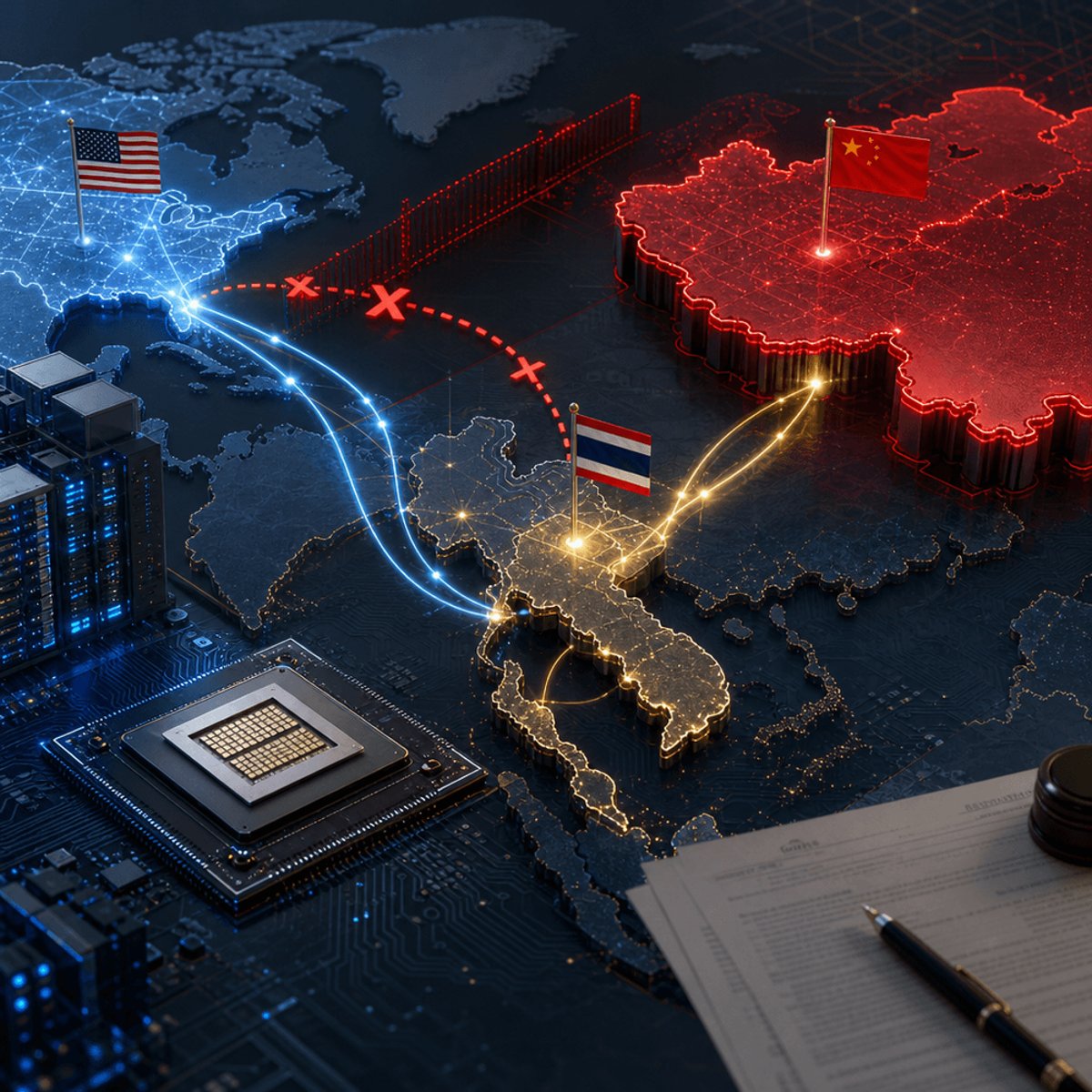
A White House official just dropped a bombshell: Chinese AI startup Moonshot AI managed to get its hands on Nvidia's cutting-edge GB300 chips through Thailand, directly skirting U.S. export restrictions designed to keep advanced semiconductors out of China. The revelation comes just days after the company unveiled its powerful Kimi K3 language model, raising urgent questions about how effectively Washington can enforce its tech blockade and whether Southeast Asia has become the new backdoor for banned chip access.
Moonshot AI, the Beijing-based startup behind the viral Kimi chatbot, just became ground zero for Washington's biggest export control nightmare. According to a White House official speaking to CNBC, the company managed to access Nvidia's restricted GB300 chips in Thailand - chips explicitly banned from export to China under current U.S. semiconductor restrictions.
The timing couldn't be more provocative. Moonshot unveiled its Kimi K3 model just last week, a large language model that industry observers say rivals capabilities from OpenAI and Anthropic. Training models at that scale demands massive computational firepower, exactly the kind that Nvidia's GB300 architecture delivers. The chips, part of Nvidia's Blackwell generation, represent some of the most advanced AI accelerators available - and precisely the technology Washington has worked to keep out of Chinese hands since export controls tightened in 2022.
But here's where it gets messy. Thailand isn't subject to the same restrictions as mainland China. The country has rapidly positioned itself as a data center hub for Southeast Asia, with both Chinese and Western companies building facilities there. That geographic and regulatory gap appears to have created exactly the loophole Moonshot exploited. Whether the company purchased chips directly, leased cloud capacity, or used some other arrangement remains unclear, but the access itself confirms what many industry insiders have quietly worried about - export controls are only as strong as their weakest link.
The White House disclosure suggests U.S. intelligence has been tracking Moonshot's infrastructure moves, likely through a combination of supply chain monitoring and technical analysis of the Kimi K3 model's capabilities. When a Chinese startup suddenly releases a frontier AI model, the immediate question in Washington becomes: where'd they get the compute? The answer - Thailand - is going to send shockwaves through both trade policy circles and the semiconductor industry.
Nvidia finds itself in an increasingly uncomfortable position. The company has publicly committed to complying with U.S. export regulations, even developing China-specific chip variants with reduced capabilities to stay within legal bounds. But controlling how customers use chips sold in third countries is far more complex. If Moonshot purchased GB300s through Thai distributors or cloud providers, Nvidia might have had limited visibility into the end user. That's precisely the scenario that keeps Commerce Department officials up at night.
For Southeast Asian nations like Thailand, this incident could fundamentally reshape their role in the global tech economy. The country has actively courted data center investment as part of its digital economy strategy, offering tax incentives and streamlined regulations. But if Thailand becomes seen as a chip smuggling route - even inadvertently - it risks getting pulled into the U.S.-China tech cold war with restrictions of its own. Washington has shown increasing willingness to impose third-country controls when necessary, as seen with recent Netherlands-based ASML restrictions.
Moonshot AI itself has stayed conspicuously quiet. The company, founded by former Microsoft and Google engineers, previously raised hundreds of millions in funding and built a reputation for its long-context Kimi chatbot that can process entire novels in a single prompt. But the GB300 revelation threatens to overshadow its technical achievements with uncomfortable questions about compliance and national security implications. Chinese AI companies have consistently argued they're being unfairly targeted by U.S. policy, but cases like this hand Washington exactly the evidence it needs to justify stricter controls.
The broader competitive dynamics are shifting fast. While U.S. policymakers debate how to slow China's AI progress through chip restrictions, Chinese companies are clearly finding creative workarounds. Some industry analysts argue this proves export controls are futile in a globalized semiconductor supply chain. Others counter that even imperfect restrictions force China to pursue less efficient paths, buying time for U.S. and allied AI development.
What happens next will likely involve a multi-agency scramble. The Commerce Department's Bureau of Industry and Security, which administers export controls, will need to determine exactly how the chips reached Moonshot and whether any violations occurred. That could mean new restrictions on chip sales to Southeast Asian countries, enhanced end-use monitoring requirements, or pressure on Thai authorities to implement their own controls. Nvidia may face pressure to demonstrate more robust know-your-customer processes for international sales.
For the AI industry, the Moonshot case underscores how tangled geopolitics and technology have become. Every major model release now triggers questions about compute access, training infrastructure, and regulatory compliance. Chinese companies are racing to develop domestic chip alternatives through initiatives like Huawei's Ascend processors, but most still lag Nvidia's performance. That makes access to banned chips - however obtained - a genuine competitive advantage.
The White House's decision to publicly call out Moonshot suggests this isn't just about one company's chip access. It's a shot across the bow to other Chinese AI startups that might be considering similar workarounds, and a signal to Southeast Asian governments that turning a blind eye carries consequences. Whether it actually closes the Thailand loophole or simply pushes the problem elsewhere remains to be seen.
This isn't just about one Chinese startup getting its hands on banned chips - it's about the fundamental challenge of enforcing technology restrictions in an interconnected world. As AI capabilities increasingly depend on access to cutting-edge semiconductors, every geographic gap in export controls becomes a potential battleground. Moonshot's Thailand workaround proves that U.S. policy needs to evolve beyond country-specific restrictions toward more sophisticated end-use monitoring. For Southeast Asian nations trying to build their digital economies, the incident serves as a warning that neutrality might not be an option anymore. And for the AI race itself, expect the compute cold war to get even more complicated as both sides hunt for advantages in an increasingly fragmented global chip market.