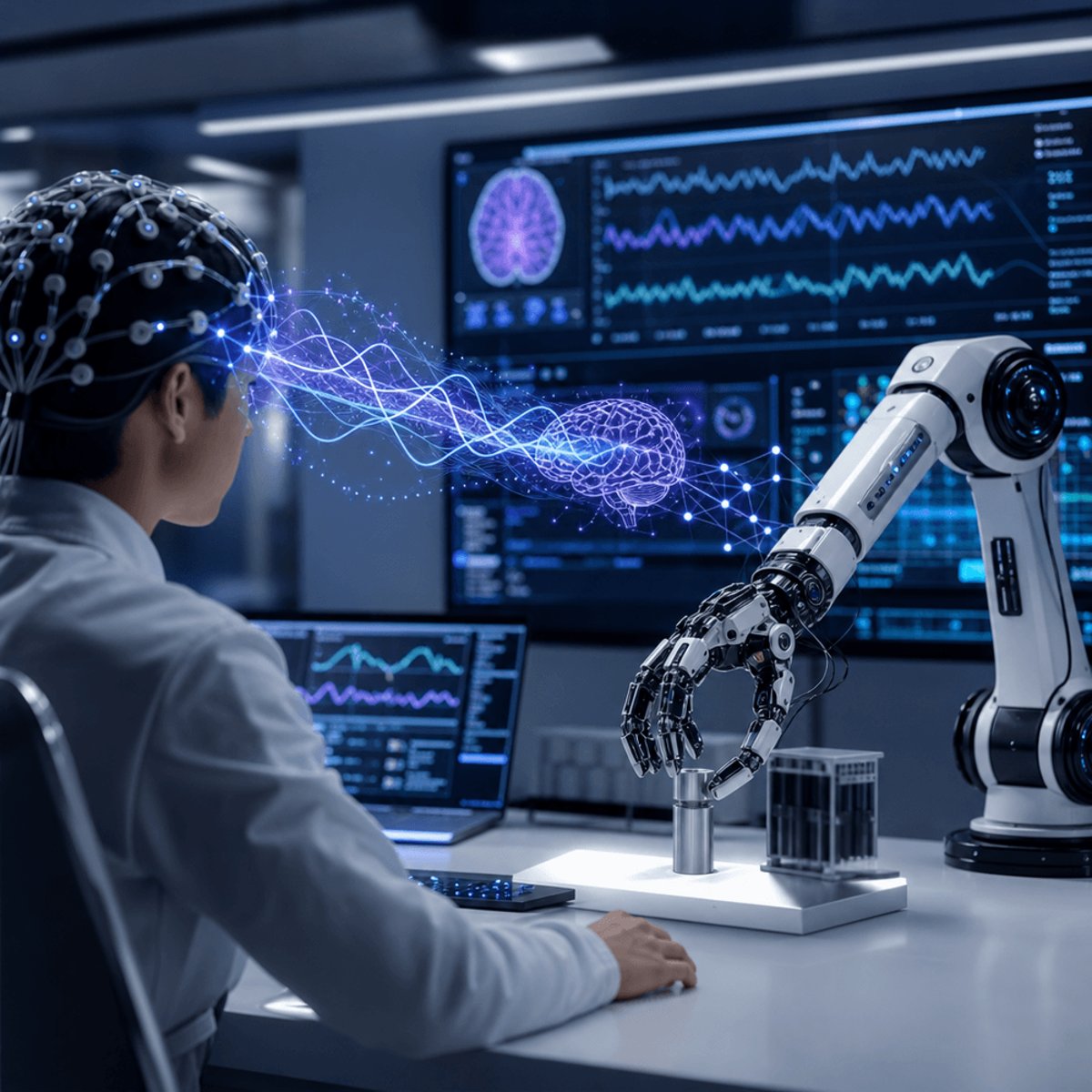
The race to build smarter robots just took a neuroscience detour. Physical AI researchers are moving beyond camera angles and video datasets to incorporate brain wave readings into their training pipelines, marking a shift in how the industry thinks about teaching machines to interact with the real world. According to a TechCrunch exclusive, the approach represents a fundamental rethinking of embodied AI development - one that could finally crack the code on human-like dexterity and decision-making.
YouTube videos won't cut it anymore. That's the emerging consensus among physical AI researchers who are scrambling to build the next generation of robots that can actually navigate messy, unpredictable human environments.
The latest frontier? Brain wave readings captured while humans perform everyday tasks. According to sources familiar with the research, multiple labs working on physical AI models have started incorporating electroencephalography (EEG) data into their training pipelines. The goal is to capture something that camera feeds alone can't provide - the cognitive intent behind human movements.
This marks a significant departure from the current approach to training embodied AI systems. Most physical AI models today rely on dense video annotation from multiple camera angles, requiring massive compute to process and label. Companies like Tesla have famously built entire data collection infrastructures around fleet vehicles, while robotics startups record humans performing tasks from dozens of simultaneous viewpoints.
But video only shows the what, not the why. When a human reaches for a coffee cup, cameras capture the motion - but they miss the micro-decisions about grip strength, approach angle, and real-time adjustments that make the movement successful. Brain wave data could fill that gap.
The technical challenges are substantial. EEG signals are notoriously noisy, requiring sophisticated filtering to extract meaningful patterns. Researchers need to correlate specific brain wave signatures with physical actions in real-time, then encode that relationship in a way AI models can learn from. It's the kind of interdisciplinary problem that sits at the intersection of neuroscience, robotics, and machine learning.
Several academic labs have published early work on brain-controlled robotic systems, but incorporating neural data into foundation model training represents a different order of magnitude. The approach suggests that physical AI development is following a similar trajectory to language models - starting with readily available internet data before moving to higher-quality, purpose-built datasets.
The implications extend beyond just better robots. If brain wave patterns can improve how AI systems understand physical tasks, the same principle might apply to other domains where human intuition plays a crucial role. Think surgical procedures, athletic training, or skilled manufacturing.
There's also a data collection arms race brewing. Just as OpenAI and Google competed to scrape the highest-quality text from the internet, physical AI labs may soon be recruiting humans for brain-monitored task performance. The companies that build the best neural-physical datasets could gain significant advantages in the robotics market.
Privacy advocates will have questions. Brain wave data sits in a murky regulatory space - more invasive than video, but less protected than medical records. As these datasets grow, expect debates about consent, data ownership, and the ethics of capturing cognitive patterns.
The shift also highlights how capital-intensive physical AI has become. Multi-camera rigs, dense annotation teams, and now neuroscience equipment - the barriers to entry keep rising. That could consolidate development among well-funded labs while locking out smaller competitors.
But if the approach works, it could finally deliver on the promise of general-purpose robots. Current systems still struggle with novel situations because they lack the adaptive decision-making humans take for granted. By training on the neural correlates of physical intelligence, AI models might learn not just to mimic human movements, but to understand the underlying logic.
The timing is notable. Major AI labs have been signaling a shift toward embodied intelligence after years of focusing on language and vision. OpenAI has been hiring robotics researchers, while Google DeepMind recently demonstrated impressive physical AI capabilities. Brain wave integration could be the next logical step in that evolution.
Brain wave integration into physical AI training represents more than just another data source - it's a bet that understanding human cognition is the key to building truly capable robots. The approach is expensive, technically complex, and raises thorny privacy questions. But if it works, it could finally bridge the gap between narrow task performance and the kind of flexible, adaptive intelligence that humans demonstrate every day. The labs that crack this puzzle first won't just build better robots - they'll redefine what physical AI can do.