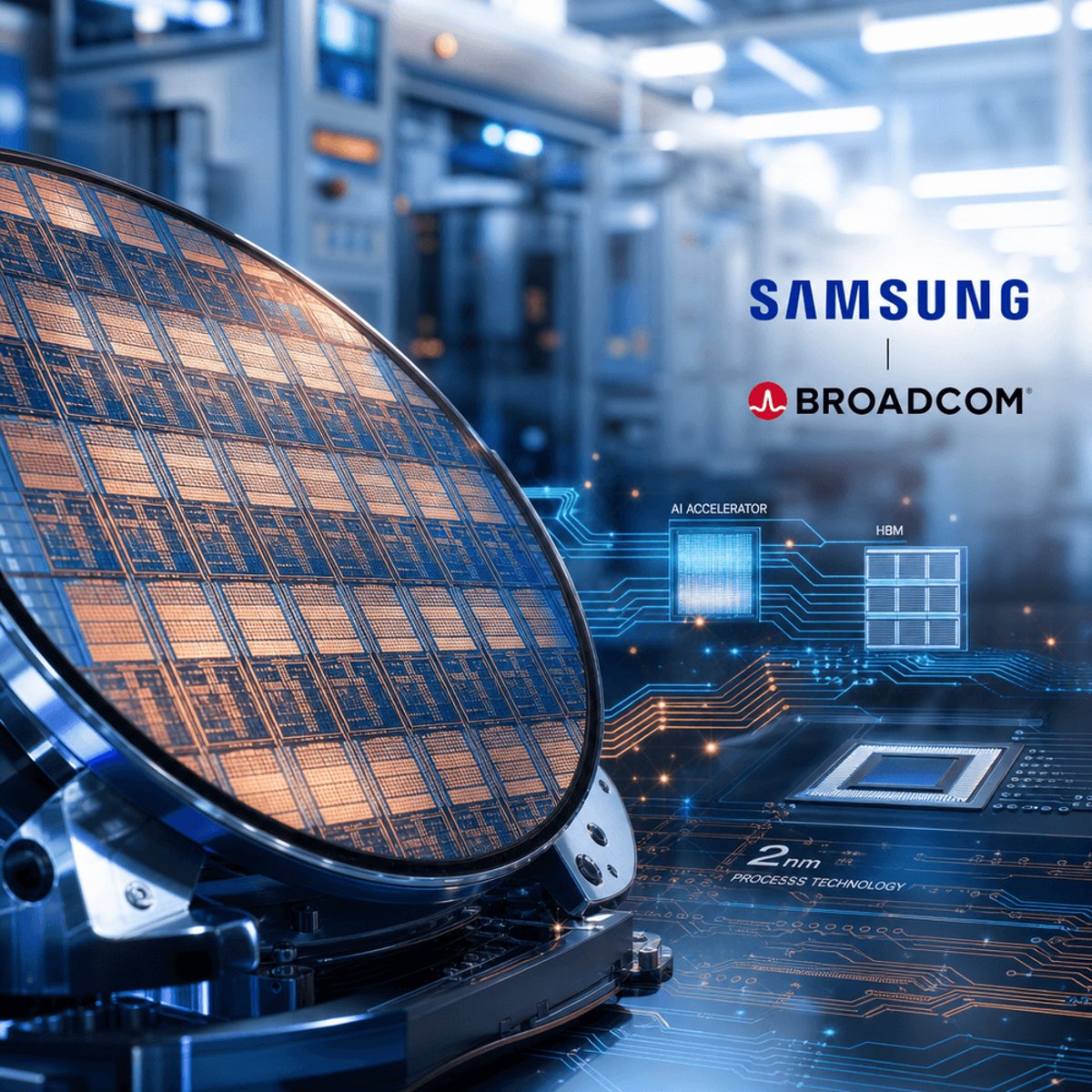
Samsung and Broadcom just dropped a bombshell at San Francisco's AI Summit - a strategic collaboration worth over $200 billion through 2030 that spans cutting-edge memory and foundry technologies. The memorandum of understanding signals one of the semiconductor industry's largest partnerships as both companies race to capture the exploding AI infrastructure market. With Samsung bringing its High Bandwidth Memory expertise and 2-nanometer process technology, and Broadcom contributing AI accelerator and networking silicon leadership, the deal reshapes the competitive landscape for AI chip production.
Samsung Electronics and Broadcom are betting big on the AI infrastructure boom. The two semiconductor giants announced a memorandum of understanding that's expected to exceed $200 billion in value over the next five years, making it one of the industry's most significant partnerships as companies scramble to meet surging demand for AI-optimized chips.
The announcement came during the AI Summit at The Midway in San Francisco, with Jinman Han, President and Head of Samsung's Foundry Business, and Hock Tan, President and CEO of Broadcom, revealing the collaboration alongside senior executives and Korean government representatives. The timing couldn't be more strategic - AI infrastructure spending is accelerating faster than most analysts predicted, and companies that can deliver integrated solutions across the semiconductor stack are gaining decisive advantages.
The partnership splits into two major fronts. On the memory side, Samsung plans to supply industry-leading High Bandwidth Memory solutions, including HBM, specifically designed to support Broadcom's next-generation AI accelerators. HBM has become critical for AI workloads, offering the massive bandwidth needed to feed data-hungry large language models and neural networks. Samsung's been ramping up HBM production capacity aggressively, and this deal locks in a major customer for years to come.
But the foundry collaboration might be even more significant. Samsung will manufacture Broadcom's products using its 2-nanometer process technology and beyond - putting Samsung squarely in competition with TSMC, which currently dominates advanced node manufacturing. The deal specifically mentions Broadcom's Wireless Broadband Communications solutions, but the scope extends to advanced packaging technologies built on Samsung's 2nm process, including 2.3D and 2.5D integration techniques that enable higher performance and better power efficiency for AI and networking silicon.
"AI is driving unprecedented demand for tightly integrated semiconductor technologies spanning memory, logic and advanced packaging," Young Hyun Jun, Vice Chairman and CEO of Samsung's Device Solutions Division, said in the announcement. "By expanding our collaboration with Broadcom across these critical technologies, we look forward to delivering greater value to customers while advancing the AI infrastructure of the future."
The statement reveals Samsung's strategic positioning - the company wants to be seen as the only player that can deliver a complete semiconductor solution from memory to logic to advanced packaging. That's a direct challenge to the fragmented supply chains most chip designers currently navigate, where they might source memory from one vendor, use another's foundry, and rely on yet another company for packaging.
Broadcom's Charlie Kawwas, President of the Semiconductor Solutions Group, emphasized the ecosystem angle. "As AI infrastructure continues to scale, close collaboration across the semiconductor ecosystem becomes increasingly important," Kawwas said in the release. "By combining Samsung's memory and foundry expertise with Broadcom's AI and connectivity leadership, we aim to continue to deliver technologies that power the next generation of AI infrastructure."
The $200 billion figure over five years is staggering, even by semiconductor industry standards. For context, that's roughly $40 billion annually - more than the entire quarterly revenue of many chip companies. It suggests Broadcom is making massive bets on AI accelerator demand and willing to commit substantial volumes to Samsung to secure capacity and technology access.
The deal also carries geopolitical weight. Korean government representatives attended the announcement, signaling Seoul's interest in strengthening its semiconductor champions as global chip competition intensifies. Samsung's been investing billions in expanding its foundry capabilities to challenge TSMC's dominance, and landing a major customer like Broadcom for 2nm production validates that strategy.
For the broader industry, this partnership signals that vertical integration - or at least very tight partnerships across the semiconductor stack - is becoming essential for AI infrastructure. The days of purely horizontal specialization might be ending as customers demand solutions that optimize memory, compute, and packaging together rather than trying to integrate disparate components.
The collaboration puts pressure on competitors across multiple fronts. Memory rivals like SK Hynix and Micron face a formidable Samsung-Broadcom combination in HBM. Foundries like TSMC and Intel now see Samsung with a locked-in advanced node customer. And AI accelerator companies watch Broadcom secure preferential access to cutting-edge manufacturing and memory technology.
The technical details matter too. Samsung's 2nm process and the mentioned 2.3D and 2.5D packaging aren't just incremental improvements - they represent fundamental shifts in how chips are built. Advanced packaging allows chiplets to communicate at speeds approaching monolithic designs while offering better yields and flexibility. For AI accelerators that need to move massive amounts of data between compute units and memory, these packaging innovations are critical.
What happens next bears watching. The memorandum of understanding needs to translate into actual production commitments and product launches. Samsung's 2nm process is still ramping, and delivering the scale Broadcom needs will test the foundry's manufacturing capabilities. HBM supply chains remain tight industry-wide, and Samsung must balance Broadcom's demands against other customers clamoring for the same technology.
The Samsung-Broadcom partnership represents a fundamental shift in how semiconductor deals get structured for the AI era. Rather than transactional relationships, companies are locking in multi-year, multi-technology collaborations that span the entire stack from memory to packaging. The $200 billion commitment signals both companies' confidence that AI infrastructure demand will sustain massive growth through 2030, but it also reveals the stakes - getting shut out of these strategic partnerships could leave competitors scrambling for scraps. As foundry competition heats up and memory technology becomes more specialized, expect more of these comprehensive deals that blur the lines between customer, partner, and co-developer.