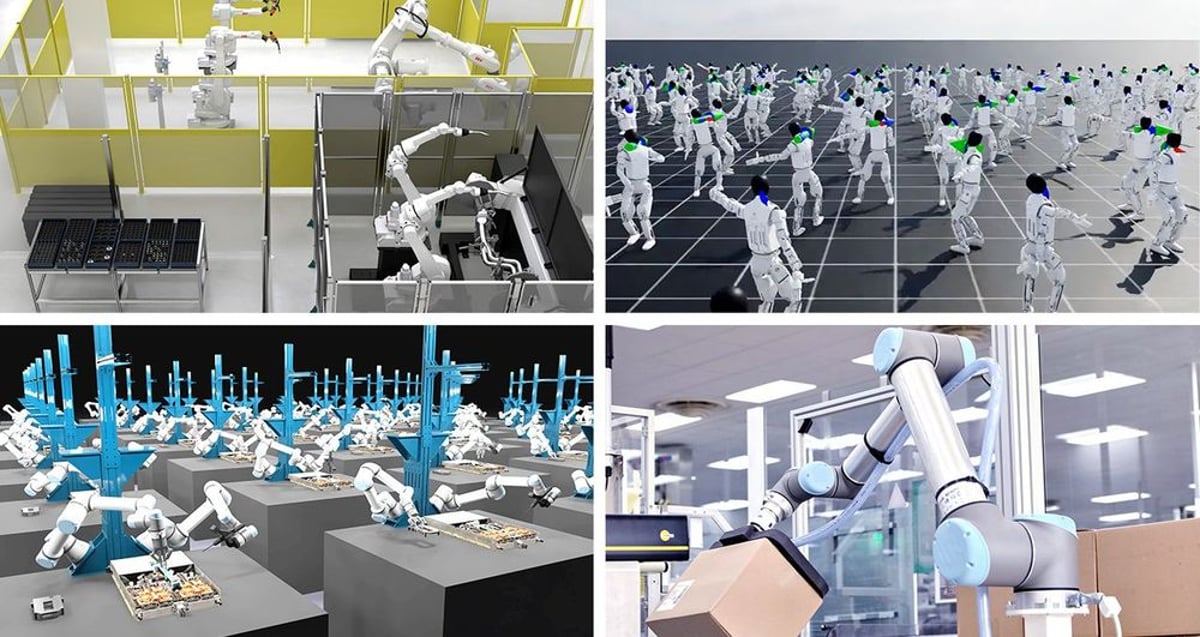
Nvidia is making a major push into industrial manufacturing, partnering with five of the world's biggest engineering software companies to bring GPU-accelerated AI tools to the factory floor. The chip giant announced today it's working with Cadence, Dassault Systèmes, PTC, Siemens, and Synopsys to deploy its CUDA-X and Omniverse platforms at manufacturing powerhouses including TSMC, Samsung, Mercedes-Benz, and Honda. It's a strategic play to embed Nvidia's AI infrastructure into the design and production workflows of industries that have traditionally been slow to adopt cutting-edge compute technologies.
Nvidia is taking its AI dominance beyond data centers and into the heart of global manufacturing. The company announced today it's teaming up with industrial software heavyweights Cadence, Dassault Systèmes, PTC, Siemens, and Synopsys to deliver GPU-accelerated tools that promise to transform how products get designed, engineered, and built.
The partnerships bring Nvidia's CUDA-X and Omniverse platforms directly into the software ecosystems that run the world's factories. According to Nvidia's announcement, the initial customer roster reads like a who's who of advanced manufacturing: semiconductor fabs TSMC, Samsung, SK hynix, and MediaTek; automakers Mercedes-Benz, Honda, and Jaguar Land Rover; plus industrial giants FANUC, HD Hyundai, KION, and even PepsiCo.
This isn't just about selling more GPUs. Nvidia is betting that the future of manufacturing lies in digital twins, AI-powered simulations, and real-time collaborative design environments - all technologies where its compute platform has become the de facto standard. By embedding itself into the software stack from companies like Siemens and Dassault Systèmes, Nvidia ensures its chips become essential infrastructure for the next generation of industrial workflows.
The timing is strategic. Manufacturing is undergoing its biggest technological shift in decades as companies race to digitize operations, reduce prototyping costs, and accelerate time-to-market. Traditional CAD and simulation tools are hitting performance walls that only GPU acceleration can break through. A Mercedes engineer running crash simulations or a TSMC process designer modeling new chip fabrication techniques needs massive parallel compute power - exactly what Nvidia's CUDA platform delivers.
Omniverse, Nvidia's collaboration and simulation platform, is the glue holding this strategy together. It allows teams across different software tools to work in shared virtual environments, running physics-accurate simulations in real time. For a company like Honda designing a new vehicle, that means aerodynamics engineers using one software package can collaborate seamlessly with thermal engineers using another, all while the design updates live in a unified digital twin.
The semiconductor manufacturers on the list are particularly noteworthy. TSMC, Samsung, and SK hynix don't just make chips - they're among the most advanced manufacturers on the planet, with fabrication processes measured in nanometers and tolerances that allow zero margin for error. If Nvidia can prove ROI in these demanding environments, it opens the door to every other manufacturing vertical.
What's interesting is how this complements Nvidia's existing enterprise push. The company already dominates AI training and inference in cloud data centers, but manufacturing represents a different revenue stream - one where customers need on-premises compute power integrated with specialized software tools. By partnering with the established industrial software giants rather than trying to build competing products, Nvidia sidesteps years of industry relationship-building and immediately gains access to existing customer bases.
The breadth of the customer list also signals that this isn't a pilot program. When you've got semiconductor fabs, automotive OEMs, industrial robotics companies, and consumer goods manufacturers all signed up, it suggests Nvidia has been working these partnerships for months if not years. PepsiCo's inclusion is especially telling - even companies outside traditional heavy manufacturing see value in AI-powered supply chain optimization and production planning.
For the software partners, the calculus is straightforward: their customers are demanding faster simulation times and more sophisticated AI capabilities. Delivering that means embracing GPU acceleration, and Nvidia's CUDA platform has a decade-plus head start on any competitor. Siemens and Dassault Systèmes aren't abandoning their core products - they're supercharging them with Nvidia's compute infrastructure.
The announcement also reveals how Nvidia is thinking about AI's role in manufacturing beyond just training models. Digital twins need real-time physics simulation. Generative design tools need massive compute to explore thousands of design variations. Predictive maintenance systems need to process sensor data from thousands of machines simultaneously. All of these workloads map naturally to GPU architectures.
Competitors like AMD and Intel are also chasing the industrial AI market, but Nvidia's first-mover advantage in GPU computing and its mature software ecosystem make it tough to dislodge. When a Siemens or Cadence engineer writes code for Nvidia's CUDA platform, porting that to a competing architecture requires significant engineering work - creating powerful switching costs.
The partnership structure is smart too. Rather than trying to sell directly to manufacturers, Nvidia embeds its technology in the tools engineers already use daily. A Honda designer doesn't need to learn Omniverse from scratch - they keep using their familiar CAD software, which now happens to be GPU-accelerated under the hood.
Nvidia's manufacturing push represents a calculated expansion beyond its data center stronghold into enterprise workflows that touch trillions of dollars in global production. By partnering with the software giants that already run the world's factories rather than competing with them, Nvidia positions its GPU infrastructure as essential for the AI-powered industrial transformation every manufacturer is chasing. For TSMC, Mercedes, and the other early adopters, the bet is that faster simulations and smarter digital twins will shave months off development cycles and millions off prototyping costs. If that ROI materializes, expect every major manufacturer to follow - and Nvidia's enterprise revenue to climb accordingly. The real question isn't whether AI will transform manufacturing, but whether any competitor can challenge Nvidia's head start before GPU acceleration becomes as fundamental to factory floors as it already is to cloud data centers.